📋 In This Guide
- Introduction — GB’s Energy Crisis Meets a Real Solution
- What Is This Scheme? Full Details
- Complete Eligibility Criteria
- Required Documents
- Step-by-Step Application Process
- Benefits & Savings
- Important Dates & Latest Updates
- Common Mistakes & Solutions
- FAQs (12 Detailed Questions)
- Conclusion & Call to Action
Imagine living through winters where temperatures plunge to minus 20°C, and your electricity supply barely lasts 2-4 hours a day. No heaters. No lights for your children to study. No way to charge your phone and stay connected with the world. This isn’t a story from decades ago — this is the daily reality for millions of people living in Gilgit-Baltistan in 2026.
Gilgit-Baltistan faces some of the worst power shortages in Pakistan. In many areas, load-shedding stretches up to 18-22 hours per day. The region is not connected to the national grid, relying almost entirely on small hydropower stations that freeze or underperform during long winters. Diesel generators are expensive, noisy, and polluting. For years, the people of GB have been asking for a permanent solution. Read Also: PM Solar Panel Scheme 2026: Apply Online and Get Details
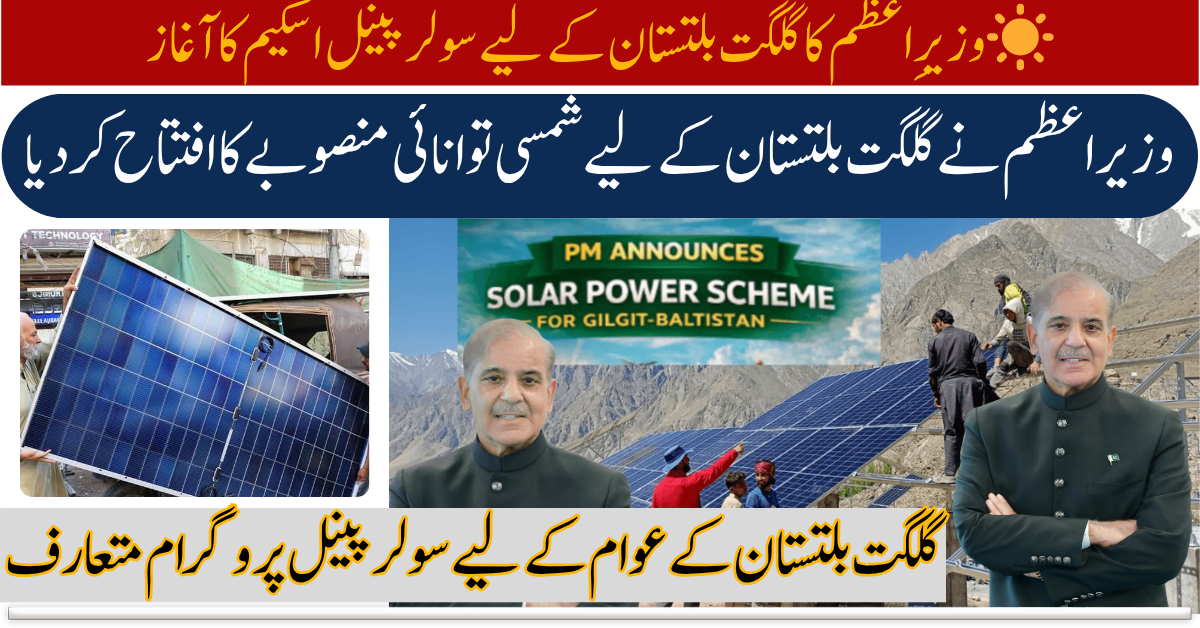
On May 7, 2026, that solution arrived on a historic scale. Prime Minister Shehbaz Sharif personally visited Gilgit and inaugurated a 100-megawatt solar energy project — the largest renewable energy initiative ever launched specifically for Gilgit-Baltistan. But the most impactful part of the announcement was this: 58.8 MW of solar panels will be distributed free of cost to households and small businesses across every district of GB through a transparent digital balloting system.
This guide is written for every resident of Gilgit-Baltistan — and every Pakistani who wants to understand this landmark scheme. We will cover every detail in simple, clear language: what you get, who qualifies, how to apply, and the mistakes to avoid.
What Is This Scheme? — Full Details of the GB Solar Initiative
The PM Solar Panel Scheme for Gilgit-Baltistan is a federal government initiative launched to address the region’s chronic electricity crisis through solar energy. It was first announced by PM Shehbaz Sharif in November 2024, and after months of planning and steering committee oversight led by Federal Power Minister Sardar Awais Leghari, it has now reached the implementation stage.
The Two Components of This Project
This is not a single simple distribution program — it has two major components working together: “Keep track of all new government initiatives in our Solar Panel Scheme section.”
| Component | Capacity | What It Does | Timeline |
|---|---|---|---|
| 1. Utility-Scale Solar + Rooftop | 100 MW total (82 MW utility + 18 MW rooftop) | Large solar farms feed clean power into GB’s local grid. 499 public buildings get rooftop solar. 66.1 MWh Battery Energy Storage System (BESS) stores daytime solar for evening use. | Rooftop: December 2026. Utility-scale: Mid-2027 |
| 2. Free Solar Panel Distribution | 58.8 MW (144,875 panels) | Free solar panels distributed directly to verified households and small businesses through digital balloting. 40 MW for domestic users, 18 MW for SMEs and IT organizations. | Distribution launched May 7, 2026. Ongoing through 2026. |
Where Did These Free Solar Panels Come From?
This detail is important and unique to this scheme. According to official statements, the solar panels being distributed free were confiscated in a fraud case by Pakistan’s Federal Board of Revenue (FBR). Under the Customs Act 1969, confiscated goods become federal government property. Instead of auctioning these panels, the PM directed that they be given free to the people of Gilgit-Baltistan. This is why the distribution does not cost the beneficiaries anything for the panels themselves.
What Exactly Will You Receive?
This is a critical point that many people are confused about. Here is exactly what selected beneficiaries get — and what they must arrange on their own: “To find out how to apply for the provincial subsidy, follow this guide: CM Punjab Solar Panel Scheme Application“
| Item | Provided Free? | Details |
|---|---|---|
| Solar Panels (PV Modules) | ✔ Yes — Free | High-capacity panels from confiscated stock, allocated per household through balloting |
| Battery Backup System | ✖ No — Self-arranged | Beneficiaries must purchase batteries themselves for nighttime power storage |
| Inverter | ✖ No — Self-arranged | Inverter must be purchased by the beneficiary to convert solar DC power to AC |
| Transportation Costs | ✖ No — Self-arranged | Cost of transporting panels from distribution point to your home is borne by you |
| Installation | Varies | Government has indicated technical guidance will be available; installation assistance may vary by district |
⚠️ Important — Read CarefullyUnlike the Punjab Roshan Gharana scheme where you receive a complete system (panels + inverter + battery + installation), this GB scheme provides only the solar panels for free. You will need to arrange and pay for the inverter, battery, and transportation yourself. Plan your budget accordingly. An inverter + battery setup for a small household typically costs Rs. 25,000 – 50,000 depending on capacity.
How Much Solar Capacity Will Each Household Receive?
The exact capacity per household depends on your category and the balloting result. Based on the total project figures — 144,875 panels producing 58.8 MW — each panel is approximately 400 watts. The number of panels allocated per household will depend on district-wise distribution ratios. The government has stated that distribution will follow population ratios to ensure equitable coverage across all districts of GB.
Complete Eligibility Criteria — Who Qualifies?
Over 50,000 applications were submitted for this scheme, and approximately 15,000 beneficiaries have been selected through digital balloting. Here is who was eligible to apply:
Eligible Applicants
| Criterion | Requirement | Status |
|---|---|---|
| Residency | Must be a permanent resident of Gilgit-Baltistan | ✔ Required |
| CNIC | Valid, non-expired CNIC with GB domicile | ✔ Required |
| Category — Domestic | Households facing electricity shortages | ✔ Eligible (40 MW allocated) |
| Category — SME / Commercial | Small businesses and IT-related organizations in GB | ✔ Eligible (18 MW allocated) |
| Electricity Connection | Existing electricity consumer OR off-grid household in remote area | ✔ Required |
| Income Level | Priority to low-income and vulnerable households | ✔ Preference |
| BISP/Ehsaas Registration | Registered beneficiaries receive selection preference | ✔ Preference |
Who is NOT Eligible?
🚫 Not Eligible
- Residents of other provinces — this scheme is exclusively for Gilgit-Baltistan domicile holders
- Applicants with expired or invalid CNICs — your CNIC must be valid at time of application
- Those who already received solar panels under any previous government scheme
- Applicants who submitted false or duplicate applications — strict verification through NADRA data
- Government employees above a certain grade (depending on final scheme guidelines)
- Large commercial or industrial establishments — only small and medium enterprises qualify for the SME category
How Were Beneficiaries Selected?
The selection process was designed to be transparent and merit-based:
- Applications collected through the online portal solar.pmrugb.gov.pk and at Assistant Commissioner offices
- Technical evaluation conducted on each application for completeness and eligibility
- District-level scrutiny verified documents and residency claims
- Digital balloting (transparent lottery system) used to select final beneficiaries from the eligible pool
- Selection results communicated through official channels
The digital balloting was inaugurated on March 12, 2026, by GB Caretaker Chief Minister Justice (R) Yar Muhammad. The system was designed to prevent favoritism and political interference.
Required Documents
Even though the initial application window has largely closed, understanding the documentation requirements is important for anyone who may apply in future phases or needs to complete verification.
| # | Document | Purpose | Mandatory? |
|---|---|---|---|
| 1 | Original CNIC (Computerized National Identity Card) | Identity and domicile verification | ✔ Yes |
| 2 | Proof of GB Residency / Domicile Certificate | Confirms permanent residence in Gilgit-Baltistan | ✔ Yes |
| 3 | Electricity Bill (if applicable) | Verifies current electricity consumption and connection details | ✔ If connected to grid |
| 4 | Registered Mobile Number | For OTP verification and status notifications | ✔ Yes |
| 5 | Income Certificate or Salary Slip | Confirms income level for priority assessment | Varies by category |
| 6 | BISP/Ehsaas Registration Proof (if applicable) | Priority category verification | Optional but beneficial |
| 7 | Business Registration (for SMEs) | Confirms small business operation in GB | ✔ For SME category |
| 8 | Passport-size Photograph | Application form requirement | ✔ Yes |
✅ Pro TipKeep photocopies of all documents with you when visiting any government facilitation center. Also save clear phone photos of your CNIC (front and back) and electricity bill — you’ll need these if applying online or for status verification.
Step-by-Step Application Process — All Methods Explained
The GB solar scheme accepted applications through multiple channels to make access easier for people in remote areas.
Method 1: Online Application via Official Portal
Visit the Official Portal
Go to solar.pmrugb.gov.pk using any browser. This is the only official government portal for this scheme. Do not use any other website.
Register Your Account
Enter your CNIC number and mobile number. You’ll receive an OTP (one-time password) via SMS to verify your identity.
Fill in Application Details
Provide your full name, address, district, household information, electricity connection details (if any), and income category. Choose whether you’re applying as a domestic consumer or SME.
Upload Required Documents
Upload clear scanned copies or photos of your CNIC, electricity bill, domicile certificate, and any other required documents.
Review and Submit
Double-check all information before hitting submit. Save the application tracking number you receive — you’ll need this to check your status.
Wait for Balloting Results
After the application deadline, all eligible applications enter the digital balloting system. Results are announced officially and selected applicants receive SMS notifications.
Method 2: Offline Application (Walk-In)
For citizens who do not have internet access — and many GB residents don’t — manual application desks were set up at Assistant Commissioner (AC) offices across all districts.
Visit Your District’s AC Office
Go to the Assistant Commissioner’s office in your district. Look for the dedicated Solar Scheme Registration Desk.
Bring All Original Documents
Carry your original CNIC, domicile certificate, electricity bill (if applicable), and photocopies of everything.
Fill the Registration Form
Staff will help you fill the application form and enter your data into the system. They will verify your documents on the spot.
Collect Your Receipt
Get a printed receipt with your application number. Keep this document safe — you will need it for status tracking and panel collection.
Method 3: Status Check via SMS
While the primary application method is online or in-person, you can check your application status via SMS. Reports indicate that application tracking updates are sent to registered mobile numbers.
📌 Current Status — May 2026The initial application window has largely closed, and digital balloting has already been conducted. Out of 50,000+ applications, approximately 15,000 beneficiaries have been selected. If you’ve already applied, check the official portal for your balloting result. If you missed this round, watch for future phase announcements on official GB government channels.
Benefits & Savings — What This Means for GB Families
For a region that experiences up to 22 hours of daily load-shedding, even a small solar system can be transformative. Here is what this scheme delivers:
Direct Benefits for Households
| Benefit | Impact | Who Benefits |
|---|---|---|
| Free Solar Panels | Savings of Rs. 30,000 – 80,000+ on panel purchase | All selected beneficiaries |
| Daytime Electricity | Free power from sunrise to sunset | Households and SMEs |
| Reduced Generator Costs | No more spending Rs. 3,000 – 10,000/month on diesel fuel | Generator-dependent households |
| Children’s Education | Reliable lighting for evening study hours | Families with school-age children |
| Health & Safety | Reduced indoor pollution from kerosene lamps and wood-burning | All households, especially in remote valleys |
| Small Business Support | Reliable power for shops, workshops, and IT services | SMEs in the 18 MW allocation |
| Tourism Infrastructure | Better electricity in guest houses and tourism services | Tourism-related businesses |
Broader Impact — The 100 MW Project
Beyond the free panel distribution, the larger 100 MW project will benefit the entire region:
- 499 public buildings — schools, hospitals, government offices — will shift to rooftop solar
- The 82 MW utility-scale solar installations will feed into GB’s local grid, reducing load-shedding for everyone
- A 66.1 MWh Battery Energy Storage System (BESS) will store solar energy for evening and nighttime use
- A centralized control system will coordinate between 82 MW solar and 52 existing hydropower plants for maximum grid stability
- The project is expected to create local employment during construction and maintenance phases
- Nearly 1.3 million people across the region will benefit from improved energy access
💡 Why This Is DifferentThis is not just another panel distribution program. The combination of utility-scale solar, battery storage, smart grid coordination, and free household panels makes this one of the most comprehensive renewable energy solutions ever implemented in a remote mountainous region of Pakistan. It addresses both immediate household needs and long-term grid-level energy challenges simultaneously.
Important Dates & Latest Updates — May 2026
Here is the complete timeline of this scheme from announcement to current status:
| Date | Event | Status |
|---|---|---|
| November 2024 | PM Shehbaz Sharif announces 100 MW solar initiative for GB | ✔ Completed |
| January–February 2026 | Online application portal (solar.pmrugb.gov.pk) opens; 50,000+ applications received | ✔ Completed |
| February 23, 2026 | Initial application deadline | ✔ Passed |
| March 2026 | ECC approves distribution plan; transportation cost of Rs. 240.1 million to be borne by GB government | ✔ Completed |
| March 12, 2026 | Digital balloting inaugurated by GB Caretaker CM Justice (R) Yar Muhammad | ✔ Completed |
| May 7, 2026 | PM Shehbaz visits Gilgit; formally inaugurates 100 MW project; launches free panel distribution | ✔ Inaugurated |
| December 2026 (Target) | Rooftop solarization of 499 public buildings to be completed | 🔄 In progress |
| Mid-2027 (Target) | 82 MW utility-scale solar clusters to be completed | ⏳ Upcoming |
🔥 Breaking — May 7-8, 2026
- PM Shehbaz personally visited Gilgit and inaugurated the project on May 7, 2026
- Approximately 15,000 beneficiaries were selected from 50,000+ applications through digital balloting
- The PM directed that the project be completed by mid-2027
- Confiscated solar panels from a fraud case were redirected to GB instead of being auctioned
- PM also launched Daanish Schools, Safe City Gilgit, and youth laptop distribution during the same visit
- Distribution is being done according to population ratios across all GB districts — no political favoritism
Common Mistakes & How to Avoid Them
Whether you’ve been selected, are waiting for results, or are preparing for future rounds, these are the errors that trip up most applicants.
Mistake 1: Applying Through Fake Websites
Problem: Multiple copycat websites mimic the official portal. Some even use similar domain names to trick applicants into entering their CNIC and personal data.
Solution: The only official portal is solar.pmrugb.gov.pk. Do not use any website with a different domain. If a website asks for money, it is a guaranteed scam.
Mistake 2: Thinking Everything Is Free
Problem: Many applicants assume they will receive a complete solar system including inverter, battery, and installation — all free. This causes confusion and frustration after selection.
Solution: Under this GB scheme, only solar panels are free. You must arrange and pay for batteries, inverter, and transportation. Budget Rs. 25,000 – 50,000 for a basic inverter and battery setup. Start saving now if you’re selected.
Mistake 3: Ignoring Transportation Costs
Problem: The GB government will recover transportation and handling costs from beneficiaries (total Rs. 240.1 million divided among beneficiaries). Some people are unaware of this cost.
Solution: Be prepared for a transportation fee. The exact amount per beneficiary depends on your district and the logistics involved. Contact your local AC office for clarity on costs.
Mistake 4: Not Keeping Application Records
Problem: Applicants lose their tracking number or application receipt, making it impossible to check status or claim their panels.
Solution: Photograph your application receipt. Write down your tracking number in multiple places. Save any SMS confirmations from the official system.
Mistake 5: Selling or Trading Allocated Panels
Problem: Some people try to sell their allocated panels to others for quick cash rather than installing them.
Solution: The scheme is designed for verified beneficiaries. Selling panels may result in disqualification from future government schemes and could have legal consequences. Use the panels for their intended purpose — powering your home or business.
Mistake 6: Trusting Agents Who Claim to “Get You Selected”
Problem: In several GB districts, individuals pose as government agents who can guarantee selection for Rs. 5,000 – 15,000.
Solution: Selection was done through digital balloting — a computerized lottery system. No human can influence the result. Anyone claiming otherwise is stealing your money. Report them to local authorities.
Mistake 7: Not Updating Contact Information
Problem: Applicants change their phone number after applying, meaning they miss important SMS updates about selection and distribution.
Solution: Keep the mobile number you registered with active and reachable. If you must change numbers, try to update your records through the official portal or district office.
Frequently Asked Questions (FAQs)
Conclusion — A Turning Point for Gilgit-Baltistan
For years, the people of Gilgit-Baltistan have endured some of the worst electricity shortages in Pakistan — up to 22 hours of daily load-shedding, freezing winters without heating, and children studying by candlelight. The PM Solar Panel Scheme for GB is not a small gesture. It is, by scale and design, one of the most comprehensive renewable energy interventions Pakistan has ever undertaken for a single region.
When completed, this initiative will deliver:
- A 100 MW solar energy system integrated with battery storage and existing hydropower
- 58.8 MW of free solar panels to nearly 15,000 households and businesses
- 499 public buildings powered by rooftop solar
- Improved energy access for 1.3 million people across all GB districts
If you are a selected beneficiary, your next steps are clear: start budgeting for your inverter and battery, keep your documents ready, and stay in contact with your district AC office about panel collection schedules.
If you missed this round, don’t lose hope. The scale of this project suggests future phases are likely, especially as the utility-scale component progresses toward its mid-2027 completion target.
And most importantly — share this information with your family, friends, and neighbors in GB. Many people in remote valleys may not have internet access to find this information on their own. A printed copy of this guide, or even a phone call explaining the key details, could help someone in your community access clean energy for the first time in their life.