📅 Published: March 2026 🔄 Updated: May 2026
📋 Table of Contents
- Introduction — Why This Scheme Matters
- What Is the PM Solar Panel Scheme 2026?
- Complete Eligibility Criteria
- Required Documents
- Step-by-Step Application Process
- Benefits & Savings Calculator
- Important Dates & Latest 2026 Updates
- Common Mistakes & Solutions
- FAQs (12 Detailed Questions)
- Conclusion & Call to Action
Pakistan’s electricity crisis is not new. But the numbers in 2026 are painful to ignore: average monthly electricity bills have crossed Rs. 8,000 to Rs. 15,000 for families using just 200-300 units. On top of that, hours of load-shedding continue to disrupt daily life, especially during summer months.
Now imagine a scenario where your electricity bill drops to near zero, your home has uninterrupted power during outages, and you didn’t pay a single rupee for the equipment. That’s exactly what the PM Solar Panel Scheme 2026 promises — and for tens of thousands of families, it has already become a reality. “Click Here to Check BISP 8171 Eligibility Result 2026“
Whether you call it the PM Solar Scheme, CM Punjab Free Solar Panel Scheme, Roshan Gharana Program, or the GB Solar Initiative — they all fall under a broader government push to bring solar energy to Pakistan’s most vulnerable households. And in 2026, with fresh deadline extensions and expanded budgets, this is the best time to apply.
⚠️ Before You Read FurtherThere is no single “PM Solar Panel Scheme” — the government runs several interconnected solar programs at both federal and provincial levels. In this guide, we cover all of them so you can identify which one applies to your region and situation.
What Is the PM Solar Panel Scheme 2026?
The “PM Solar Panel Scheme” is an umbrella term used by millions of Pakistanis to refer to a set of government-led solar energy programs designed to provide free or heavily subsidized solar panel systems to eligible households. These programs operate at both federal and provincial levels.
The Key Solar Programs Running in 2026
| Program Name | Operated By | Region | What You Get | Cost to You |
|---|---|---|---|---|
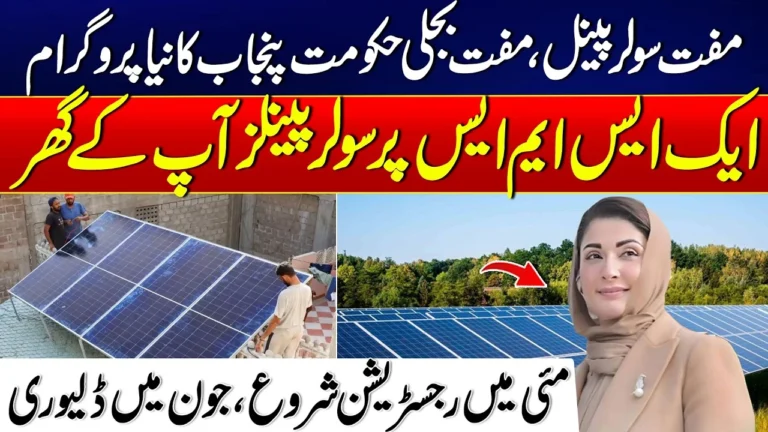
| CM Punjab Free Solar Panel Scheme (Roshan Gharana) | Punjab Government | All Punjab districts | Complete solar system (panels, inverter, battery, wiring) | 100% Free (for selected applicants) |
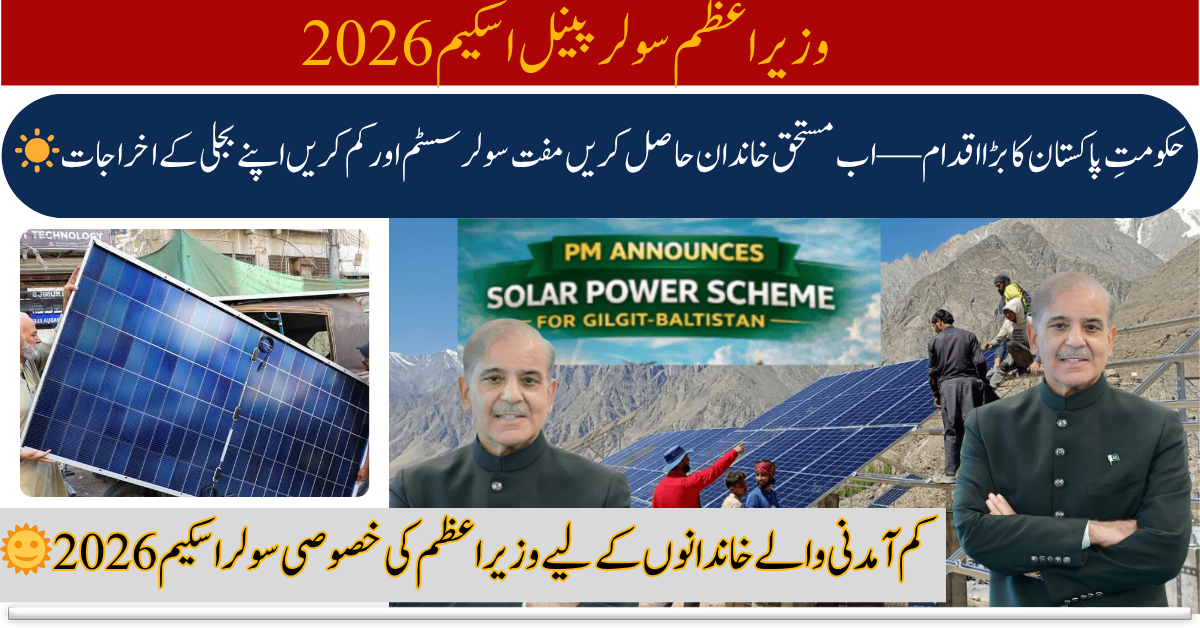
| PM Solar Scheme for Gilgit-Baltistan | Federal Government + GB Government | Gilgit-Baltistan | Free solar panels for households and institutions | Free for eligible citizens |
| Punjab Solar Tubewell Scheme | Punjab Agriculture Dept. | Punjab (farmers) | Solar tubewells (10HP, 15HP, 20HP) | 80% subsidy (you pay 20%) |
| Federal Solar Initiative (Net Metering) | Federal Government / AEDB | Nationwide | Net metering facilitation and solar subsidies | Subsidized rates |
Since the CM Punjab Free Solar Panel Scheme is the largest program currently active — targeting over 100,000 households — we will focus primarily on this program throughout this guide. However, all relevant details about the GB program and other initiatives are also included.
What Do You Actually Receive?
Selected beneficiaries don’t just get solar panels. They receive a complete, ready-to-use solar system professionally installed at their home:
- High-efficiency solar panels (1 kW to 3 kW depending on your consumption level)
- Certified solar inverter to convert solar energy into usable electricity
- Battery backup system for power during nighttime and load-shedding
- Complete wiring and installation done by government-approved technicians
- Net metering eligibility where applicable (sell extra electricity back to the grid)
- Warranty coverage on panels and inverter components
✅ Key PointThe installation is handled entirely by the government’s approved contractors. You do not need to hire anyone or buy any additional equipment. Everything is provided as part of the package.
Complete Eligibility Criteria — Who Qualifies and Who Doesn’t
This is the section most people are searching for. Eligibility rules differ slightly between programs, but the core requirements are similar. Let’s start with the Punjab scheme since it’s the largest.
CM Punjab Solar Panel Scheme — Eligibility Requirements
| Criterion | Requirement | Status |
|---|---|---|
| Residency | Must be a permanent resident of Punjab | ✔ Required |
| Electricity Connection | Must have an active domestic electricity connection | ✔ Required |
| Monthly Consumption | 0 to 200 units per month | ✔ Required |
| Sanctioned Load | Up to 2 kW | ✔ Required |
| CNIC | Valid, non-expired CNIC | ✔ Required |
| Electricity Bill | Latest bill with reference number | ✔ Required |
| Consumer Category | Domestic / Residential consumer only | ✔ Required |
| Reference Bill Period | Eligibility based on June 2024 bill data | ✔ Important |
Priority Categories — Who Gets Selected First
Since the scheme has limited slots and hundreds of thousands of applications, the government uses a priority system and transparent balloting. The following groups receive preference:
- Widows and women-headed households
- Persons with disabilities
- Households in rural and remote areas
- Families registered with Ehsaas / BISP
- Households with the lowest electricity consumption (lifeline consumers: 0-100 units)
Who is NOT Eligible? — Read This Carefully
🚫 Not Eligible — Important Exclusions
- Commercial, industrial, or shop electricity connections — only domestic consumers qualify
- Consumers using more than 200 units per month — your bill must consistently show 200 units or less
- Consumers with sanctioned load above 2 kW
- Households involved in electricity theft (kunda) — this is strictly checked
- Consumers with defective or tampered meters
- Consumers with multiple meters at a single residential address
- Rental properties where the tenant does not own the connection in their name
- Residents outside Punjab (for the Punjab scheme — other provinces have separate programs)
PM Solar Scheme for Gilgit-Baltistan — Eligibility
For the GB program, the requirements are different:
- Must be a resident of Gilgit-Baltistan
- Households in areas with severe power shortages are prioritized
- Both residential and institutional (schools, government buildings) applications are accepted
- Applications were submitted through solar.pmrugb.gov.pk or at Assistant Commissioner offices
Required Documents
Getting your documents ready before applying is essential. Missing or incorrect paperwork is the number one reason applications get delayed or rejected.
| # | Document | Purpose | Mandatory? |
|---|---|---|---|
| 1 | Original CNIC (National Identity Card) | Identity verification and registration | ✔ Yes |
| 2 | Latest Electricity Bill | Verifies consumption, meter number, and reference number | ✔ Yes |
| 3 | Electricity Bill Reference Number | Used during online/SMS application | ✔ Yes |
| 4 | Registered Mobile Number (linked to CNIC) | Receive confirmation SMS and updates | ✔ Yes |
| 5 | Proof of Residence | Confirms permanent address in the eligible area | Optional but helpful |
| 6 | Photocopy of CNIC (front and back) | For physical application at facilitation centers | For offline only |
| 7 | Disability Certificate (if applicable) | Priority category verification | If claiming priority |
💡 Pro Tip — Save TimeBefore applying, take a clear photo of your electricity bill with your phone. You will need the 14-digit reference number printed on the bill — it starts with your DISCO code (LESCO, FESCO, MEPCO, etc.). Write this number down separately so you don’t lose it.
Step-by-Step Application Process — All 3 Methods Explained
The government has made the application process simple and accessible. You can apply through three different methods depending on what’s most convenient for you.
Method 1: Online Application (Recommended)
This is the most complete and recommended method. It lets you fill in all details, upload documents, and track your application.
Visit the Official Portal
Go to cmsolarscheme.punjab.gov.pk in your browser. This is the only official website for the Punjab solar scheme. For GB residents, use solar.pmrugb.gov.pk.
Create Your Account
Click on “Register” or “Apply Now.” Enter your CNIC number and mobile number. You will receive an OTP (one-time password) via SMS to verify your phone.
Enter Your Electricity Bill Details
Provide your electricity bill reference number, consumer number, and the DISCO (distribution company) name — such as LESCO, FESCO, MEPCO, GEPCO, or IESCO.
Upload Required Documents
Upload clear photos of your CNIC (front and back) and your latest electricity bill. Make sure the images are readable and not blurry.
Review and Submit
Carefully review all entered information. Once submitted, you will receive a confirmation SMS with your application tracking number. Save this number.
Wait for Balloting and Selection
Applications are processed in phases. Selected applicants are notified via SMS and the results are published on the official portal. Selection is done through a transparent balloting process.
Method 2: SMS Application (Easiest — No Internet Needed)
For people without internet access or smartphones, the SMS method is the simplest option available.
Open Your SMS App
This works on any mobile phone — even basic keypad phones without internet.
Type Your CNIC Number
In the message body, type your 13-digit CNIC number without dashes. Some sources also indicate including your electricity bill reference number separated by a space.
Send to 8800
Send the SMS to the designated shortcode 8800.
Wait for Reply
You will receive a confirmation or status SMS within minutes. This will indicate whether your initial data has been registered and whether you meet basic eligibility.
📱 SMS Format — Send to: 88003520112345678
📌 Note About SMS MethodThe SMS registration captures basic details. For full application and document submission, you may still need to visit the online portal or a facilitation center. The SMS method is primarily used for initial eligibility check and registration.
Method 3: Offline Application (Walk-In)
If you’re not comfortable with digital methods, you can apply in person.
Find Your Nearest Facilitation Center
For Punjab: visit any Bank of Punjab branch or government facilitation center in your district. For GB: visit the Assistant Commissioner’s office in your area where registration desks have been set up.
Bring All Original Documents
Carry your original CNIC, latest electricity bill, and photocopies of both. Also bring your mobile phone for OTP verification.
Fill the Application Form
Staff at the center will help you fill out the application form and enter your details into the system. They will also verify your documents on the spot.
Collect Your Receipt
Get a printed receipt or reference number. Keep this safe — you’ll need it to check your application status later.
Benefits & Monthly Savings — How Much Will You Actually Save?
This is the section that excites people the most — and rightfully so. The savings from a solar system are real and substantial.
Rs. 3,000 – 6,000+Estimated Monthly Savings on Electricity Bills for a Typical 1-3 kW Solar System
Breakdown of Benefits
| Benefit | Details | Impact |
|---|---|---|
| Reduced Electricity Bill | Solar system covers most or all daytime usage | Rs. 3,000 – 6,000+ saved per month |
| Load-Shedding Protection | Battery backup provides power during outages | Uninterrupted fans, lights, and phone charging |
| Net Metering Income | Sell extra electricity back to the grid (where applicable) | Additional credit on your bill |
| 25-Year Panel Lifespan | Solar panels last 25+ years with minimal maintenance | Long-term financial freedom |
| Zero Installation Cost | Government covers entire setup for selected beneficiaries | Rs. 150,000 – 350,000 saved on equipment |
| Environmental Impact | Clean energy reduces carbon emissions | Contribution to a greener Pakistan |
| Increased Property Value | Homes with solar systems have higher market value | Better resale or rental value |
Real-World Savings Example
Consider a household in Lahore currently using 180 units of electricity per month. With a 1.5 kW solar system installed through the scheme:
- Before solar: Monthly bill approximately Rs. 5,500 – 7,000
- After solar: Monthly bill drops to Rs. 500 – 1,500 (meter charges and minor night usage)
- Monthly savings: Approximately Rs. 5,000
- Annual savings: Rs. 60,000
- Over 25 years: Rs. 15,00,000+ (fifteen lakh rupees) — from a system you got for free
✅ Pro Tip — Maximize Your SavingsRun your high-consumption appliances (iron, washing machine, water motor) during daytime sunlight hours to get maximum benefit from your solar panels. This way, you use solar power directly instead of drawing from the grid.
Important Dates, Deadlines & Latest May 2026 Updates
This is where we share the most current developments. The solar landscape has changed significantly in recent weeks.
Punjab Scheme — Deadline Extended to December 2026
In a major development in April 2026, the Punjab government officially extended the CM Free Solar Panel Scheme deadline by six months. Here are the confirmed details:
- Original deadline: June 2026
- New extended deadline: December 2026
- Target distribution: More than 94,000 solar systems
- Budget allocated: Approximately Rs. 10 billion
- Applications received so far: Over 800,000
- Selection method: Transparent balloting across all Punjab districts and tehsils
🔥 Breaking Update — April 2026Chief Minister Maryam Nawaz has personally directed the deadline extension and budget increase. The scheme is being implemented across all districts and tehsils of Punjab. If you haven’t applied yet, you still have time — but don’t wait, as competition is extremely high with 800,000+ applications for 94,000 systems.
Gilgit-Baltistan Scheme — Current Status
- The 100 MW solar project includes 18 MW rooftop solar and 82 MW utility-scale installations
- Applications were accepted through solar.pmrugb.gov.pk
- The program is under active implementation with installations underway
Punjab Solar Tubewell Scheme — For Farmers
- 8,000 solar tubewells with 80% government subsidy
- Applications through agriculture.punjab.gov.pk
- Target districts include Faisalabad, Multan, and other agricultural zones
⚠️ Important WarningAll the dates and figures mentioned above are based on the latest available government announcements as of May 2026. Government policies can change. Always verify deadlines and current status from official government websites before making any decisions. Never rely solely on social media or unofficial sources.
Common Mistakes & How to Avoid Them
Thousands of applications get rejected every cycle because of avoidable errors. Learn from others’ mistakes and get your application right the first time.
Mistake 1: Applying on Fake Websites
Problem: Dozens of copycat websites use names similar to the official portal to steal your CNIC data or charge you money for “guaranteed registration.”
Solution: The only official Punjab portal is cmsolarscheme.punjab.gov.pk. For GB, use solar.pmrugb.gov.pk. If any website asks you for money, it is a scam. Registration is always free.
Mistake 2: Wrong Electricity Bill Reference Number
Problem: Entering the wrong reference number is one of the most common reasons for rejection. Many people confuse the consumer number with the reference number.
Solution: The reference number is a 14-digit number printed on your bill. It’s different from the consumer number. Look for it carefully on your bill, or ask your DISCO office to confirm.
Mistake 3: Consumption Above 200 Units
Problem: Applicants whose consumption exceeds 200 units (even in a single month) may be flagged as ineligible.
Solution: Remember, eligibility for the Punjab scheme is based on your June 2024 bill. You cannot change this retroactively. If your consumption was above 200 in June 2024, you unfortunately do not qualify for this specific scheme.
Mistake 4: Expired CNIC
Problem: An expired CNIC will automatically disqualify your application.
Solution: Renew your CNIC at any NADRA office before applying. You can also start the renewal process online at nadra.gov.pk.
Mistake 5: Multiple Applications from Same Address
Problem: Some family members submit separate applications from the same meter or address, thinking it increases their chances.
Solution: The system checks by meter number and address. Multiple applications from the same connection will flag your file and may result in all applications being rejected. Submit only one application per electricity connection.
Mistake 6: Paying Agents or Middlemen
Problem: In many areas, individuals claim to be “authorized agents” who can guarantee your selection for a fee of Rs. 5,000 – 20,000.
Solution: This is fraud. The selection is done through random balloting. No one — not even government officials — can guarantee selection. Never pay anyone. Report fraud to the scheme helpline.
Mistake 7: Not Checking Application Status After Applying
Problem: Many applicants submit their form and then forget about it, missing important updates or verification requirements.
Solution: Regularly check your application status on the official portal using your tracking number. Also keep your mobile phone active, as notifications arrive via SMS.
Frequently Asked Questions (FAQs)
Conclusion — Don’t Miss This Opportunity
The PM Solar Panel Scheme 2026 is not just another government program — it is a genuine opportunity for millions of Pakistani families to permanently reduce their electricity burden, gain independence from load-shedding, and contribute to a cleaner environment.
With the Punjab scheme’s deadline now extended to December 2026 and over 94,000 solar systems being distributed with Rs. 10 billion in funding, the scale of this initiative is unprecedented. But with 800,000+ applications already submitted, the competition is fierce.
Here is your action checklist:
- Step 1: Check your eligibility using your June 2024 electricity bill (must be 0-200 units)
- Step 2: Gather your CNIC and electricity bill with the 14-digit reference number
- Step 3: Apply online at cmsolarscheme.punjab.gov.pk or send SMS to 8800
- Step 4: Save your application tracking number and check status regularly
- Step 5: Share this guide with family, friends, and neighbors who might be eligible
Solar energy is not a luxury anymore — it’s becoming a necessity in Pakistan. And for the first time in history, the government is giving it to deserving families for free. Don’t let this chance slip through your fingers.