Every property transaction in Punjab just changed — permanently. Effective July 1, 2026, the Chief Minister’s Green Property Certificate is now the only document the law recognises for buying, selling, or transferring land anywhere in the province. The old “Fard Baraye Bai” and every other conventional paper-based ownership document have been officially abolished. If you hold property in Punjab, or are planning to buy, sell, or inherit land, you now have a hard deadline to get this certificate before your transaction can legally proceed.
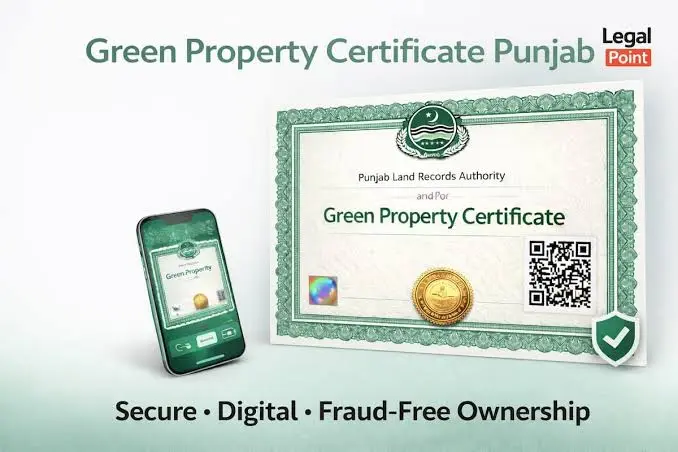
The CM Punjab Green Certificate 2026(GPC) is an official digital ownership document issued by the Punjab Land Records Authority (PLRA) under the Punjab Urban Land Systems Enhancement (PULSE) Project, developed in collaboration with the Board of Revenue. It is QR-coded, GIS-mapped, and digitally signed — meaning it can be verified instantly from anywhere in the world with a smartphone scan, and it cannot be forged, altered, or duplicated by a third party.
The problem it solves is real and urgent. Pakistan’s property sector has long been plagued by fake registries, duplicate claims, ghost mutations, and illegal possession — the mechanics of “qabza mafias” that have defrauded landowners across Punjab for generations. A document that ties physical boundary coordinates to a central, tamper-proof government database cuts off the mechanisms fraudsters rely on.
| Quick Reference | Details |
|---|---|
| Issuing Authority | Punjab Land Records Authority (PLRA) |
| Project Framework | PULSE (Punjab Urban Land Systems Enhancement) |
| Mandatory Since | July 1, 2026 (province-wide) |
| Fee | Rs. 950 (one-time) |
| Pilot District | Sahiwal (from April 30, 2026) |
| Application Channels | Arazi Record Centre (ARC) in-person OR PULSE Zameen online portal |
| Estimated Processing Time | 3–4 weeks (clean records) |
| Old System Abolished | Fard Baraye Bai and all conventional land documents |
Background: 486 Years of Manual Records — and Why They Failed Punjab
Pakistan’s land administration system traces its unbroken operational lineage back to 1540, when the Mughal Empire’s revenue apparatus first codified land surveys and ownership registers across the subcontinent. For 486 years, that manual, paper-based system — evolving through colonial British Patwari records into post-independence iterations — served as the foundational layer of property ownership across what is now Punjab. The core technology remained unchanged: hand-entered entries, physical registers, and local officials with enormous discretionary power over what got recorded, when, and how.
The consequences of running that system into the digital age were severe. Patwari offices became notorious chokepoints for corruption, where mutations (legal ownership transfers called intiqal) could be delayed indefinitely, entered fraudulently, or suppressed for a bribe. A single property could accumulate competing ownership claims across different registers, none flagged against the other. Overseas Pakistanis were particularly vulnerable — unable to monitor what happened to their inherited property from abroad, they returned to find their land transferred under forged paperwork while they were away.
The Punjab Land Records Authority was established in 2017 specifically to begin digitizing these records, but the digitization of the underlying Fard was a first-generation fix: it made old data digital without fundamentally restructuring how ownership was verified and boundaries were drawn. The PULSE project, launched under CM Maryam Nawaz Sharif, takes the reform to its logical conclusion. Rather than digitising the old system, it replaces it entirely. <cite index=”30-1″>For the first time in the 486-year history of the land administration system, a historic initiative has been introduced to promote transparency and ensure secure property transactions.</cite>
Punjab’s land fraud problem also carries a direct economic cost. Properties locked in disputes cannot be used as collateral for business loans. Investors hesitate to enter a market where title risk is a genuine variable. Rural families lose agricultural land to well-connected encroachers with no practical recourse. A credible, tamper-proof ownership document directly unblocks capital that would otherwise sit frozen in legal limbo.
Core Mechanics: What the Green Property Certificate Actually Does
What It Is — and What It Is Not
The Green Property CM Punjab Green Certificate 2026 is not a digitised version of the old Fard. It is an entirely new category of document that simultaneously verifies ownership (who legally holds the title), possession (who is physically present on the land), and boundaries (exact GPS-mapped coordinates of the parcel). <cite index=”30-1″>The Green Property Certificate ensures verification of both ownership and possession.</cite> These three elements — often separately disputed, separately documented, and separately exploitable — are bound together into a single certificate backed by the government’s land record database.
Each certificate carries:
- A unique QR code for instant mobile verification of ownership status
- GIS-mapped boundary data from satellite and GPS field surveys
- A digital signature by PLRA — no human can overwrite or edit entries post-issuance
- Cloud-based storage under government control — no local file that can be “lost”
Who Must Get One
<cite index=”45-1″>From July 1, 2026, the sale and purchase of residential, commercial, and agricultural land will be prohibited without the Green Property Certificate. The existing Fard system will be abolished.</cite> This applies to:
- Anyone buying or selling urban or rural property
- Anyone executing a property transfer, inheritance mutation, or gift deed
- Housing society members completing plot transfers
- Overseas Pakistanis conducting property transactions through representatives
Eligibility Conditions for the Certificate
Not every property qualifies on day one. The following conditions must be met before a Green Property Certificate can be issued:
| Condition | Requirement |
|---|---|
| Ownership record | Must exist and be current in PLRA’s official land records |
| Outstanding taxes | All property tax and government dues must be fully cleared |
| Litigation status | No active court stay orders or disputes on the title |
| Bank pledge | Property must not be currently pledged/mortgaged to a financial institution |
| Partition status | Joint-ownership properties must have a completed land partition, or all co-owners must apply jointly |
| CNIC linkage | Applicant’s CNIC must be registered in their own name; SIM card used for OTP must also be self-registered |
Step-by-Step Process: Getting Your Green Property Certificate
The process runs across ten official stages. Understand them in sequence before you begin — missing or rushing any step extends your processing time significantly.
Step 1 — Visit your nearest Arazi Record Centre (ARC). Every district in Punjab has at least one. Bring your original CNIC, your property’s Khasra number and Khewat number, and copies of any existing title documents (old Fard, registry, mutation records). On arrival, a Service Centre Official issues you a processing token and formally begins the application.
Step 2 — Pay the official fee of Rs. 950. <cite index=”44-1″>In January 2026 the Punjab Land Record Authority increased the fee for Green Property Certificate from Rs 700 to Rs 950.</cite> Payment is accepted at the Bank of Punjab counter inside the ARC or through the PLRA e-Pay system online. Keep the receipt — you will need it throughout the process.
Step 3 — Complete NADRA biometric verification. Your fingerprints are scanned against NADRA’s database to confirm you are the registered CNIC holder making the application. This step closes off one of the most common fraud vectors in the old system — identity impersonation.
Step 4 — Ownership history review. PLRA officials conduct a comprehensive audit of your property’s chain of ownership in the government records, checking for gaps, inconsistencies, and competing claims back through the system.
Step 5 — GPS field survey and boundary demarcation. A PLRA surveyor visits the physical property to mark exact coordinates using GPS equipment. This generates the GIS data that gets embedded in your certificate. Neighbouring property owners are present at this stage to confirm the demarcation — their agreement is formally recorded.
Step 6 — Gazetted Officer verification. <cite index=”44-1″>A Grade-17 officer or authorized revenue staff member verifies the possession in the system.</cite> This is the administrative sign-off that the field data matches the ownership records.
Step 7 — Fifteen-day public notice. Following the field survey, PLRA publishes a public notice on its website for 15 days. Any third party with a competing claim on the property has this window to file a formal objection. No objection means the process advances automatically.
Step 8 — Final review by the Assistant Director of Land Records (ADLR). The ADLR reviews the complete case file. If possession is verified at two administrative levels (Revenue Officer and Gazetted Officer) with no pending objections, the property is cleared for certification.
Step 9 — “Green Status” assignment. The property receives its digital Green Status in the PLRA system — the classification that makes it eligible for legal transactions.
Step 10 — Issuance of the Green Property Certificate. The ADLR issues the final certificate, which is delivered digitally. You can download it immediately via the PLRA portal or receive a printed copy at the ARC. <cite index=”45-1″>Assuming no objections are filed and all documents are in order, the end-to-end process typically takes 3 to 4 weeks after initial application.</cite>
Online Application Alternative
Property owners who prefer not to visit an ARC in person can begin their application through the PULSE Zameen portal on the official PLRA website. The online route follows the same stages but allows document upload remotely. Physical steps — the GPS survey and NADRA biometric — still require local coordination, but overseas Pakistanis can appoint an authorised representative through a notarised Special Power of Attorney (SPA) to handle in-person requirements on their behalf.
Benefits, Challenges, and Practical Solutions
What the Reform Gets Right
The Green Property Certificate solves the legal ambiguity that made Punjab’s property market one of South Asia’s riskiest for individual buyers. A property with a QR-coded, PLRA-issued certificate means a buyer can verify in seconds — from their phone — that the title is clear, the boundaries are confirmed, and no competing claims are pending. Banks can lend against verified land with confidence, unlocking mortgage and business loan access for property owners who previously couldn’t use their assets as collateral. Overseas Pakistanis gain an enforcement mechanism they previously lacked: a government-issued digital certificate that proves fraudulent transfers happened if someone attempts to act on forged documents while they’re abroad.
Where Applicants Will Hit Friction
The 15-day public notice period is necessary but creates a vulnerability window — a disputed property or one with a litigious neighbour can stall indefinitely at Step 7. Properties with outdated or mismatched records in the PLRA system require mutation corrections before applying, adding weeks to the timeline. Joint-ownership situations — common in inherited agricultural land split among siblings — require all owners to cooperate and apply together, which is logistically difficult when family members are in different cities or abroad. The volume of applications across 36 districts simultaneously may also strain ARC capacity during the initial mandatory rollout.
Practical Solutions
Start your application now rather than waiting for transaction pressure — the 3–4 week minimum timeline means leaving it until you have a buyer or need to close a deal puts you at risk of losing the transaction. Clear any outstanding property tax before you visit the ARC; unpaid dues block the process outright. If your existing Khasra or Khewat records in PLRA don’t match your physical documents, file a mutation correction first at the same centre. For joint-ownership land, coordinate with all co-owners and appoint a lead applicant with a power of attorney before approaching the ARC — this prevents documentation gaps mid-process
Future Outlook: Punjab’s Property System in 2027 and Beyond
<cite index=”48-1″>The government plans to expand this system to Lodhran and Hafizabad from July 1 and fully implement it across Punjab by December 2026.</cite> Once the province-wide rollout completes, every active property record in Punjab’s 36 districts will sit inside a unified, GIS-linked database — the conditions that make large-scale land fraud structurally impossible rather than merely illegal.
The next logical step, already signalled by the provincial government’s broader digitisation drive, is integration with the Federal Board of Revenue’s tax systems, NADRA’s identity infrastructure, and the banking sector’s collateral verification processes. A property database this complete, once stabilised, becomes the backbone for a functioning mortgage market in Punjab — a product category that barely exists at scale in Pakistan today. Property lawyers and real estate analysts tracking the PULSE project’s technical architecture expect title insurance products to emerge from the private sector once the Green Certificate system demonstrates consistent data integrity over a 12–18 month operational period.
The Stakes Are Clear
Pakistan’s property sector has been reformed in promise dozens of times. What makes this moment different is the mechanism: the abolition of the old Fard is not a supplementary programme running alongside existing documents — it is a mandatory replacement with a hard legal deadline. Any transaction attempted after July 1, 2026 without a Green Property Certificate is legally void. That means the incentive structure for every property owner in Punjab — whether they trust the new system or not — now runs only one direction.
Get your records in order, clear outstanding dues, and visit your nearest Arazi Record Centre without delay. The Rs. 950 fee and three to four weeks of processing time is a small price for a title that cannot be stolen, forged, or disputed without leaving a traceable digital trail in a government database. After 486 years, Punjab’s land administration system has finally been reset from scratch.