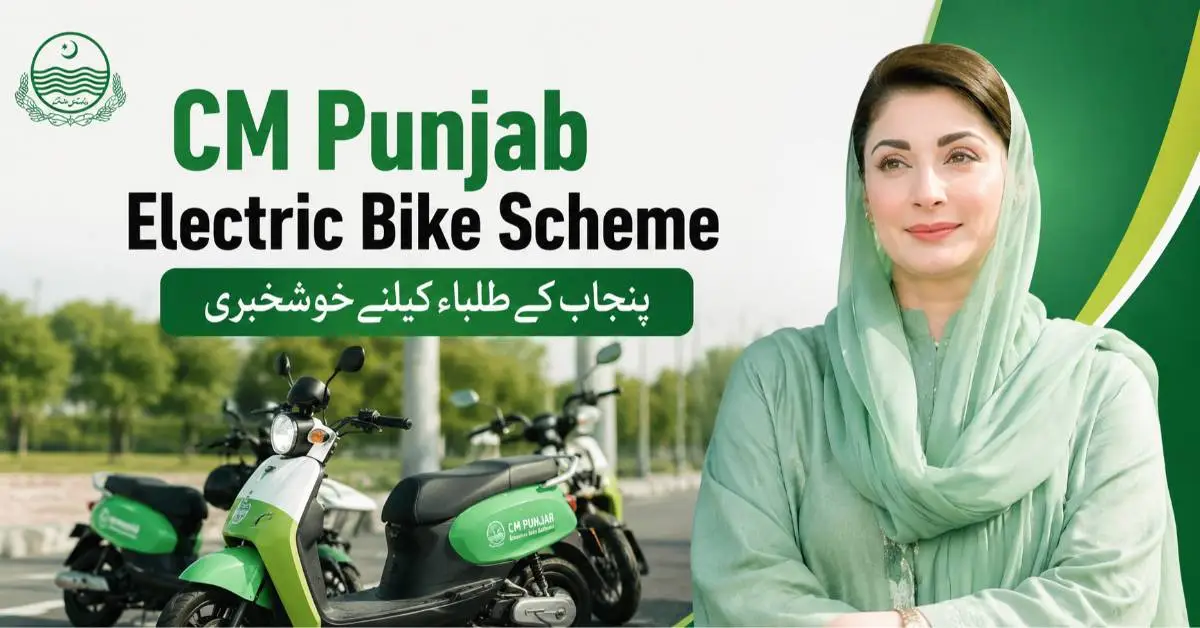
Petrol crossed PKR 320 a liter in Pakistan, and for students commuting daily to college on rented vans or overcrowded buses, that number isn’t abstract — it’s the difference between affording a semester’s books or not. The CM Punjab Bike Scheme 2026, run by the Government of Punjab’s Transport Department and the CM Special Monitoring Unit in partnership with the Bank of Punjab, exists to put a personal motorcycle or electric bike within reach of exactly that student, on a payment plan that doesn’t require savings most families don’t have.
This guide breaks down what the scheme actually offers, who qualifies, what the real installment structure looks like, and where the program currently stands after several rounds of expansion. The numbers below come from Punjab’s official flagship projects page and corroborating reports from Samaa TV, not from the dozens of unofficial “scheme guide” sites currently repeating wildly inconsistent figures about this program.
Quick Summary
| Detail | Information |
|---|---|
| Program Name | CM e-Bikes / Bike Scheme |
| Implementing Bodies | Punjab Transport Department, CM Special Monitoring Unit, Bank of Punjab |
| Eligibility | HEC-recognized college/university student, age 18+, valid learner’s permit or license |
| Total Bikes (expanded) | 27,200 (19,000 petrol + 8,179 electric, per official figures) |
| Down Payment | Reduced to PKR 25,000 |
| Monthly Installment | Under PKR 5,000 |
| Special Provision | Orphan students receive bikes free of cost; all female applicants guaranteed a bike |
| Official Portal | bikes.punjab.gov.pk |
If you want the registration steps without the backstory, skip to the process guide below. If you want to understand how this scheme evolved and why the numbers keep shifting between different websites, the next section explains it.
Background: Why Punjab Is Subsidizing Student Transport
Public transport in Pakistan’s major cities has never reliably served the volume of students commuting to colleges and universities every day. Buses run late or overcrowded, vans charge fares that add up fast over a semester, and women in particular face safety concerns on shared transport that male students don’t navigate the same way. For a student living even a moderate distance from campus, unreliable transport translates directly into missed classes and lost academic standing.
The CM Punjab Bike Scheme 2026 began as a more modest pilot: the Punjab cabinet initially approved 20,000 electric bikes for distribution, launched specifically in five cities — Lahore, Faisalabad, Multan, Rawalpindi, and Bahawalpur. Early rollout surfaced a practical problem quickly: electric bikes alone struggled with limited mileage and reports of battery theft, which pushed the government to fold petrol motorcycles into the program as a parallel option rather than relying on electric models exclusively.
Demand outpaced the original allocation almost immediately. In response, the government raised the total from 20,000 to 27,200 bikes, expanded geographic coverage toward all of Punjab’s districts in later phases, and added targeted provisions that weren’t part of the original design — most notably a guarantee that every female applicant who applies receives a bike, and a commitment that orphan students receive their bike completely free, with no installment plan attached.
This fits a broader pattern in Punjab’s current governance approach: youth-facing subsidy programs launched in a limited pilot, adjusted in response to real uptake data, then scaled with added equity provisions for women and economically vulnerable groups. The bike scheme sits alongside parallel state-subsidized initiatives — a separate electric bike track for government school teachers through the Punjab Teachers Foundation, and a proposed track for low-grade government employees — suggesting the province is treating subsidized two-wheeler ownership as a recurring policy tool rather than a single one-off scheme.
Eligibility Criteria and Scheme Structure
Eligibility for the core student scheme is narrower than some unofficial sources suggest. The official Punjab government page is specific about who the program targets and how selection works when demand exceeds supply.
Who Can Apply
- Enrollment status: Must be a regular student at a degree college or university recognized by the Higher Education Commission (HEC)
- Age: At least 18 years old
- Licensing: Must hold a valid motorcycle learner’s permit or driving license
- Residency: Punjab domicile and residency requirements apply
- Geographic scope: Originally limited to five cities, with later phases expanding toward province-wide coverage
Selection and Quota Structure
| Category | Provision |
|---|---|
| Gender quota | Equal quota for male and female students at the divisional level, with proportional quotas for the rest of Punjab |
| Female applicants | All eligible female applicants who apply are guaranteed a bike, per Transport Department confirmation |
| Orphan students | Receive bikes completely free, with no installment obligation |
| Oversubscription | Selection conducted through e-balloting based on domicile district when applications exceed quota |
| Electric bike category | No restricted quota — open access for all eligible applicants regardless of other quota limits |
This structure means two students with identical qualifications can have very different odds depending on which category they fall into. A female applicant or an orphaned student bypasses the balloting risk entirely under current provisions, while a general-category male applicant in an oversubscribed division competes through a digital draw.
Financial Structure
The down payment was reduced from its original level to PKR 25,000, with monthly installments kept under PKR 5,000 — a deliberate move by the Chief Minister’s office to widen access for lower-income households who couldn’t manage a steeper upfront cost. The Bank of Punjab handles the lending side, running credit and verification checks before finalizing any installment plan, and bikes typically come with insurance coverage during the loan period.
It’s worth noting that some secondary sources cite different installment figures — ranging from PKR 2,000 up to PKR 7,000 depending on bike model and financing terms. Until the Bank of Punjab publishes a model-by-model breakdown on its own channels, treat the sub-PKR 5,000 figure as the credible baseline rather than an exact universal number.
Step-by-Step Registration Process
Follow this sequence in order. Several stages here involve bank-side verification that unofficial guides tend to skip entirely.
Step 1: Confirm your eligibility category before applying. Determine whether you fall under the general quota, the female applicant guarantee, or the orphan student provision — this affects what happens if applications exceed available bikes in your division.
Step 2: Gather your documents in advance. You will typically need your CNIC, proof of current enrollment (student ID or institute letter), and your learner’s permit or driving license. Have clear scans ready before starting the online form.
Step 3: Go directly to the official portal. Visit bikes.punjab.gov.pk rather than any third-party site claiming to host the application. Scheme names this widely publicized attract cloned phishing pages designed to collect CNIC data.
Step 4: Create your account. Register using your email, CNIC number, and mobile number, and set a password you’ll remember — you’ll need to log back in repeatedly to track your application status.
Step 5: Complete the application form. Enter your personal details, academic or institutional information, contact details, and select your bike preference between electric and petrol models.
Step 6: Upload required documents. Submit your CNIC, passport-sized photograph, proof of enrollment, and license or learner’s permit. Make sure scans are legible and within any stated file-size limit before submitting.
Step 7: Submit and save your reference number. After submission, you should receive a confirmation via SMS and email along with a tracking reference. Save this — you’ll need it for any status inquiry.
Step 8: Wait for Bank of Punjab verification. This is the stage most applicants underestimate. The bank reviews your documents and runs a financial verification check before any installment plan is finalized, and this step takes longer than the application itself.
Step 9: Participate in e-balloting if applicable. If your category is oversubscribed, a transparent digital draw determines selection based on domicile district. Female applicants and orphan students are not subject to this step under current provisions.
Step 10: Complete final paperwork and receive your bike. Once approved, you’ll sign the necessary loan or grant documents, settle your down payment if applicable, and the bike is distributed through the Bank of Punjab’s network in coordination with local dealers.
Benefits, Challenges, and Practical Solutions
What the Scheme Gets Right
- Removes the upfront cost barrier. A PKR 25,000 down payment is a fraction of a bike’s full retail price, and sub-PKR 5,000 installments are manageable against most household budgets.
- Built-in equity provisions. Guaranteed bikes for female applicants and free bikes for orphan students go beyond a flat subsidy model and target groups facing the steepest mobility barriers.
- Responsive scaling. The jump from 20,000 to 27,200 bikes in response to real demand shows the program adjusting rather than capping access arbitrarily.
- Dual bike options. Offering petrol alongside electric addresses the real-world limitations — range, charging access, battery durability — that electric-only programs run into in areas without reliable charging infrastructure.
Where It Gets Difficult
- Inconsistent public information. The sheer volume of conflicting “guide” websites citing different bike totals, age limits, and deadlines makes it genuinely hard for an applicant to know what’s current.
- Geographic rollout gaps. Phase 1’s five-city limitation meant students outside Lahore, Faisalabad, Multan, Rawalpindi, and Bahawalpur had no access until later expansion phases reached their districts.
- Verification delays. Bank-side credit and document checks add real waiting time beyond the online application itself.
- Battery and mileage concerns on electric models. Documented issues with limited range and theft risk on electric units are a legitimate factor in choosing between bike types, not just a preference question.
Practical Fixes
Treat bikes.punjab.gov.pk and punjab.gov.pk as your only trustworthy sources for current numbers, deadlines, and phase status — cross-check anything you read elsewhere against the official portal before acting on it. If your division isn’t yet covered by an active phase, register your interest as soon as the portal opens for your area rather than waiting, since rollout has consistently moved toward broader coverage over time. If choosing between bike types, weigh your daily commute distance and access to charging against the electric model’s known range limitations before committing.
What Comes Next for This Program
The scheme’s trajectory points toward continued expansion rather than a fixed endpoint. With over 15,000 students reportedly still on a waiting list after the most recent distribution round, additional releases appear likely as the government works through the backlog. Parallel tracks for government school teachers and a proposed track for government employees suggest Punjab is replicating this subsidized-mobility model across other public-sector groups, not just students.
Expect continued geographic expansion toward full province-wide coverage, possible standardization of installment terms as the Bank of Punjab refines its lending structure, and continued emphasis on the female-applicant guarantee as a flagship equity feature going forward.
Final Word
A reduced down payment, an installment plan under PKR 5,000 a month, and guaranteed access for female and orphan students turns a basic transportation problem into something genuinely solvable for thousands of Punjab’s students. The program isn’t without friction — verification takes time, electric models carry real limitations, and the information landscape around it is messier than it should be. But the core offer, verified directly against Punjab’s own government channels, is real. Confirm your eligibility category, register through the official portal, and treat the bank verification stage as part of the timeline rather than a delay to worry about.
One Comment