A widow in a small Punjab town has been receiving her Rs. 14,500 quarterly Benazir Taleemi Wazaif 2026 payment for two years. She has three school-age children — two in government primary school, one in middle school. She has no idea that BISP runs a separate stipend specifically for those children’s education, on top of her regular Kafaalat payment. She only finds out when a neighbor mentions “Taleemi Wazaif” in passing at a payment camp.
This is one of the most under-claimed benefits in Pakistan’s social protection system — not because families don’t qualify, but because nobody tells them it exists as a distinct, additional entitlement. This article explains exactly what it is, who qualifies, how to check your status online, and — just as importantly — where the numbers you’ll find online start to contradict each other, and what to actually trust.
What Benazir Taleemi Wazaif Actually Is
According to BISP’s own programme page (bisp.gov.pk) and Pakistan’s Ministry of Poverty Alleviation and Social Safety (under which BISP institutionally sits), Benazir Taleemi Wazaif 2026 is a Conditional Cash Transfer (CCT) programme — meaning the payment is tied to a condition (school enrollment and attendance), not given unconditionally like the main Kafaalat cash transfer.
It exists specifically for the children of active Benazir Kafaalat beneficiaries, from primary school through higher secondary (intermediate) level. The programme was piloted in just 5 districts in November 2012, expanded to 32 districts by 2015, 50 by 2018, and reached 100 districts by January 2020, according to BISP’s official history of the programme. Since inception, BISP’s own figures (via the Ministry of Poverty Alleviation and Social Safety) state that 9.4 million children have been enrolled and Rs. 40 billion disbursed — note that some independent websites cite a much higher cumulative figure (over 12 million children, Rs. 63+ billion), but that number could not be traced back to an official BISP or ministry statement, so treat it with caution.
The core mechanic is simple: the child gets verified once at registration, receives their first payment after enrollment, and from the second quarter onward must maintain at least 70% school/college attendance to keep receiving the stipend. If a child fails to meet this attendance requirement for three consecutive quarters, BISP suspends them from the programme — this exact rule is stated directly on BISP’s official programme page.
How Much Does It Actually Pay? (Where the Numbers Disagree)
This is worth being honest about upfront, because it’s exactly the kind of detail where a lot of websites quietly guess.
The most traceable official figure comes from a Government of Pakistan Press Information Department (PID) release, which directly quotes the then-BISP Chairperson on the disbursement structure:
| Level | Boys (per quarter) | Girls (per quarter) |
|---|---|---|
| Primary | Rs. 1,500 | Rs. 2,000 |
| Secondary | Rs. 2,500 | Rs. 3,000 |
| Higher Secondary | Rs. 3,500 | Rs. 4,000 |
Plus a one-time graduation bonus of Rs. 3,000 for girls who complete primary school — this specific bonus amount is confirmed directly on BISP’s own programme page, independent of the PID release.
However, multiple 2026-dated websites report meaningfully higher numbers — some citing a flat Rs. 500 increase per tier, others citing amounts nearly Rs. 1,000 higher per tier (for example, Rs. 4,500–5,000 at the higher secondary level). None of these higher figures could be traced to a dated, named official BISP or Ministry of Poverty Alleviation and Social Safety announcement — they appear across several similar-looking aggregator sites without a clear original source, which is often a sign of sites copying each other rather than reporting an actual notification.
Our honest recommendation: don’t rely on any article — including this one — for your exact current amount. Check the 8171 portal with your CNIC, which will display the actual amount BISP currently has on record for your household, and treat that as ground truth over any published table.
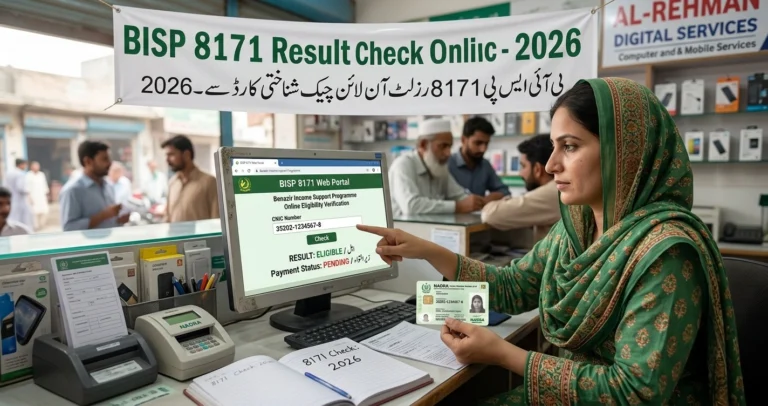
BISP 8171 Result Check Guide 2026 – Step-by-step instructions on checking your Kafalat payment status by CNIC and resolving common web portal errors.
Who Is Eligible — Including the Edge Cases
The baseline eligibility, per BISP’s official programme details, is:
- The mother must be an active Benazir Kafaalat beneficiary — Taleemi Wazaif is not a standalone program you can apply to independently.
- Primary level: child aged 4–12
- Secondary level: child aged 8–18
- Higher secondary level: child aged 13–22
- The child must have a NADRA-verified B-Form or Child Registration Certificate (CRC) — this verification is mandatory and is described as a one-time check at registration.
- The child must be enrolled in a recognized school or college and produce an admission slip verified by a teacher/headmaster.
Edge cases people genuinely ask about:
- “My household just became a BISP Kafaalat beneficiary this quarter — can I register my kids for Taleemi Wazaif immediately?” Yes, once your Kafaalat status is active, you can register your eligible children; there’s no separate waiting period specified in official materials, though processing still takes time.
- “My daughter is in a low-cost private school, not a government school — does she still qualify?” Official BISP materials refer to “school/college” enrollment broadly rather than specifying government schools only, but always confirm with your local BISP field office, since interpretation can vary by region.
- “I have five school-age children — do I get the stipend for all of them?” Yes, each eligible child is registered individually with their own documentation, and stipends are calculated per child.
- “My son’s B-Form doesn’t list me (the mother) as a guardian — is that a problem?” Yes — several current reports note that B-Forms without the mother’s CNIC linked can delay or block payments, and BISP now treats this as mandatory. Visit NADRA to have the B-Form updated before registering.
- “My child failed a grade and is repeating it — do they still get paid?” This specific detail is not clearly addressed on BISP’s own Taleemi Wazaif page. A comparable rule exists in Punjab’s own provincial stipend program (see comparison table below), where repeating students are explicitly excluded — but whether BISP applies the same rule isn’t confirmed in what we could verify, so ask directly at your Tehsil office rather than assuming either way.
BISP 8171 Updates – A complete archive of articles covering beneficiary registration, balance checks, and new dynamic survey guides.
Step-by-Step: Checking Your Status and Registering
To check your existing status online:
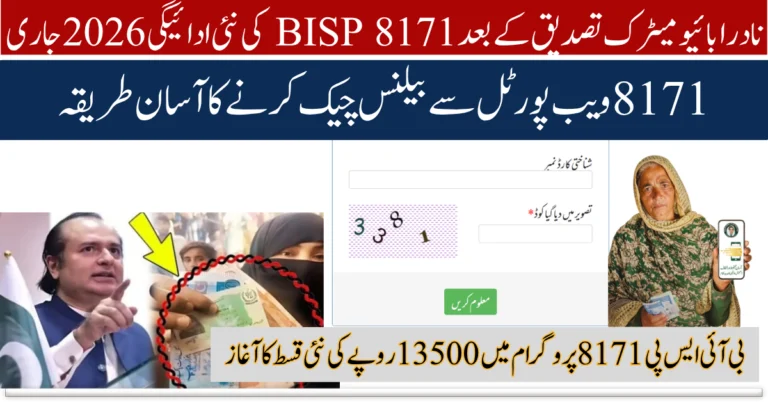
- Go to 8171.bisp.gov.pk on any browser.
- Enter the mother’s 13-digit CNIC (no dashes) — Taleemi Wazaif is checked against the mother’s CNIC, not the child’s.
- Complete the captcha verification.
- Click “Check Eligibility” / “Maloom Karen.”
- The result shows registration status, school details on file, and quarterly payment history where applicable.
Alternatively, send the mother’s 13-digit CNIC via SMS to 8171 for a basic status reply — useful if you don’t have reliable internet access.
To register a child who isn’t yet enrolled:
- Confirm the mother’s Kafaalat status is active (check via the method above first).
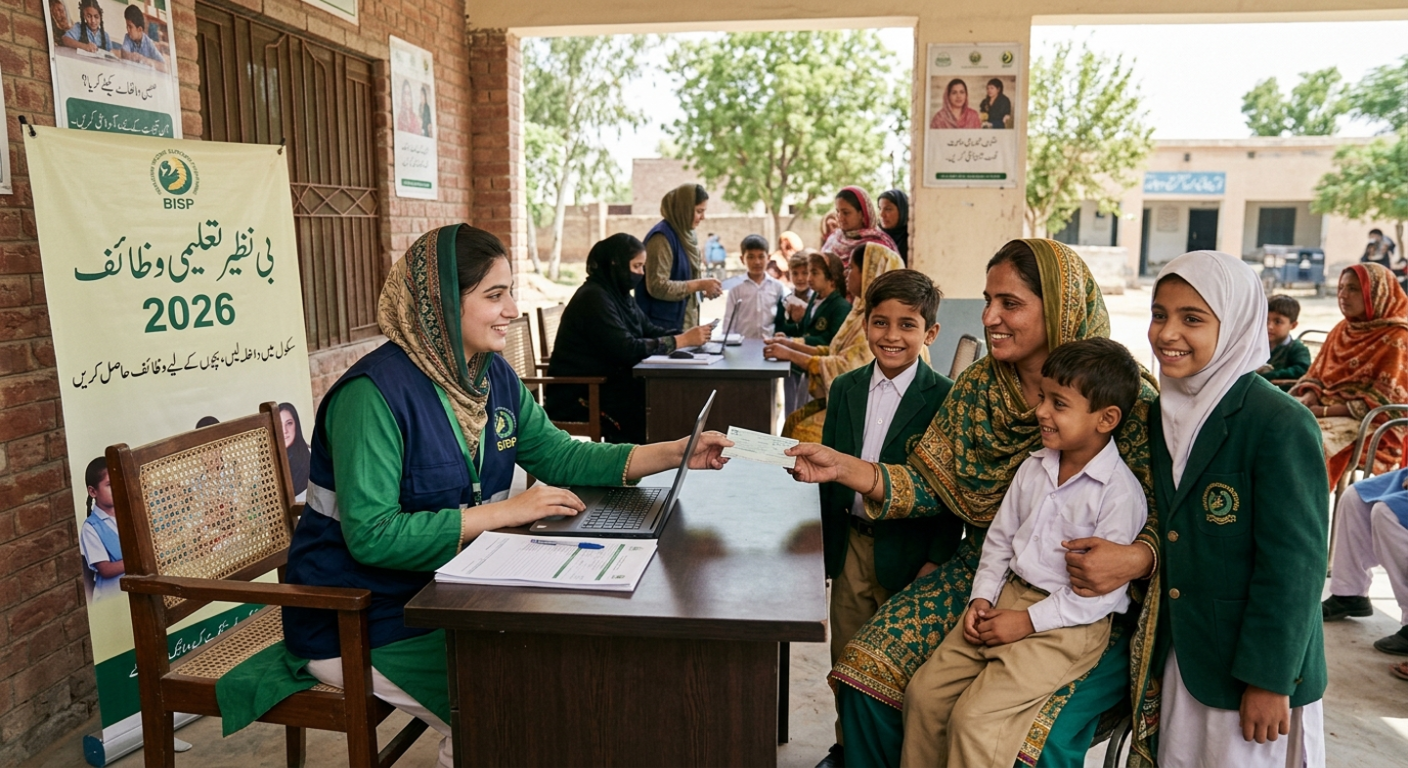
- Visit your nearest BISP Tehsil Office or an active enrollment camp with the mother’s original CNIC and the child’s B-Form/CRC.
- Take the child’s school admission slip, signed and stamped by the headmaster/teacher, confirming class and school name.
- BISP staff will verify the B-Form against NADRA’s database — this is described as a one-time verification step.
- Once verification is complete, you’ll receive an enrollment confirmation; the first payment is released after this enrollment is processed.
- From the second quarter onward, the school is expected to report attendance data, and payment continues automatically as long as the 70% threshold is met — you generally don’t need to resubmit documents every quarter.
Save This Checklist
- Mother’s original, unexpired CNIC
- Confirmation that mother is an active Kafaalat beneficiary (check 8171 first)
- Child’s B-Form/CRC with mother’s CNIC correctly linked
- Recent school/college admission slip, signed by the headmaster/teacher
- Confirmation of child’s age against the correct tier (primary/secondary/higher secondary)
- A record of your enrollment confirmation slip once registered
Common Mistakes Applicants Make
- Assuming registration in Kafaalat automatically registers your children in Taleemi Wazaif. It doesn’t — this is a separate, additional registration step.
- Not updating the B-Form when the mother’s CNIC isn’t linked. This is currently one of the most cited reasons for delayed or blocked payments.
- Letting attendance drop below 70% without realizing payments will simply stop. BISP does not always send an advance warning — the safest approach is proactive attendance tracking.
- Assuming a one-time registration means one-time paperwork forever. While the B-Form/CRC check is one-time, attendance-linked payment continuity depends on the school reporting data every quarter — if a school is inconsistent about this, follow up.
- Trusting stipend amount figures from random websites rather than checking the actual amount on the 8171 portal, given the inconsistencies described above.
- Registering a child who is technically outside the age bracket for their current class level, which can cause delays during NADRA verification.
If Registration Is Rejected or Payment Is Delayed
- First, confirm the mother’s core Kafaalat status is still active — if that lapses (for example, due to a pending NSER re-survey), Taleemi Wazaif payments will also be affected, since it’s fully dependent on that status.
- Check whether the B-Form correctly lists the mother’s CNIC; this is one of the most common fixable issues.
- Ask the school to confirm whether they submitted the quarter’s attendance data — sometimes the delay originates at the school’s end, not BISP’s.
- File a complaint at citizenportal.gov.pk if the issue remains unresolved after checking the above, or call the BISP helpline 0800-26477.
- Visit your BISP Tehsil Office in person with all original documents if the online status hasn’t updated in a reasonable time — BISP does not publish a guaranteed processing timeframe, so persistence, not panic, is the right approach.
Red Flags: Scam Patterns to Watch For
- Anyone asking for payment to “register” or “fast-track” your child’s stipend. Registration and processing are free.
- Unofficial websites with URLs that resemble but aren’t bisp.gov.pk or 8171.bisp.gov.pk — several copycat sites exist to collect CNIC data or serve ads; double-check the domain before entering any information.
- SMS messages from numbers other than 8171 claiming to be BISP communications about your child’s stipend.
- Anyone offering to “guarantee” your child’s enrollment or a specific stipend amount for a fee — no legitimate BISP staff member can guarantee outcomes.
- Agents at schools or offices asking for a “processing fee” to submit attendance records — attendance reporting is a school-BISP administrative function, not something a parent should be charged for.
Benazir Taleemi Wazaif vs. Punjab’s Own Girls Stipend Program (Zaver-e-Taleem)
Here’s a genuinely important distinction most coverage of this topic completely misses — and it matters specifically for readers in Punjab: the province runs its own, separate girls’ education stipend program, unrelated to BISP.
Punjab’s Zaver-e-Taleem Programme (ZTP), run by the Punjab School Education Department through PMIU-PESRP, is a provincial conditional cash transfer that predates and operates independently of BISP’s Taleemi Wazaif.
| Benazir Taleemi Wazaif | Punjab’s Zaver-e-Taleem (Girls Stipend Program) | |
|---|---|---|
| Run by | Federal BISP (Ministry of Poverty Alleviation & Social Safety) | Government of Punjab, School Education Department (PMIU-PESRP) |
| Who qualifies | Sons and daughters of active BISP Kafaalat beneficiaries, nationwide | Girls only, grades 6–10, in 16 specified low-literacy Punjab districts |
| Prerequisite | Mother must be a Kafaalat beneficiary | No BISP registration required — school-based enrollment only |
| Attendance requirement | 70% per quarter | 80% per quarter, plus promotion to the next grade |
| Amount (per officially traceable figures) | Rs. 1,500–4,000/quarter depending on level and gender | Rs. 3,000/quarter (Rs. 1,000/month) |
| Repeaters/failed students | Not explicitly addressed in available official materials | Explicitly excluded — must be promoted to next grade |
| Districts covered | Nationwide, active in around 100 districts | Only 16 specified districts (e.g., Bahawalpur, Bahawalnagar, Rajanpur, D.G. Khan, Muzaffargarh, Vehari, and others) |
Practical takeaway: if you live in one of the 16 districts covered by Zaver-e-Taleem and have a daughter in grades 6–10, she may be eligible for both programs simultaneously if your household also receives Kafaalat — they are not mutually exclusive, since they’re run by entirely different government tiers. Don’t assume checking one covers the other.
Consider a composite, illustrative example reflecting a common pattern: “Farzana,” a Kafaalat beneficiary in a Punjab tehsil, had been receiving her quarterly Rs. 14,500 payment for over a year without knowing Taleemi Wazaif existed. After a field visit from a BISP awareness team, she registered her two children — a 10-year-old daughter in grade 5 and a 14-year-old son in grade 9 — bringing their B-Forms and school admission slips to the Tehsil office. Her daughter’s B-Form initially lacked her CNIC, causing a two-week delay while she had it corrected at NADRA. Once resolved, both children were enrolled, and she began receiving an additional stipend on top of her existing Kafaalat payment from the following quarter.
This reflects a genuinely common scenario — the biggest obstacle usually isn’t eligibility itself, but incomplete paperwork like an unlinked B-Form.
FAQs
What To Do Right Now
If your household already receives Benazir Taleemi Wazaif 2026 and you have school-age children not yet registered for Taleemi Wazaif, check your status today at 8171.bisp.gov.pk, gather your children’s B-Forms and school admission slips, and visit your nearest BISP Tehsil Office this week. If you’re in one of Punjab’s designated low-literacy districts with a daughter in grades 6–10, also ask your daughter’s school about Zaver-e-Taleem registration separately.