A widow searching online for the Rehmat Card right now will find at least three different payment figures, two different program names, and a handful of deadlines that contradict each other. That confusion is the real barrier — not the application itself, which the Punjab government built to be free, digital, and middleman-free from day one.
This guide goes straight to the Zakat & Ushr Department’s own program page and the official launch briefing to separate confirmed facts from the noise circulating across unofficial blogs, and walks through exactly who qualifies, what the payment actually is, and how to register correctly.
Quick Reference Box
| Detail | Confirmed Information |
|---|---|
| Official Name | CM Punjab Rahmat Card |
| Administered By | Zakat & Ushr Department, Government of Punjab |
| Official Portal | rahmatcard.punjab.gov.pk |
| Helpline | 1077 |
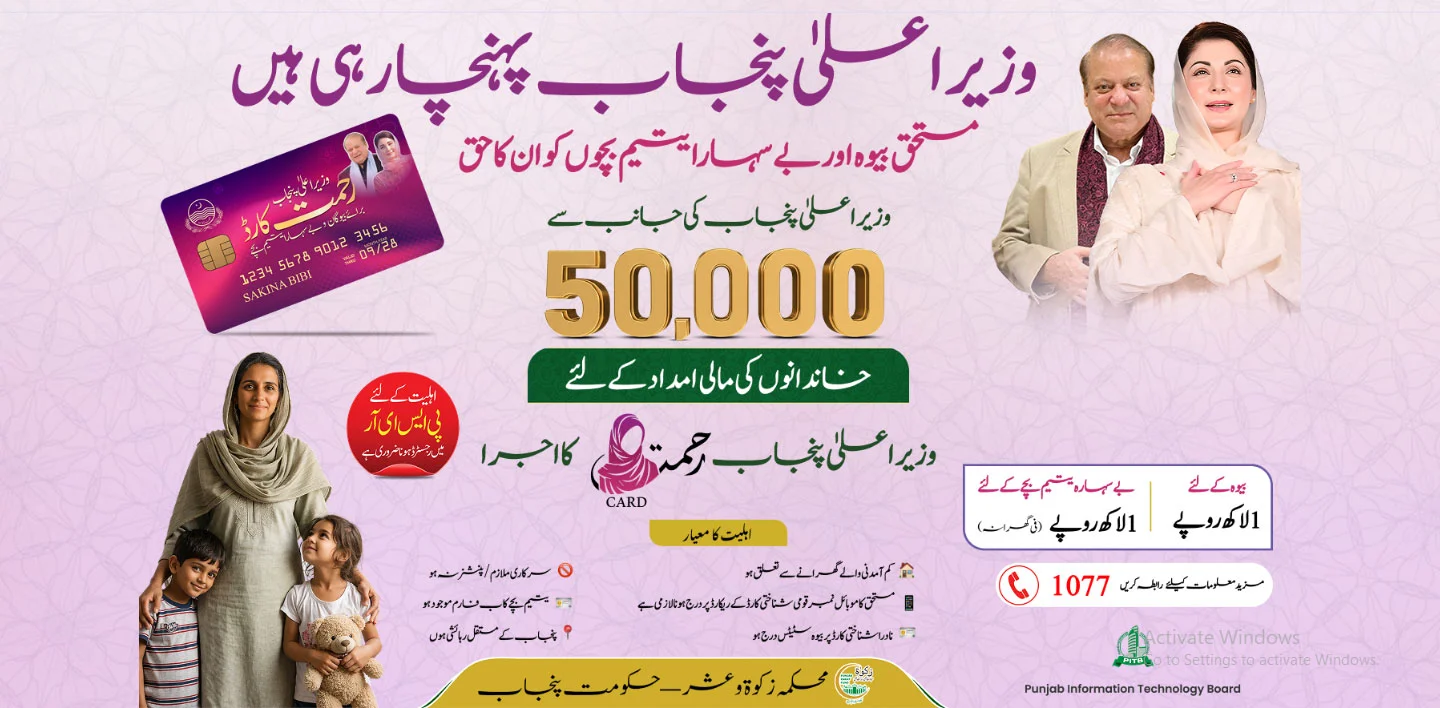
| Payment for Widows | Rs. 100,000 (one-time) |
| Payment for Double-Parent Orphans | Rs. 100,000 per child (one-time) |
| Phase 1 Coverage | 50,000 families |
| Total Allocation | Rs. 5 billion from the provincial Zakat Fund |
| Selection Basis | PSER database, scored via Proxy Means Test (PMT) |
Background: A Zakat-Funded Program With a Digital Front End
Punjab’s Zakat & Ushr Department has run targeted poverty relief for decades — Guzara Allowance for the chronically poor, marriage assistance grants, and health-care subsidies for patients who can’t afford treatment, all funded through the province’s Zakat collection. The Rehmat Card Online Registration 2026 sits in that same lineage but represents a shift in how the money reaches people.
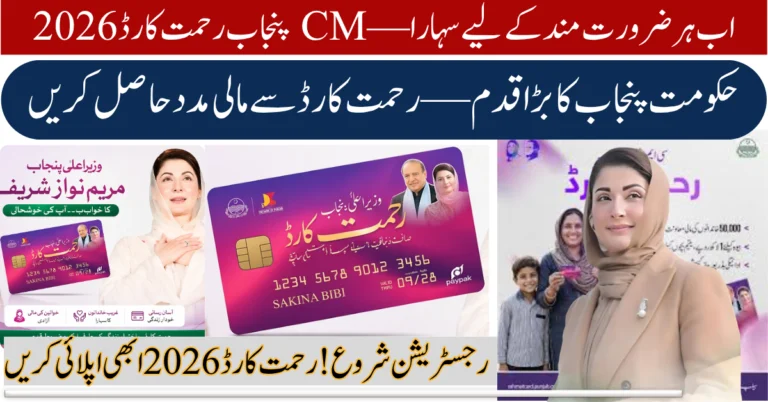
Chief Minister Maryam Nawaz Sharif digitally inaugurated the program in a launch event, with the Advisor to CM Punjab on Zakat and Ushr confirming a Rs. 5 billion allocation drawn from the provincial Zakat Fund. The stated goal was to support 50,000 widows and double-parent orphans in the program’s first phase, with selection run through the Punjab Socio-Economic Registry (PSER) rather than manual nomination by local committees — a deliberate move to reduce the political favoritism that has historically dogged Zakat distribution at the local level.
The card fits into a broader pattern in Punjab’s current welfare push, sitting alongside other targeted instruments like the Ration Card and Himmat Card for persons with disabilities. All of them increasingly route eligibility decisions through the same PSER data and a PMT scoring model, similar in spirit to how the federal BISP program uses NSER and PMT scoring at the national level. Search interest spikes under both “Rehmat Card” and the officially used “Rahmat Card” spelling, which partly explains why so many unofficial sites carry inconsistent figures — many were written quickly to capture both spelling variants without checking the source document.
Core Mechanics: Who Actually Qualifies and For How Much
The eligibility rules come directly from the Zakat & Ushr Department’s program page, and they’re narrower than most secondhand summaries suggest.
Two Separate Beneficiary Categories — Not One
A persistent source of confusion online treats this as “widows get Rs. 100,000, plus Rs. 25,000 per child.” That isn’t what the official criteria describe. The program defines two distinct, independently eligible groups:
- Zakat-deserving widows, who receive Rs. 100,000 in their own right
- Double-parent orphans — children who have lost both parents, not children of a living widow — who each separately qualify for Rs. 100,000
A widow’s own children are not automatically covered under the orphan category, since that category specifically applies to parentless children. Conflating the two groups is the single most common factual error circulating in unofficial guides.
Full Eligibility Table
| Requirement | Detail |
|---|---|
| Religion/Status | Must be Muslim and eligible to receive Zakat under Shariah |
| Beggary Status | Must not be a habitual beggar |
| Employment | Must not be a government servant or pensioner |
| Wealth Status | Must not be Sahib-e-Nisab (i.e., not above the wealth threshold that would make the applicant a Zakat payer rather than a recipient) |
| Other Assistance | Must not already be receiving regular financial assistance from another Punjab government scheme |
| Documentation | Valid CNIC reflecting widow status; B-Form required for orphan applications |
| Database Match | Must appear in, or be added to, the PSER system |
Why the PMT Score Still Decides Final Selection
Meeting the basic criteria gets an applicant into the candidate pool — it doesn’t guarantee selection. Final beneficiary lists are drawn using the Proxy Means Test applied to PSER data, the same poverty-scoring logic BISP uses nationally. Budgets are allocated to District Zakat Committees by population, meaning the number of slots available in any one district is fixed regardless of how many applications that district receives, which is why two equally poor widows in different districts can have different odds of approval in the same registration cycle.
What “Sahib-e-Nisab” Actually Means for an Applicant
This term trips up a lot of first-time applicants. Under Islamic jurisprudence, Nisab is a fixed wealth threshold — once a person’s assets exceed it, they become obligated to pay Zakat rather than eligible to receive it. Being classified as Sahib-e-Nisab simply means an applicant’s recorded assets (savings, gold, livestock, or property beyond a basic threshold) place them above that line. The exclusion exists for a structural reason, not a punitive one: Zakat funds are religiously earmarked for those below this threshold, so anyone above it falls outside the program’s legal basis for distribution, regardless of how genuinely difficult their cash-flow situation might feel month to month.
Step-by-Step: How to Register Correctly
Step 1: Confirm Your PSER Status First
Since selection draws from the Punjab Socio-Economic Registry, check whether your household already has a PSER record before applying for the Rahmat Card specifically. If you’ve never been surveyed, registering for PSER is the necessary first move — applying for the card without an underlying PSER record will likely stall at verification.
Step 2: Choose a Registration Channel
Four official channels exist, side by side:
- Web Portal — register directly at rahmatcard.punjab.gov.pk
- Mobile App — the official “CM Punjab Rahmat Card” app
- Helpline — call 1077 for phone-guided registration
- In-Person — visit your nearest Zakat & Ushr Department office
Step 3: Complete the Application Form
- Create an account using your CNIC number
- Enter personal and household details exactly as they appear on official documents
- For widow applications, ensure your CNIC reflects widow status accurately — a mismatch here is one of the most common rejection triggers
- For orphan applications, attach the child’s B-Form
- Submit and retain any reference or tracking number issued
Step 4: Track Verification Progress
Applications go through cross-verification against PSER and NADRA records before approval, which typically takes longer than a same-day confirmation. Log back into the portal periodically using your CNIC to check status rather than assuming silence means rejection.
Step 5: Watch for the Disbursement Notification
Approved beneficiaries are notified once payment is ready, with disbursement designed to route through bank accounts or digital wallets tied to the card rather than handed out in cash at a counter — part of the program’s stated effort to minimize informal handling of Zakat funds.
Benefits, Challenges, and Practical Solutions
What This Program Gets Right
- A meaningful lump sum rather than a token monthly stipend, large enough to genuinely change a widow’s immediate financial position
- PSER-driven selection instead of manual local committee picks, reducing the influence of personal connections in who gets chosen
- Multiple registration channels, so a lack of internet access or smartphone literacy doesn’t lock someone out entirely
Where Confusion and Friction Show Up
- Conflicting figures across unofficial sites — some claim Rs. 150,000 family caps or Rs. 25,000 per child, numbers that don’t appear anywhere in the official program criteria
- Deadline rumors that don’t match official statements — several third-party sites have circulated specific cutoff dates for the first phase that the Zakat & Ushr Department itself has not published as a recurring or confirmed deadline
- PSER backlog — applicants without an existing PSER record face a longer path, since a fresh survey has to happen before card eligibility can even be assessed
What Actually Resolves These Problems
- Treat zakat.punjab.gov.pk and the official rahmatcard.punjab.gov.pk portal as the only authoritative sources for figures and deadlines — not aggregator blogs, regardless of how official they look.
- If you don’t have a PSER record yet, register for one proactively rather than waiting for a door-to-door survey team to reach your area.
- Report any individual requesting payment to “process” or “fast-track” a Rahmat Card application directly to the 1077 helpline — the program operates on a strict no-middleman basis.
Future Outlook: Where the Program Goes From Here
Phase one’s 50,000-family target represents an opening allocation, not a ceiling — Punjab’s broader card-based welfare strategy (Ration Card, Himmat Card, and now Rahmat Card) suggests continued phased expansion as PSER coverage deepens across districts. Expect tighter integration between PSER and NADRA verification to shorten current processing times, following the same trajectory BISP’s NSER system has taken at the federal level. Whether a confirmed second phase opens on a fixed published timeline remains unconfirmed as of this writing, making the official portal’s live status — not third-party deadline rumors — the only reliable signal for when a new registration window opens.
Final Word
Rs. 100,000 delivered through a verified, PSER-screened digital process is a genuinely different proposition than the same amount handed out through informal Zakat committee discretion, and that structural shift is what makes this program worth taking seriously rather than dismissing as another welfare announcement. The eligibility line is narrower than most blog summaries suggest — widows and double-parent orphans specifically, not every low-income household — and getting through verification cleanly depends far more on having an accurate PSER record and correctly reflected CNIC status than on application speed. For the families this program was actually built for, that distinction is worth understanding before assuming rejection means ineligibility rather than a fixable documentation gap.