Last Updated: May 2026 | By DailyAgahi Team |
You have been waiting for your BISP payment for weeks. You visited the nearest BISP camp office, stood in line for three hours, and came home empty-handed because the staff said “system is down.” Sound familiar?
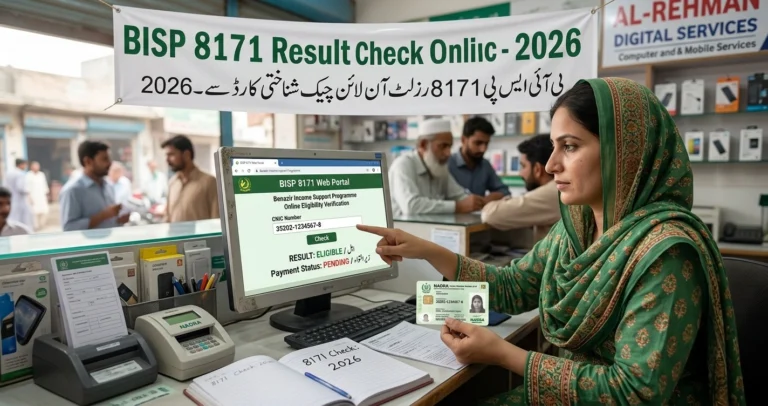
This is the reality for millions of Pakistani families who depend on the Benazir Income Support Programme for their basic survival. But here is something many people still do not know: you can check your BISP 8171 balance from home, using just your CNIC number — in less than 60 seconds. No queues. No agents. No cost.
Whether you want to verify your latest Rs 13,500 or Rs 14,500 installment, confirm your eligibility, or find out when your next payment will arrive — this complete guide from Daily Agahi covers everything. We have written it in simple, clear language so that anyone can follow along, regardless of their education level.
The government has released the May 2026 installment. Visit our BISP 8171 Registration & Payment Category to see the latest guides on checking your Rs. 13,500 balance by CNIC.
What is BISP 8171 and How Does It Work?
BISP stands for Benazir Income Support Programme — Pakistan’s largest social protection initiative that provides quarterly cash assistance to low-income families across all provinces. The program was originally launched in 2008 and has grown to serve approximately 10 million families nationwide.
The number 8171 is the official government helpline and SMS code used for everything related to BISP. You can use it to check your eligibility, verify your payment status, find out your PMT (Poverty Means Test) score, and get updates about upcoming installments.
Think of 8171 as your personal connection to the BISP system. Instead of traveling to a government office and waiting in long lines, you can get all your information through a simple text message or by visiting the official web portal.
How the BISP Payment System Works
The entire BISP system operates through a structured process. The government conducts an NSER (National Socio-Economic Registry) survey of households across Pakistan. Based on the survey data, each family receives a PMT (Poverty Means Test) score — a number that reflects their poverty level. Families with a PMT score of 32 or below are deemed eligible for the Kafalat cash transfers. Eligible families then receive quarterly payments, which they can collect through bank ATMs, BISP campsites, or authorized point-of-sale agents.
The entire process is meant to be transparent and corruption-free. The 8171 system allows you to verify every step from your phone.
“Click here to check the complete guide for BISP 8171 Online Registration 2026”
👉 https://dailyagahi.com/bisp-8171-online-registration-2026/
BISP Payment Amounts in 2026
| Program | Payment Amount | Frequency |
|---|---|---|
| Benazir Kafalat (Standard) | Rs 13,500 | Quarterly |
| Benazir Kafalat (Ramadan Special) | Rs 14,500 | Special Quarter |
| Benazir Taleemi Wazaif (Education) | Rs 2,000 – Rs 4,000 per child | Quarterly |
| Benazir Nashonuma (Nutrition) | Rs 2,000+ | Monthly (for eligible mothers) |
| Double Installment (Missed Previous) | Up to Rs 27,000 – Rs 29,000 | One-time catch-up |
In early 2026, BISP Chairperson Senator Rubina Khalid announced an increase in the Kafalat quarterly payment from Rs 13,500 to Rs 14,500 during the Ramadan period, along with Rs 500 increases for both the Taleemi Wazaif and Nashonuma programs.
How to Check BISP 8171 Balance Online by CNIC – Step by Step
This is the most important section of this article. There are three official methods to check your BISP balance, and we will explain each one in detail.
Method 1: Check Balance Through the 8171 Web Portal (Recommended)
This is the fastest and most detailed method. You will need a phone or computer with internet access.
Step 1: Open your internet browser (Chrome, Safari, or any browser) on your phone or computer.
Step 2: Type the following web address carefully: 8171.bisp.gov.pk — Make sure you see “bisp.gov.pk” in the URL. This confirms it is the official government website. Do not trust any other website that looks similar but has a different address.
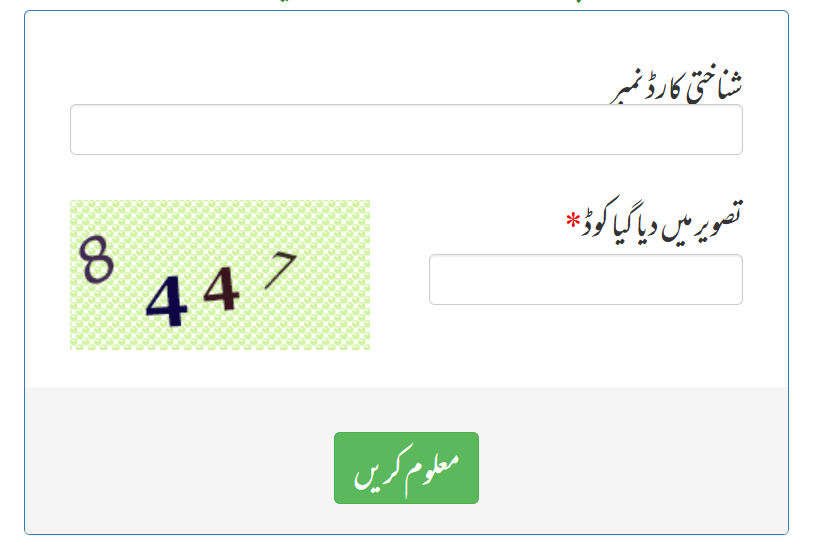
Step 3: You will see a page asking for your CNIC number. Enter your full 13-digit CNIC number without any dashes or spaces. For example, if your CNIC is 35201-1234567-1, you would type 3520112345671.
Step 4: A CAPTCHA image will appear on the screen — this is a security code made up of numbers or letters. Type the code exactly as shown in the image. This step exists to prevent fake or automated queries.
Step 5: Click the button that says “Maloom Karein” (Find Out) or “Check.”
Step 6: Within a few seconds, the screen will display your complete BISP information, including your eligibility status (eligible or not eligible), your PMT score, details of your last payment (amount and date), your next expected payment, the payment center or bank assigned to you, and whether your Taleemi Wazaif or Nashonuma payments are active.
Pro Tip: Take a screenshot of your results page. If you ever face a problem at the payment center, this screenshot serves as proof of your verified status.
Method 2: Check Balance Through SMS to 8171
If you do not have internet access, this method works perfectly. You only need a basic mobile phone — it does not need to be a smartphone.
Step 1: Open your phone’s messaging app (SMS).
Step 2: Type your 13-digit CNIC number in the message body. Do not add any spaces, dashes, or extra text — just the number. For example: 3520112345671
Step 3: Send this message to 8171.
Step 4: Within a few minutes, you will receive a reply message from 8171 containing your eligibility status, last payment details, and next payment information.
Important Notes About SMS Method: The SIM card you use must be registered in your own name (the same name as your CNIC). If you use someone else’s SIM, the system may not respond or may show incorrect information. Standard SMS charges may apply depending on your mobile network, but the BISP service itself is completely free.
Method 3: Visit a BISP Office in Person
If both online and SMS methods are not working for you, you can visit your nearest BISP Tehsil Office or District Office. Bring your original CNIC with you. The staff will check your status on their system and give you a printed or verbal update.
This method is recommended only when you are facing technical issues with the other two methods, you need to update your NSER survey information, you want to file a complaint or grievance, or you are registering for the first time.
Complete Eligibility Criteria for BISP 2026
Not everyone qualifies for BISP payments. The government uses a specific system to identify deserving families. Understanding these criteria can save you a lot of time and confusion.
Who IS Eligible
Your household must be registered in the NSER (National Socio-Economic Registry) database. Your PMT (Poverty Means Test) score must be 32 or below for Kafalat cash assistance. The primary applicant must be the female head of the household — BISP is specifically designed to empower women. You must have a valid, non-expired CNIC issued by NADRA. You must be a Pakistani citizen. Your family should not own significant assets such as luxury vehicles or large agricultural land.
Who is NOT Eligible
Understanding who cannot receive BISP payments is equally important. Many people apply without realizing they do not qualify, which wastes their time and creates frustration.
| Category | Reason for Ineligibility |
|---|---|
| Government employees (or their spouse) | Considered financially stable |
| Families with PMT score above 32 | Above the poverty threshold for Kafalat |
| Owners of luxury vehicles (car, jeep, etc.) | Indicates financial capacity |
| Large landowners | Significant asset ownership |
| Families with high utility bills (200+ units electricity) | Indicates higher income bracket |
| People with expired CNIC | Cannot be verified in the system |
| Those with frequent international travel | Travel history raises PMT score |
| Households not registered in NSER | No data in the system to evaluate |
Pro Tip: If your PMT score is between 33 and 40, you may still qualify for the Taleemi Wazaif (education stipends) program even if you do not qualify for Kafalat cash. Always check specifically for each sub-program.
Warning: Around 830,000 women were removed from the BISP program in recent years because their PMT scores crossed the eligibility limit of 32 during re-surveys. If your family’s financial situation has improved — even slightly — your score may go up, and your payments could stop. This is not a punishment; it simply means the system has detected a change in your household’s economic condition.
Required Documents for BISP Registration and Verification
Whether you are registering for the first time or updating your information, you will need the following documents:
| Document | Purpose | Where to Get It |
|---|---|---|
| Original CNIC (female head of household) | Primary identification and eligibility check | NADRA office |
| Spouse’s CNIC (if applicable) | Family verification | NADRA office |
| Children’s B-Forms | For Taleemi Wazaif registration | NADRA office |
| Recent Electricity or Gas Bill | Household income indicator | Utility company |
| Mobile Number (registered on your own CNIC) | For SMS verification and payment alerts | Telecom provider |
| Bank Account Details (if available) | For digital wallet payments | Any Pakistani bank |
Pro Tip: Before visiting a BISP office, make sure your CNIC is not expired. An expired CNIC will prevent the system from processing your information. If your CNIC is close to expiry, visit NADRA first and get it renewed. This small step can save you multiple trips.
BISP Registration Process – How to Register for the First Time
If you have never been registered in the BISP system and believe you qualify, here is how the registration process works in 2026.
Online Pre-Check
Before doing anything else, check if your household is already in the NSER database. Send your CNIC number to 8171 via SMS. If you receive a reply that says “No Record Found” or “Data Not Available,” it means your household has not been surveyed yet and you need to register.
In-Person Registration (Dynamic Survey)
The main registration for BISP happens through the NSER Dynamic Survey at BISP offices. Here is the step-by-step process:
Step 1 — Locate Your Nearest BISP Office. Find the BISP Tehsil Registration Center closest to your home. You can ask at your local government office or search online for “BISP office near [your district name].”
Step 2 — Bring Required Documents. Take your original CNIC, your children’s B-Forms, and a recent electricity or gas bill. Do not bring photocopies — they need to see the originals.
Step 3 — Visit the Registration Desk. When you arrive at the BISP office, go to the registration desk. The staff will take your documents and give you a token number.
Step 4 — Complete the Dynamic Survey Interview. A data entry operator will ask you questions about your family size, household income, living conditions, assets owned (TV, fridge, motorcycle, etc.), type of house construction (katcha, pakka, semi-pakka), water source, education levels, and employment status of family members. Answer all questions honestly. Giving false information will not help you — the system is designed to cross-check data, and inaccurate answers can lead to rejection or future removal.
Step 5 — Biometric Verification. You will provide your thumbprint to secure your application. This biometric data is linked to your CNIC.
Step 6 — Wait for Confirmation SMS. After registration, you will receive an SMS from 8171 confirming whether you are eligible or not. This message usually arrives within a few days to a few weeks, depending on processing volume.
BISP Mobile Registration Vans
For people living in remote areas who cannot easily travel to a BISP office, the government has deployed mobile registration vans in several districts. These vans bring the registration process directly to your community. Keep an eye on local announcements or ask your local government representative about the van schedule in your area.
Benefits and Financial Impact of BISP
The BISP program provides much more than just quarterly cash payments. Here is a complete overview of all the benefits available to registered and eligible families:
Benazir Kafalat (Cash Transfers): The core program that provides Rs 13,500 to Rs 14,500 every quarter directly to women beneficiaries. Over the course of a year, this adds up to Rs 54,000 to Rs 58,000 — a significant amount for families living below the poverty line.
Benazir Taleemi Wazaif (Education Stipends): If you are a Kafalat beneficiary and your children are enrolled in school, you can receive additional stipends of Rs 2,000 to Rs 4,000 per child per quarter. This amount varies based on the child’s age, gender, and education level. Girls typically receive slightly higher stipends to encourage female education.
Benazir Nashonuma (Nutrition Program): Pregnant and breastfeeding women from BISP-registered families can receive additional monthly support to ensure proper nutrition during critical periods. This program has also received a Rs 500 increase in 2026.
Digital Wallet Payments: The government has expanded digital wallet payments to over 104,000 families, allowing them to receive funds directly on their phones without visiting a bank or ATM. This initiative is expected to expand nationwide.
Annual Value for a Typical BISP Family: If a family receives the Kafalat payment plus Taleemi Wazaif for two school-going children, the total annual support could reach Rs 70,000 to Rs 90,000 or more — all completely free, with no repayment required.
Important Dates and Latest Updates – May 2026
Staying informed about the latest developments helps you avoid unnecessary confusion and ensures you collect your payments on time.
| Update | Details |
|---|---|
| Kafalat Standard Payment | Rs 13,500 quarterly (ongoing) |
| Ramadan 2026 Special Payment | Rs 14,500 (increased by Rs 1,000) |
| Taleemi Wazaif Increase | Additional Rs 500 per child |
| Nashonuma Increase | Additional Rs 500 for pregnant/nursing women |
| Digital Wallet Expansion | 104,000 families in Phase 1; nationwide expansion planned |
| Target Beneficiaries | 10 million (1 crore) cardholders |
| Payment Collection Methods | HBL/Bank Alfalah ATMs, BISP Campsites, POS Agents, Digital Wallets |
| Helpline Number | 0800-26477 (toll-free) |
| SMS Code | 8171 |
| Official Portal | 8171.bisp.gov.pk |
Latest May 2026 Update: Payments for the current quarter are being released in phases across all provinces. If your status shows “eligible” but you have not received a confirmation SMS yet, it may simply mean your district’s disbursement phase has not started. Check again in a few days.
Common Mistakes and How to Avoid Them
Every day, thousands of BISP beneficiaries face problems that could easily be avoided. Here are the most common mistakes — and practical solutions for each one.
Mistake 1: Checking balance on fake websites. Dozens of websites look like the official BISP portal but are actually scams designed to steal your CNIC information. The only official portal is 8171.bisp.gov.pk — always check the URL carefully before entering your CNIC. If the address does not end in “.bisp.gov.pk,” do not use it.
Mistake 2: Using an expired CNIC. If your CNIC has expired, the system cannot verify your identity. Your payments will be paused until you renew it at NADRA. Do not wait until your CNIC expires — renew it at least one month before the expiry date.
Mistake 3: Using someone else’s SIM card for SMS. When you send your CNIC to 8171, the SIM must be registered in your own name. If you use a family member’s SIM, you may get incorrect results or no reply at all.
Mistake 4: Paying agents or middlemen for “help.” BISP registration and balance checking are completely free. No agent, broker, or facilitator has the right to charge you money. If someone asks for a fee — whether Rs 500 or Rs 5,000 — they are committing fraud. Report them to the BISP helpline at 0800-26477 immediately.
Mistake 5: Not updating NSER information. If your family circumstances have changed (birth of a child, death of a family member, change in income), you should update your NSER survey data at the nearest BISP office. Outdated data can result in incorrect PMT scores and potential loss of benefits.
Mistake 6: Giving your thumbprint to unauthorized people. Your biometric data (fingerprint) is your security. Never give your thumbprint to anyone except official BISP staff at authorized payment centers. Scammers sometimes collect fingerprints to withdraw funds from your account.
Mistake 7: Ignoring “Pending Verification” status. If your online check shows “Pending Verification,” it does not mean you have been rejected. It means your application is being reviewed. Be patient, check again in a few days, and make sure your phone is active in case the verification team needs to contact you.
Mistake 8: Not collecting payments on time. Payments are available for a limited window. If you do not collect your installment within the designated period, it may be returned to the system. When you receive a confirmation SMS, collect your payment as soon as possible.
Understanding Your PMT Score — Why It Matters
Your PMT (Poverty Means Test) score is the single most important number in the entire BISP system. It determines whether you get payments or not. Here is what you need to know:
What Factors Affect Your PMT Score?
The PMT score is calculated based on more than 20 data points collected during the NSER survey. The main factors include your household income, type of house construction, ownership of assets like TV, fridge, motorcycle, or car, utility bill amounts, education levels of family members, number of dependents, employment status, and land ownership.
PMT Score Ranges and What They Mean
| PMT Score Range | Eligibility Status |
|---|---|
| 0 – 20 | Ultra-poor — highest priority for all BISP programs |
| 21 – 32 | Eligible for Benazir Kafalat (quarterly cash) and other programs |
| 33 – 40 | May qualify for Taleemi Wazaif (education stipends) only |
| Above 40 | Generally not eligible for BISP cash assistance |
Why Scores Increase Unexpectedly
Many families are confused when their score suddenly goes up. Common reasons include purchasing a new motorcycle or vehicle, renovating your house from katcha to pakka, a family member getting a government job, higher electricity consumption, and incorrect data recorded during the survey. If your score seems wrong, visit the nearest BISP Tehsil Office to request a dynamic survey update.
Frequently Asked Questions (FAQs)
Safety Tips — Protect Yourself from BISP Scams
Fraud targeting BISP beneficiaries is a serious and growing problem. Here are essential safety guidelines every beneficiary must follow:
Only use the official 8171 portal at 8171.bisp.gov.pk — do not enter your CNIC on any other website. Official BISP messages come only from the number 8171 — ignore messages from personal phone numbers claiming to be BISP agents. Never share your CNIC details, ATM PIN, or fingerprint with unauthorized individuals. BISP registration and services are always free — report anyone demanding payment. Do not download unofficial apps that claim to check your BISP balance — they may steal your personal data. If you receive a call asking for your bank details or PIN in the name of BISP, hang up immediately. It is a scam.
If you suspect fraud, call the BISP toll-free helpline: 0800-26477.
Conclusion and Call to Action
The BISP 8171 system has made it possible for millions of families to check their payment status, verify their eligibility, and track their financial support — all from home, without spending a single rupee or standing in a queue for hours.
Whether you are a current beneficiary checking your latest Rs 13,500 or Rs 14,500 installment, or someone who believes they may qualify and wants to check their eligibility, the process is straightforward: visit 8171.bisp.gov.pk or send your CNIC to 8171 via SMS.
Here is what you should do right now: First, check your BISP balance today through the official 8171 portal or SMS. Second, if you are not registered, gather your documents and visit the nearest BISP Tehsil Office for a dynamic survey. Third, make sure your CNIC is valid and not expired — renew it at NADRA if needed. Fourth, share this guide with family members and neighbors who may benefit from this information. And fifth, never pay anyone for BISP services — they are always free.
Your financial support is your right. The system exists to help you. Use it wisely, stay informed, and always rely on official sources.