On February 4, 2026, Chief Minister Maryam Nawaz Sharif stood in Rajanpur — one of Punjab’s most historically under-served districts — and announced a programme that had not been attempted in the province at this scale since the 1970s. The land underneath hundreds of thousands of rural families’ feet, worked for generations by tenant farmers who never owned a single acre, was finally going to change hands. Not through compulsory acquisition or legal challenge, but through a transparent, digitally administered allocation system backed by the full machinery of the Punjab government.
The programme is called Apna Khet Apna Rozgar — “Your Own Field, Your Own Livelihood” — and for the farming communities of rural Punjab, it represents one of the most substantive opportunities for economic transformation in living memory. Over 125,000 acres of state-owned agricultural land are earmarked for distribution to 50,000 landless families across all 36 districts of the province.
But opportunity, unaccompanied by accurate information, often becomes frustration. Across Punjab, applicants are encountering conflicting guidance about who qualifies, what documents to submit, and how the selection process actually works. This article addresses those questions using verified, official sources.
What Is the Apna Khet Apna Rozgar Scheme?
The Apna Khet Apna Rozgar Eligibility Criteria 2026 (AKAR) Scheme is a provincial agricultural land distribution programme launched by the Government of Punjab in 2026. Its central promise is straightforward: eligible landless citizens can receive state-owned agricultural land on a ten-year conditional lease at a nominal rate of Rs 100 per acre per year.
According to official announcements, the scheme is not limited to land alone. It is structured as a comprehensive agricultural support package that includes:
- Agricultural land allocation: Between 3 and 10 acres per selected household, depending on land availability in the relevant district and the applicant’s household profile
- Kisan Card facility: Access to the CM Punjab Kisan Card for subsidised inputs such as seeds, fertiliser, and pesticides
- Green Tractor Scheme linkage: Eligible allottees can access subsidised tractor financing and shared agricultural machinery
- Interest-free loans: Financial assistance for initial cultivation costs, seeds, and farm inputs
- Agricultural training: Free enrolment in modern farming technique workshops at tehsil-level Centres of Excellence
The scheme is administered through the Punjab Enterprise Land Record Authority (PELRA), which uses the province’s digitised land records infrastructure to ensure transparency. The official application portal is akar.pulse.gop.pk, operated through the Punjab government’s digital services platform. The Punjab Agriculture Department’s portal at agripunjab.gov.pk serves as a cross-reference point where applicants can view available state agricultural land in their revenue estate.
According to official announcements, the scheme targets all 36 districts of Punjab, with a specific focus on Kacha areas and underdeveloped rural regions such as Rajanpur, Dera Ghazi Khan, and Muzaffargarh, where landlessness is most acute.
Eligibility Criteria
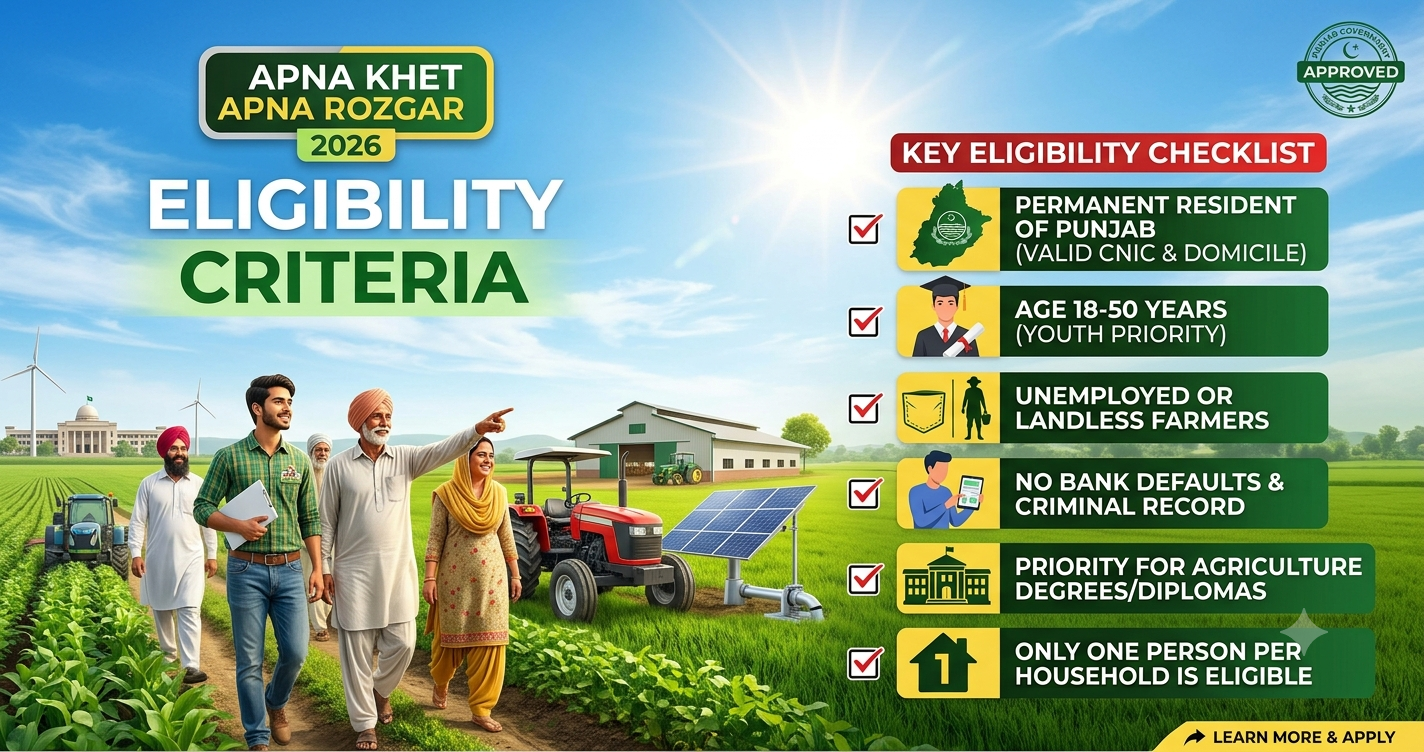
The eligibility conditions for AKAR 2026 are deliberately narrow. They are designed to direct resources to the most genuinely deserving applicants while preventing urban speculation or misuse of agricultural land. Understanding these conditions before applying is essential — the system cross-checks submissions against NADRA records and provincial land databases automatically.
Who Qualifies
Based on official scheme guidelines and announcements from the Punjab Agriculture Department:
Residency and Citizenship
- Must be a Pakistani citizen holding a valid, active CNIC
- Must hold a Punjab domicile and be a permanent resident of Punjab
- Crucially, the applicant must be a permanent resident of the same revenue estate (mauza) where the state land being offered is located — this is a strict localisation condition designed to prevent urban applicants from claiming rural land
Land Ownership Status
- Must be landless — owning no agricultural land — or own a maximum of 10 marlas of residential property only
- Individuals who own agricultural land of any significant area are not the target group; the scheme specifically targets those with no productive land assets
Age
- According to official announcements, the general age range is 18 to 55 years, though some official communications reference a range of 18 to 50 years. Applicants are advised to verify the current upper limit on the official portal, as this may be subject to revision between phases
Financial History
- Must not be a defaulter on any government loan, agricultural finance scheme, or bank borrowing — financial credibility is a screening factor under the AKAR framework
- Must not have previously benefited from any government land allotment or lease scheme
Employment and Family Status
- Priority is given to unemployed rural youth and low-income landless farming families
- Only one member per family may apply for a single allotment — this is strictly enforced using NADRA records
- Both men and women are eligible, including widows and divorced women
Who Is Automatically Disqualified
The following categories of applicants will not be considered, according to official scheme conditions:
- Government employees and their direct dependents — this includes employees of federal and provincial government departments, autonomous bodies, and government corporations
- Previous beneficiaries of any government land allotment programme, whether at federal or provincial level
- Individuals with expired, blocked, or mismatched CNIC records
- Bank loan defaulters who have not cleared their outstanding dues
- Individuals found to have submitted multiple applications under different identities or CNIC numbers — this results in permanent disqualification from the scheme and potentially future programmes
- Applicants who own sufficient agricultural land already capable of generating a stable household income
Required Documents
Gather and prepare all documents before beginning the online registration process. Incomplete or unreadable submissions are among the most common causes of rejection.
- Valid CNIC — front and back, clearly photographed or scanned. The 13-digit number must be active and match the applicant’s domicile records exactly
- Punjab domicile certificate — confirming permanent residency in the relevant district and revenue estate
- Proof of landlessness — a declaration or affidavit confirming that the applicant owns no agricultural land, or land revenue records showing maximum residential ownership of 10 marlas
- Proof of unemployment — an affidavit or supporting documentation; required where the applicant is claiming priority on grounds of unemployment
- Recent utility bill or rental agreement — as evidence of current residential address within the revenue estate
- Active Pakistani mobile number — registered in the applicant’s name; all government communications, OTPs, and status updates are sent to this number
Where applicable, widows should attach their husband’s death certificate, and divorced women may be asked to provide relevant family court documentation to support their application for priority consideration.
Step-by-Step: How to Apply Online
The application window for Phase 1 of the AKAR Scheme opened on May 2, 2026, with a deadline of May 18, 2026, through the official portal at akar.pulse.gop.pk. According to official announcements, an appeals window for rejected applicants is scheduled for June 1 to June 8, 2026, at the relevant Deputy Commissioner’s office. The final beneficiary list is expected to be announced on June 19, 2026, with land distribution beginning June 30, 2026.
Note: These dates applied to Phase 1. Applicants who missed this window should monitor official channels for Phase 2 announcements.
Step 1: Access the Official Portal
Open a browser and navigate to akar.pulse.gop.pk. Confirm that the URL contains the .gop.pk or .gov.pk domain before entering any personal information. Fraudulent mirror sites have circulated on social media — always verify the domain independently.
Step 2: Create a New Account
Click on New Registration. Enter your 13-digit CNIC number, your full name as it appears on your CNIC, and your active Pakistani mobile number. Set a secure password.
Step 3: OTP Verification
The portal will send a one-time password (OTP) to your registered mobile number via SMS. Enter the OTP when prompted. If it does not arrive within two to three minutes, request a resend. Do not attempt to enter a guess — failed OTP attempts can temporarily lock your registration session.
Step 4: Complete the Application Profile
Once logged in, fill in all personal details carefully: full name, father’s name, date of birth, CNIC number, current address, district, and tehsil. All information must match your CNIC and official records precisely — even minor discrepancies trigger rejection during the NADRA verification stage.
Enter your land details, confirming your landless or minimal-land status. Provide information about your farming background or agricultural interest.
Step 5: Select Your Preferred District and Revenue Estate
Choose the district and revenue estate (mauza) where you wish to receive land. You must be a permanent resident of this location. The portal cross-references available state agricultural land on a district-by-district basis — you can also verify available plots through the Agriculture Department portal at agripunjab.gov.pk.
Step 6: Upload Supporting Documents
Upload clear, high-resolution scans or photographs of all required documents. Each image must show all four corners of the document with no shadows or blurring. Poor-quality uploads are rejected at the document verification stage without the opportunity to resubmit in the same phase.
Step 7: Review and Final Submission
Before clicking Submit, go through every section of the form once more. Pay particular attention to your CNIC number, your mobile number, and your residential address — these three fields are the most frequent sources of error. Once submitted, applications cannot ordinarily be edited.
Step 8: Save Your Reference Number
After submission, the system will generate an application reference number and display it on the confirmation screen. Save this number immediately — it is required to track your application status. You may also receive it via SMS on your registered mobile.
Offline Alternative
Applicants without internet access can visit their nearest District Agriculture Office or the office of the Assistant Commissioner for in-person assistance. Staff at these offices are authorised to assist with registration and document submission.
Helpline: 042-111-111-111
After Submission: The Selection Process
Shortlisted applications go through a transparent, computerised balloting process administered through the PELRA digital infrastructure. This system is designed to remove the manual verification weaknesses that characterised previous land reform efforts in Pakistan, where local officials or influential landlords could interfere with records.
Following the balloting, selected applicants undergo physical verification, in which government teams visit the identified addresses to confirm residency, landless status, and the suitability of the household for agricultural land use. Successful candidates are then assigned to certified vendors and extension officers who guide the installation of farming support and the actual land handover.
Common Mistakes to Avoid
A significant number of applications in Phase 1 were affected by avoidable errors. Based on reported patterns from scheme administrators and official guidance:
- Applying from the wrong revenue estate: Your CNIC and domicile address must match the revenue estate where you are applying for land. Urban applicants attempting to claim rural land allotments are automatically rejected.
- Mismatched CNIC details: The name, father’s name, and address on the application form must exactly match what is printed on your CNIC. Auto-filling from memory is risky — copy directly from the physical document.
- Submitting unreadable documents: Dark, blurry, or partially cropped document uploads are one of the most common rejection causes. Photograph documents in good natural light on a flat, contrasting surface.
- Using an unregistered mobile number: All government communications are sent to the registered mobile number. Using a family member’s number, or a number not registered in your name, delays verification and may prevent you from receiving critical status updates.
- Applying through unofficial portals or agents: Several third-party websites and middlemen have offered to “assist” with AKAR applications, in some cases charging fees. The entire application process is free of charge. Only akar.pulse.gop.pk is the official platform — no private individual or unofficial website is authorised to collect applications or fees.
- Failing to declare existing land: Applicants who own agricultural land and attempt to conceal it are disqualified upon NADRA and land record cross-verification. In serious cases, this may result in permanent disqualification from future government welfare programmes.
- Applying as multiple family members: Only one person per household may apply. Households that submit applications under multiple family members’ names are flagged and rejected during NADRA record matching.
Frequently Asked Questions
Final Note
The Apna Khet Apna Rozgar Scheme represents the most ambitious attempt in decades to convert state-owned land into productive, family-owned farms across Punjab. For eligible households — particularly in historically marginalised districts — it offers not just land but an entire infrastructure of support: financing, machinery access, training, and market linkage.
The scheme is free to apply for. No government official, intermediary, or agent is authorised to collect fees at any stage. If anyone approaches you claiming to secure approval in exchange for payment, that is fraud.






One Comment