Last Updated: May 2026 | By DailyAgahi.com
Every three months, millions of Pakistani families wait for one SMS — a message from 8171 confirming that their next BISP payment is ready. For a mother in rural Sindh, that Rs. 14,500 means her children eat three meals a day this month. For a widow in southern Punjab, it means she can finally buy medicine she has been putting off for weeks. And for a disabled man in Balochistan, it means he does not have to borrow money from his neighbor again.
The Benazir Income Support Programme (BISP) is not just another government scheme. Since 2008, it has grown into Pakistan’s largest social safety net, currently supporting over 9.3 million families across all four provinces, Azad Kashmir, and Islamabad. But despite being so widespread, the registration and eligibility process still confuses thousands of people every single day.
All Government Schemes 2026 – Stay informed about the latest CM Punjab and Federal Government initiatives. Visit our category page for a complete list of active programs, including E-Bike, Solar, and Loan schemes.
Questions like “How do I register for BISP?”, “Why is my CNIC showing ineligible?”, “Is the 8171 portal real or fake?”, and “How much money will I get in 2026?” flood social media and helpline calls constantly.
This guide answers every one of those questions — clearly, accurately, and based on verified official sources including bisp.gov.pk, the Ministry of Poverty Alleviation (pass.gov.pk), and confirmed news reports. Whether you are a first-time applicant or someone checking their payment status, read this article from start to finish. It could save you weeks of running around offices unnecessarily.
What Is BISP and What Does 8171 Mean?
The Benazir Income Support Programme (BISP) is a federal government program launched in July 2008. It was created to protect the poorest families in Pakistan from the effects of rising inflation, food crises, and economic instability. The program is named after former Prime Minister Benazir Bhutto. As of the 2025-26 budget, the government has allocated Rs. 716 billion to BISP — roughly a 20% increase over the previous year.
The current Chairperson of BISP is Senator Rubina Khalid, and the program operates under the Ministry of Poverty Alleviation and Social Safety (PASS), led by Minister Syed Imran Ahmad Shah. ( pass.gov.pk)
What Does 8171 Mean?
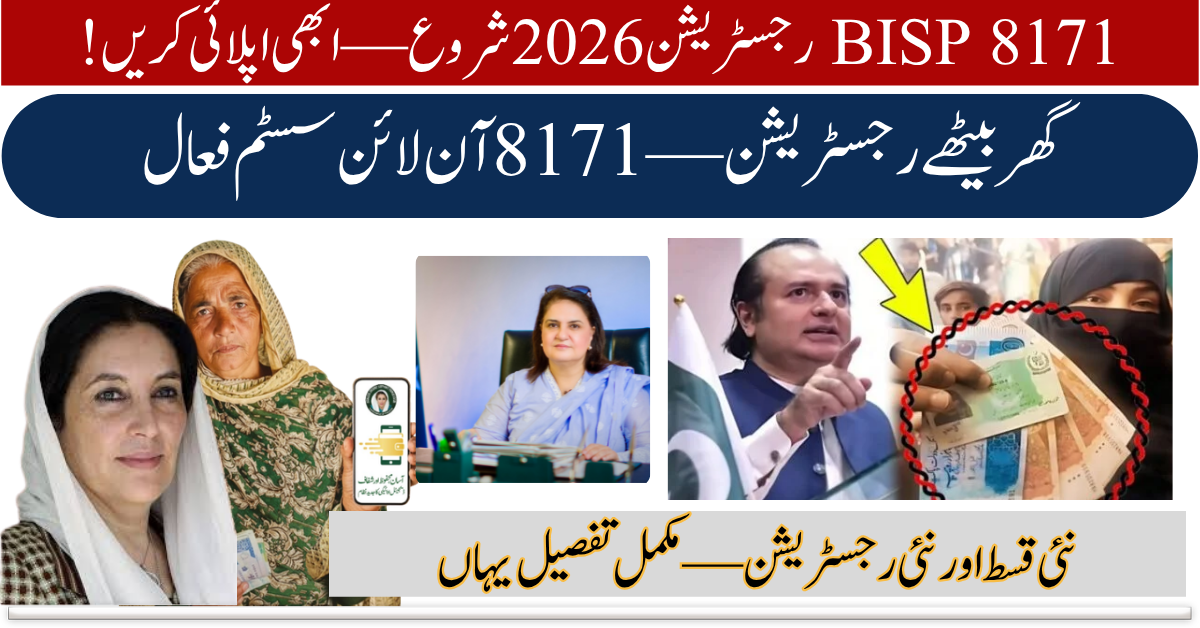
8171 is the official SMS shortcode used by BISP. You can send your CNIC number to 8171 from any mobile phone to check whether you are eligible for financial assistance. The number 8171 is also associated with the official web portal — 8171.bisp.gov.pk — where you can check eligibility, registration status, and payment details online.
Think of 8171 as the single gateway to the entire BISP system. Whether you want to check eligibility, verify your payment status, or confirm your registration — 8171 is where you start.
If you are interested in more financial aid programs, you can explore the full list of active schemes on our homepage at dailyagahi.com. We cover everything from student laptops to kisan loans.
BISP Programs at a Glance (2026)
| Program Name | What It Does | Who Gets It | Amount (2026) |
|---|---|---|---|
| Benazir Kafaalat | Quarterly cash transfer | Registered low-income women | Rs. 14,500/quarter |
| Benazir Taleemi Wazaif | Educational stipends for children | BISP families with school-going children (4-22 years) | Varies by level and gender |
| Benazir Nashonuma | Nutrition support for mothers and children | Pregnant/breastfeeding women + children under 2 | Cash + nutritional supplements |
| Benazir Hunarmand | Vocational skills training | Youth from BISP families | Free training + stipend |
| Emergency Cash | Disaster relief payments | Families affected by floods/earthquakes | Varies by crisis |
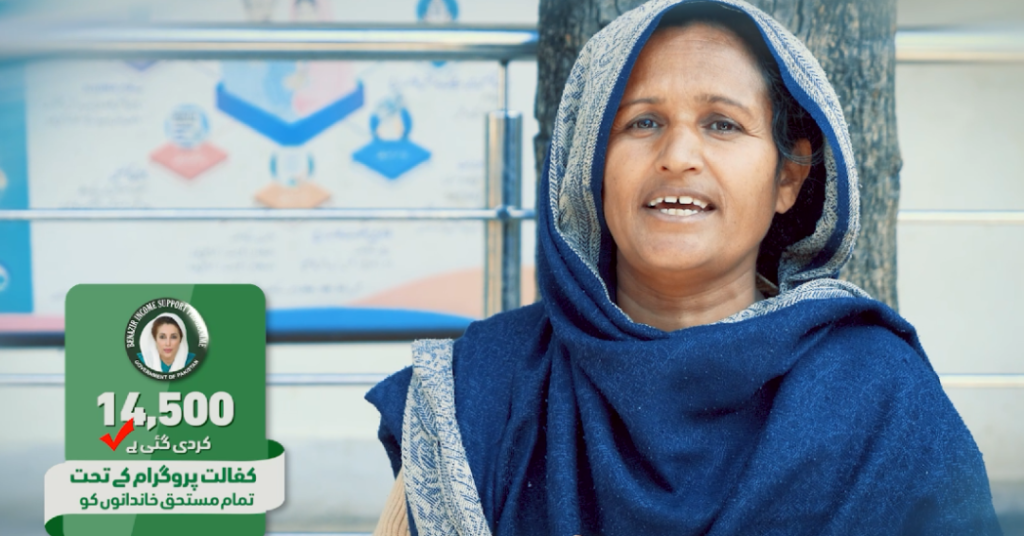
Key Update for 2026: In February 2026, BISP Chairperson Senator Rubina Khalid confirmed that the quarterly Kafaalat payment has been increased from Rs. 13,500 to Rs. 14,500, effective from Ramadan 2026. The Taleemi Wazaif and Nashonuma stipends were also increased by Rs. 500 each.
Complete Eligibility Criteria for BISP 8171 Registration 2026
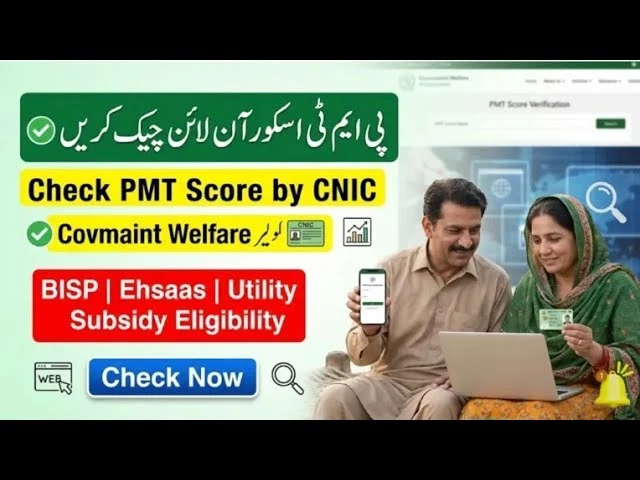
Not everyone qualifies for BISP. The government uses a system called the National Socio-Economic Registry (NSER) to assess which families truly need assistance. Your eligibility is determined through a poverty assessment called the Proxy Means Test (PMT), which calculates a score based on your household’s income, assets, living conditions, and employment status.
Who IS Eligible?
You may qualify for BISP if you meet ALL of the following conditions:
- Low-Income Household: Your family’s income must be below the poverty threshold set by NSER. Generally, families earning less than Rs. 25,000 per month are considered.
- NSER Registration: Your household must be registered in the National Socio-Economic Registry database through the dynamic survey process.
- PMT Score Below Threshold: Families with a poverty score below 32-34 (on the PMT scale) are prioritized for the Kafaalat program.
- Female Head of Household: The primary beneficiary must be a woman with a valid CNIC. BISP deliberately empowers women by making payments directly to the female member of the household.
- Valid CNIC: The applicant must possess a valid, non-expired Computerized National Identity Card (CNIC) issued by NADRA.
- No Government Employment: Neither the applicant nor their spouse should be employed in any government job, military service, or government-affiliated organization.
- Priority Categories: Widows, divorced women, disabled persons, elderly citizens, and families in extremely poor conditions receive higher priority.
Who Is NOT Eligible?
Understanding who cannot apply is just as important. Many people waste time and travel costs without checking these disqualification rules first:
| Category | Reason for Disqualification |
|---|---|
| Government employees or pensioners | Already receiving government salary/benefits |
| High-income taxpayers | Income is above the poverty threshold |
| Families owning more than 3 acres of farmland | Considered asset-rich under NSER criteria |
| Families owning more than 80 sq yards of residential land | Asset threshold exceeded |
| Owners of registered vehicles (cars) | Indicates non-poverty status |
| Family members living abroad | Remittance income expected |
| Applicants with expired or invalid CNIC | Cannot be verified in NADRA system |
| Families with multiple properties | Does not meet poverty criteria |
| Men applying directly (without female household head) | BISP payments go to women only |
Pro Tip: If you have been declared ineligible in the past, the government has reopened registration through the NSER Dynamic Survey in 2026. You can update your household information and reapply. Visit your nearest BISP Tehsil Office for this process.
Required Documents for BISP 8171 Registration
Before visiting a BISP office or attempting online registration, make sure you have the following documents ready. Missing even one can delay your application by weeks.
- Applicant’s Original CNIC — This is the most critical document. It must be valid (not expired) and belong to the female head of the household.
- CNIC Photocopy — Keep 2-3 extra copies. Staff at registration centers often ask for copies.
- Children’s B-Forms — NADRA-issued birth registration certificates for all children. This is essential if you want to enroll in the Benazir Taleemi Wazaif program. Note: Handwritten birth certificates are no longer accepted — only NADRA B-Forms.
- Recent Utility Bill — An electricity or gas bill showing your current address. This helps verify your residence during the survey.
- Husband’s Death Certificate — Required only if you are a widow applying for priority consideration.
- Disability Certificate — If any family member has a disability, bring the official disability certificate issued by the relevant government authority.
- Mobile Phone Number — Must be registered on the applicant’s own CNIC. BISP sends all status updates and payment notifications through SMS from 8171.
Document Checklist
| Document | Required For | Notes |
|---|---|---|
| Woman’s CNIC (original + copy) | All applicants | Must be valid and not expired |
| Children’s NADRA B-Forms | Taleemi Wazaif enrollment | Handwritten certificates NOT accepted |
| Electricity/Gas bill | Address verification | Recent bill preferred |
| Husband’s Death Certificate | Widows only | Needed for priority status |
| Disability Certificate | Disabled family members | Official government-issued |
| Mobile number on own CNIC | All applicants | Required for 8171 SMS service |
Warning: BISP registration is 100% free. No fees, no charges, no “processing costs.” If any agent, shopkeeper, or person at a center asks you for money, they are committing fraud. Report them immediately to the BISP helpline at 0800-26477.
Step-by-Step Application and Registration Process
Here is the part most people struggle with. Let me break down every method of registration and eligibility checking so there is no confusion.
Important Clarification First
Many websites claim you can “fully register” for BISP online. Let me be honest with you: the 8171 web portal and SMS service are primarily for checking eligibility and payment status. Full registration for new applicants requires completing the NSER Dynamic Survey, which must be done in person at a BISP Tehsil Office. The online portal and SMS are supplementary tools, not replacements for the physical survey.
Now, here are all three methods explained clearly:
Method 1: NSER Dynamic Survey at BISP Tehsil Office (Full Registration)
This is the official and complete registration method for new applicants or those updating their information.
Step 1: Locate Your Nearest BISP Tehsil Office Every tehsil in Pakistan has a BISP registration center. Ask at your local government offices or call the BISP helpline (0800-26477) to find the nearest one.
Step 2: Bring All Required Documents Carry your original CNIC, children’s B-Forms, utility bill, and any other relevant documents listed above.
Step 3: Complete the NSER Dynamic Survey A data entry operator at the center will interview you about your family’s income, living conditions, assets, employment, and household details. Answer every question honestly — false information leads to disqualification and possible blacklisting.
Step 4: Biometric Verification You will provide your thumbprint (fingerprint) for identity verification. This is linked to the NADRA database to prevent fraud.
Step 5: Receive Confirmation After your survey is submitted, you will receive a confirmation acknowledgment. The system then processes your PMT score. This typically takes a few weeks.
Step 6: Wait for 8171 SMS Once your data is verified, BISP will send you an SMS from 8171 confirming whether you are eligible or ineligible. Do not visit the office repeatedly — wait for the SMS first.
Method 2: Check Eligibility via SMS (8171)
This is the simplest way to check if you or your family is already registered and eligible.
Step 1: Open the messaging app on your phone.
Step 2: Type your 13-digit CNIC number without any dashes or spaces (for example: 3520112345678).
Step 3: Send this message to 8171.
Step 4: Within a few minutes, you will receive a reply SMS telling you whether you are eligible, ineligible, or if your survey needs to be updated.
Important Notes about SMS method: Your SIM card must be active and have a minimum balance (around Rs. 2-15 depending on the network, though the service itself is free on most networks). If you do not receive a reply within a few hours, try again later — network delays happen during peak times.
Method 3: Check Eligibility via 8171 Web Portal (Online)
The official online portal lets you check your eligibility and payment status from any device with internet access.
Step 1: Open your browser and go to 8171.bisp.gov.pk.
Step 2: Enter your 13-digit CNIC number in the field provided.
Step 3: Enter the verification code (captcha) shown on screen.
Step 4: Click “Check” or “Submit.”
Step 5: The portal will display your eligibility status, survey details, and payment information if applicable.
Fraud Warning: Only use the official portal at 8171.bisp.gov.pk. Many fake websites with similar-looking URLs exist to steal your CNIC information. Never enter your CNIC on any website that does not have “bisp.gov.pk” in its address. If a website asks for your bank details, ATM PIN, or money — it is 100% a scam.
How to Check Your Payment Status
If you are already registered and eligible, checking your payment status is straightforward:
SMS: Send your CNIC to 8171. The reply will include your payment amount, date, and collection method.
Web Portal: Visit 8171.bisp.gov.pk, enter your CNIC, and view payment history and upcoming payment details.
BISP Helpline: Call 0800-26477 (toll-free) for assistance with payment queries, complaints, or status checks. (Source: bisp.gov.pk)
Benefits and Financial Support Under BISP 2026
The BISP program offers much more than a single cash payment. Here is a complete breakdown of every financial benefit available to registered families in 2026:
Benazir Kafaalat (Main Cash Transfer)
This is the core program. Every eligible woman receives a quarterly cash payment deposited directly into her account or digital wallet.
2026 Payment Amount: Rs. 14,500 per quarter (increased from Rs. 13,500).
Annual Total: Rs. 58,000 per year (4 quarters × Rs. 14,500)
Payment Method: Payments are made through partner banks (HBL, Bank Alfalah, Bank of Punjab), JazzCash, Easypaisa, and authorized Point of Sale (POS) agents. The government has introduced biometric verification at withdrawal points to prevent theft and deductions.
Benazir Taleemi Wazaif (Educational Stipends)
If you are already a Kafaalat beneficiary, your school-going children (ages 4-22) can receive additional educational stipends. The condition: your child must maintain at least 70% school attendance each quarter. If attendance drops, the payment stops automatically.
Stipend amounts vary by education level and gender — girls typically receive slightly higher amounts to encourage female education.
Benazir Nashonuma (Nutrition Program)
Pregnant and breastfeeding women from BISP families, along with their children under age 2, receive both cash support and nutritional supplements. This program has been shown to reduce child stunting by 6.4% according to a study by Aga Khan University. (Source: bisp.gov.pk)
Complete Benefits Comparison Table (2026)
| Benefit | Amount (2026) | Frequency | Condition |
|---|---|---|---|
| Benazir Kafaalat | Rs. 14,500 | Quarterly | Must be registered, eligible, female CNIC holder |
| Taleemi Wazaif (Primary) | Varies (Rs. 2,000-3,000/quarter) | Quarterly | Child must have 70%+ school attendance |
| Taleemi Wazaif (Secondary) | Varies (Rs. 3,000-5,000/quarter) | Quarterly | Child must have 70%+ school attendance |
| Nashonuma | Cash + supplements | Ongoing | Pregnant/breastfeeding women, children under 2 |
| Ramadan Bonus (2026) | Rs. 1,000 extra | One-time | Added to Kafaalat during Ramadan |
| PM Ramzan Package | Up to Rs. 13,000 | One-time | Separate package for 12 million families |
How to Collect Your Payment Safely
Once your payment is confirmed via 8171 SMS, you can collect it through:
Bank ATMs: Use HBL or Bank Alfalah ATMs with the biometric (fingerprint) option.
BISP Campsites: Temporary payment centers set up in various tehsils during payment windows.
POS Agents: Authorized retailers in local markets who process biometric payments.
Digital Wallets: Payments transferred directly to JazzCash or Easypaisa accounts linked to your CNIC.
Safety Rule: The full amount of Rs. 14,500 must be given to you without any deduction. If any agent, shopkeeper, or bank staff asks for a “fee” or “commission,” report them immediately to the BISP helpline at 0800-26477. The government has a zero-tolerance policy for payment deductions.
Important Dates, Deadlines, and Latest Updates (May 2026)
January 16, 2026: First quarter payment disbursement of Rs. 13,500 began under the cluster-based district system.
February 2026: BISP Chairperson Senator Rubina Khalid announced the Kafaalat payment increase from Rs. 13,500 to Rs. 14,500 effective Ramadan 2026. Taleemi Wazaif and Nashonuma stipends also increased by Rs. 500 each.
March 2026: Ramadan payments of Rs. 14,500 began rolling out across Pakistan. PM Ramzan Relief Package of Rs. 13,000 also launched separately for 12 million families.
April 2026: Benazir Taleemi Wazaif April 2026 installments released. NSER Dynamic Survey re-registration continues at Tehsil offices for previously ineligible families.
May 2026 (Current): Second quarter payment cycle is underway. Registration through NSER Dynamic Survey remains open at BISP Tehsil offices. The government is also rolling out the new Benazir Social Protection Accounts (bank account-based payment system) announced in January 2026.
Budget 2025-26: The government allocated Rs. 716 billion for BISP — approximately 20% more than the previous year — reflecting expanded coverage and increased payment amounts.
Real Stories: How BISP Changes Lives
Note: The following stories are based on realistic scenarios reflecting the actual circumstances of millions of BISP beneficiaries across Pakistan. Names and locations have been changed. These are not official government case studies, but they represent the real impact of this program.
Zainab from Tharparkar — When Rs. 14,500 Means Survival
Zainab is a 35-year-old mother of five living in a remote village in Tharparkar, Sindh. Her husband works as a seasonal farm laborer, earning roughly Rs. 8,000-10,000 in good months and nothing during dry spells. The family often went days eating only one meal.
When the NSER survey team visited her village in 2024, Zainab’s household was registered and her PMT score qualified her for Kafaalat. Since then, every three months, she receives Rs. 14,500 directly on her phone through JazzCash.
With this money, she buys flour, cooking oil, and lentils in bulk — enough for almost two months. She also enrolled her eldest daughter in school under the Taleemi Wazaif program, which brings an additional Rs. 3,000 per quarter as long as her daughter maintains 70% attendance.
For Zainab, that single SMS from 8171 is not just a message. It is the difference between her children eating and going hungry.
Rashid’s Mother in Quetta — A Widow Who Almost Gave Up
Rashid’s father died in a mining accident three years ago. His mother, Fatima, was left with four children and no income. She applied for BISP but was initially rejected because her CNIC address was outdated — it still showed her parents’ village, not her current address in Quetta.
She spent months confused, thinking she was permanently disqualified. Then a neighbor told her about the NSER Dynamic Survey and encouraged her to visit the BISP Tehsil Office. She updated her CNIC at NADRA, then completed a new survey with her correct address and current household details.
Six weeks later, she received the SMS from 8171: eligible. Her first payment of Rs. 14,500 arrived the following month. She used most of it for her children’s school fees and winter clothes.
Lesson: If you were rejected before, do not give up. The Dynamic Survey exists specifically to give people a second chance. Update your records and try again.
A Warning Story — The Man Who Paid Rs. 2,000 to a Fake Agent
In a market in Multan, a man approached several women waiting outside a bank, claiming he could “activate” their BISP payments for Rs. 2,000. Three women paid him. He took their CNIC numbers, typed something on his phone, and said “your payment will come in 3 days.” It never did. He was a scammer.
The lesson is simple: BISP registration is 100% free. Nobody — no agent, no shopkeeper, no person outside a bank — has the authority to process your BISP application. If anyone asks for money, they are stealing from you. Report them to the BISP helpline (0800-26477) or local police.
Common Mistakes and How to Avoid Them
These are the most frequent problems applicants face — and the exact solutions for each:
Mistake 1: CNIC Is Expired Your application will be instantly rejected. Visit NADRA and renew your CNIC at least 2-3 weeks before attempting any BISP process. CNIC renewal costs Rs. 400-1,000 depending on the type.
Mistake 2: CNIC Address Does Not Match Current Residence If your CNIC shows a different city or village than where you actually live, the NSER survey cannot verify your household. Update your address at NADRA before visiting the BISP office.
Mistake 3: Sending SMS to Wrong Number The official BISP number is 8171. Not 8181, not 8711, not any other variation. Double-check before sending.
Mistake 4: Using Someone Else’s SIM Card The SIM must be registered on your own CNIC. If your phone number is registered on your husband’s or brother’s CNIC, you will not receive status updates or payment notifications. Get the SIM transferred to your own name.
Mistake 5: Giving False Information During the Survey Some people exaggerate their poverty or lie about assets to get a lower PMT score. The NSER system cross-checks your data with NADRA, vehicle registration, property records, and other databases. If caught, you are permanently disqualified.
Mistake 6: Not Completing Biometric Verification Even if you are eligible, you cannot collect payment without biometric (fingerprint) verification. If your fingerprints are not reading properly at the ATM or POS, visit a NADRA e-Sahulat Center to update your biometrics.
Mistake 7: Paying Agents or Middlemen Repeat this to everyone you know: BISP is free. Zero cost. If someone takes money from you for BISP, they are a criminal. The government has authorized zero private agents for this program.
Mistake 8: Not Checking Taleemi Wazaif Attendance If your child’s school attendance drops below 70%, their educational stipend is automatically stopped. Many parents do not realize this until the payment disappears. Check with the school regularly and keep attendance above the threshold.
Mistake 9: Ignoring the 8171 SMS Reply When you receive an SMS from 8171, read it carefully. It often contains instructions — like visiting an office for verification or updating your data. Ignoring these messages can delay your payments by months.
Mistake 10: Using Fake or Unofficial Websites The only official portal is 8171.bisp.gov.pk. There are dozens of fake websites designed to steal your CNIC data. Never enter your personal information on any site that does not end with “bisp.gov.pk.”
Frequently Asked Questions (FAQs)
Conclusion: Take Action Today — Do Not Wait
The BISP program exists for one reason: to make sure that Pakistan’s poorest families can survive. If you are eligible, this is your right — not charity, not a favor. The government has allocated Rs. 716 billion for this program in 2026. That money is meant for families like yours.
Here is what you should do right now:
If you have never registered: Gather your documents (CNIC, B-Forms, utility bill) and visit your nearest BISP Tehsil Office. Complete the NSER Dynamic Survey. It is free.
If you were rejected before: Go back to the Tehsil Office and request a Dynamic Survey update. Many families who were ineligible in earlier phases are qualifying now due to changed circumstances.
If you are already registered: Send your CNIC to 8171 right now to check whether your Q2 2026 payment is ready. Make sure your children’s school attendance is above 70% if you are enrolled in Taleemi Wazaif.
If someone asks you for money: Walk away. Report them. Call 0800-26477.
And if you know a family in your street, village, or community who does not know about this program — share this article with them. Many of the poorest families in Pakistan have never heard of BISP or do not know how to apply. A simple share could change someone’s life.
Your next step: Send your CNIC to 8171 today.
Official Sources Referenced in This Article
| Source | Link / Contact |
|---|---|
| BISP Official Website | bisp.gov.pk |
| 8171 Web Portal | 8171.bisp.gov.pk |
| 8171 Beneficiary Validation | 8171validation.bisp.gov.pk |
| Ministry of Poverty Alleviation (PASS) | pass.gov.pk |
| BISP Helpline (Toll-Free) | 0800-26477 |
| SMS Eligibility Check | Send CNIC to 8171 |
| Payment Increase Announcement | Pakistan Observer, Feb 18, 2026 |
Always verify the latest information from these official sources before making any decisions. Do not trust unofficial websites, WhatsApp forwards, or social media posts claiming to process BISP applications.