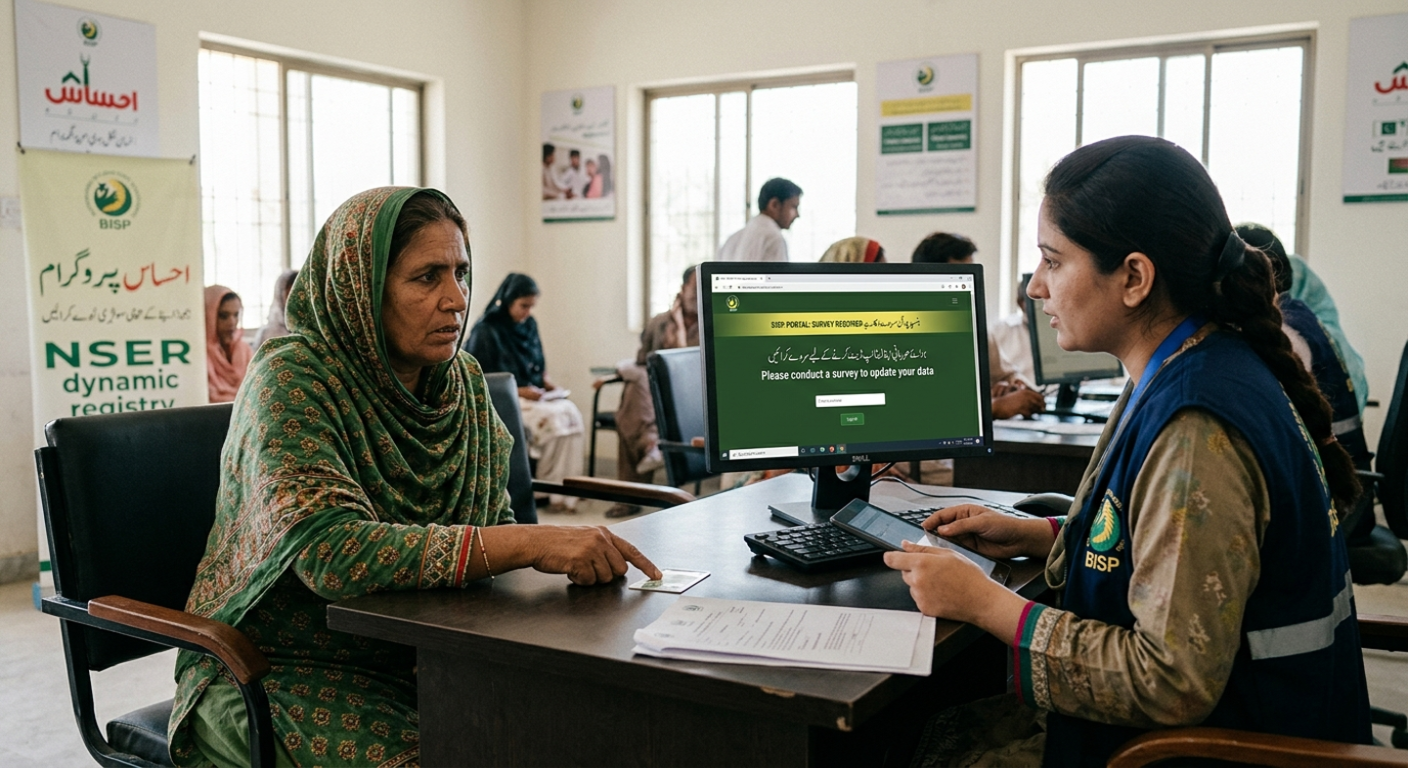
A woman in a Punjab tehsil town has been checking her phone anxiously for three days, waiting for her quarterly BISP payment SMS. Her husband’s small shop closed down eight months ago after his health declined, and the household now survives on what her eldest son sends home from a factory job. She finally walks to a cybercafé, pays Rs. 20 to have someone check her CNIC on the 8171 portal — and instead of a payment amount, the screen shows one line: what to do if bisp portal shows survey required “Survey Required.”
She has no idea what that means. Is she rejected? Does she need to start over? Did she do something wrong?
This happens to thousands of families across Punjab every month — not because they’re ineligible, but because BISP’s system is built around a database that needs periodic updating, and most people are never told, in plain language, what “Survey Required” actually means or what to do about it. This article exists to close that gap, using only information that can be traced back to BISP’s own website, official statements, and verifiable news coverage — not WhatsApp forwards or guesswork.
If your tracking status isn’t updating, you can check the latest registration guides and payment updates on theBISP 8171 Category Page, which covers the newest program updates.
What The Scheme Actually Is
The Benazir Income Support Programme (BISP) is a federal cash-transfer program run by the Government of Pakistan, not by the Punjab government. It operates as an autonomous statutory body established under the BISP Act 2010, currently headed by Chairperson Senator Rubina Khalid, and works under Pakistan’s Poverty Alleviation and Social Safety framework. Its main component, Benazir Kafaalat, gives a quarterly unconditional cash payment to low-income women heads of household. Related sub-programs include Benazir Taleemi Wazaif (education stipends for enrolled children) and Benazir Nashonuma (nutrition support for mothers and young children).
As of the Ramadan 2026 cycle, the quarterly Kafaalat payment stands at Rs. 14,500, raised from Rs. 13,500. This increase was publicly announced by Chairperson Rubina Khalid in February 2026 during a session at BISP headquarters, and is corroborated by BISP’s own news page as well as multiple independent news outlets — so this figure can be treated as confirmed. Whether a further increase to Rs. 19,500 will take effect from January 2027, as some outlets have reported, has not been confirmed on BISP’s official channels as of this writing — treat that specific figure as unverified until BISP itself announces it.
Every BISP decision rests on one underlying database: the National Socio-Economic Registry (NSER). This is essentially a nationwide household survey that scores every registered family on a poverty index. When you check your CNIC and the system returns “Survey Required,” it means your household either has no record in NSER, or the record is old enough that BISP wants it refreshed before making a payment decision.
If you’ve already registered for the program, you can use theBISP 8171 Result Check Online By CNIC 2026guide to easily understand your tracking status and verify your payment eligibility.
Who Is Eligible — Including the Edge Cases
Getting surveyed itself has no eligibility bar — any household, registered or not, can request an NSER survey or update. What determines whether you actually qualify for payments is your Proxy Means Test (PMT) score, calculated after the survey on a 0–100 scale, where a lower score indicates greater financial need.
Based on BISP’s public statements and consistent reporting:
- A PMT score of 32 or below generally qualifies a household for standard Benazir Kafaalat payments.
- Households with a differently-abled member reportedly qualify at a higher threshold (around 37), based on media coverage of BISP policy — this specific number has not been independently verified against a primary BISP document, so treat it as indicative rather than guaranteed.
- Monthly household income is generally expected to fall well below Rs. 25,000–30,000, though this is a rule of thumb reflected in PMT scoring rather than a single hard cutoff.
- If any household member — spouse, parent, or the applicant herself — is a salaried government employee, the household is typically disqualified, regardless of income level.
Before heading to a registration center, you should first check your status on the officialBISP 8171 Web Portal 2026to see if your household’s PMT score already qualifies you for the Rs. 14,500 stipend.
Common edge cases people ask about:
- “I’m already registered in a Punjab provincial scheme like the Ramzan Relief Package — does that count as my BISP survey?” No. This is one of the most common points of confusion, and it’s addressed in detail in the comparison section below — Punjab’s PSER survey and BISP’s NSER survey are two separate databases run by two separate governments.
- “My husband passed away and I never updated my CNIC marital status — will BISP still show me as married?” Yes, until you update your NADRA record and bring proof (death certificate) to a BISP Tehsil Office.
- “I was surveyed years ago and rejected — can I try again?” Yes. If your circumstances have genuinely changed, you can request a re-survey; you are not permanently locked out.
- “I have a small piece of inherited agricultural land but no real income from it — will that disqualify me?” Land and asset ownership does affect your PMT score, but the exact weighting isn’t published in a simple public formula. If you believe your case has been misjudged, you can request a review at your Tehsil office rather than assuming automatic disqualification.
Step-by-Step: What To Actually Do
- Reconfirm the exact status. Go to 8171.bisp.gov.pk or SMS your 13-digit CNIC (no dashes) to 8171. Make sure it genuinely says “Survey Required” and not “Not Eligible” or “Payment Pending” — each requires a different response.
- Find your nearest BISP Tehsil Registration Center. The official center locator is at
nser.nadra.gov.pk/nsersurvey/bispnsersurveycenters. Search by your tehsil or district. - Gather your documents before you go (see checklist below). Missing even one document is the single most common reason people make two or three trips instead of one.
- Visit during working hours, generally Monday–Friday. Expect to wait in a queue; bring a copy of everything since some offices retain photocopies.
- Complete the interview. A BISP officer will ask about household size, income sources, assets (house type, land, vehicle, livestock), and children’s school enrollment. Answer accurately — inconsistencies between what you say and what NADRA records show can delay or complicate your case.
- Biometric verification. Your fingerprint is recorded, both to confirm identity and to enable biometric payment collection later.
- Wait for processing. Your data is sent for PMT scoring at the central level. Realistically, this can take anywhere from a few weeks to two or three months — BISP does not publish a guaranteed turnaround time, so treat any website promising an exact number of days with caution.
- Watch for your confirmation SMS from 8171. This will tell you whether you now qualify. You can also recheck manually on the portal at any time rather than waiting passively.
Save This Checklist
- Original CNIC (must not be expired — renew at NADRA first if it is)
- Two photocopies of CNIC
- B-Forms for all children under 18
- Nikah Nama (if marital status needs updating)
- Death certificate or Talaq Nama (if applicable)
- A recent utility bill for address proof
- A mobile number registered in your own name (for SMS confirmation)
- Any documents proving a change in circumstances (job loss letter, medical records, etc.)
Common Mistakes Applicants Make
This is where most families lose time unnecessarily:
- Assuming “Survey Required” means rejection, and giving up instead of visiting the office.
- Going with an expired CNIC — biometric verification will fail, and you’ll be sent home to renew it first.
- Relying only on SMS and never checking the web portal, even though SMS replies are frequently delayed by network congestion.
- Confusing BISP’s federal NSER survey with a provincial survey (like Punjab’s PSER/8070 system) — completing one does not register you in the other.
- Under-reporting or over-reporting household details out of fear it will hurt their case — the survey is designed to capture your actual situation, and inconsistencies with NADRA records can cause more delay than an honest answer would.
- Getting surveyed once and assuming it lasts forever. Records need periodic updates, particularly after major life changes.
- Paying someone to “fast-track” the process. There is no legitimate fast-track; this always signals a scam.
If Your Case Is Rejected or Delayed
If your PMT score comes back above the qualifying threshold, or your case seems stuck for months with no update:
- Don’t assume this is final or that appealing is pointless — re-verification is a normal, available process.
- File a formal complaint at citizenportal.gov.pk (the Prime Minister’s Delivery Unit portal), which logs your case with a trackable reference.
- Call the BISP helpline, 0800-26477, and ask directly for your case status using your CNIC.
- If you believe an asset or income figure was recorded incorrectly, go back to your Tehsil office with supporting documents and formally request a re-survey rather than simply re-checking the portal repeatedly.
- Keep a written or photographed record of every visit, form submitted, and staff member you spoke with — this matters if you need to escalate later.
Be realistic: re-verification can take weeks to months, and there is no guaranteed outcome. Anyone claiming they can guarantee your approval — for a fee or otherwise — is not being honest with you.
Red Flags: How Scam Versions of This Process Operate
Fraud around BISP is common enough that the Chairperson has publicly addressed it multiple times. Watch for:
- Anyone asking for money to register you, “process” your survey, or guarantee eligibility. The survey and registration are entirely free.
- SMS messages from numbers other than 8171 claiming to be from BISP. Only 8171 is official.
- Unofficial websites that look like the government portal but use different domains (not bisp.gov.pk or 8171.bisp.gov.pk). Several copycat sites exist purely to harvest CNIC numbers or push ads; always check the URL carefully before entering personal information.
- Agents at payment points who “deduct” part of your payment as a so-called fee or commission. If you receive less than the announced Rs. 14,500, you have the right to file a complaint at your Tehsil office for deduction or misappropriation.
- Anyone promising a specific approval date or a guaranteed increase to your PMT score. No legitimate BISP employee can promise outcomes.
If you encounter any of the above, report it to 0800-26477 or your nearest BISP Tehsil Office immediately.
BISP’s NSER Survey vs. Punjab’s PSER (8070) Survey — Why This Confusion Matters
Here is something most coverage of this topic misses entirely, and it’s one of the most practically important points for readers in Punjab: BISP and the Punjab government run two completely separate survey systems, and passing one does not automatically register you in the other.
| BISP / NSER Survey | Punjab PSER (8070) Survey | |
|---|---|---|
| Run by | Federal Government of Pakistan (BISP) | Government of Punjab (Punjab Social Protection Authority) |
| Purpose | Determines eligibility for Kafaalat, Taleemi Wazaif, Nashonuma | Determines eligibility for Punjab-specific relief (e.g., Ramzan Nigehban/Rehmat programs) |
| Check via | 8171.bisp.gov.pk or SMS to 8171 | pser.punjab.gov.pk or SMS to 8070 |
| Registration method | In-person at BISP Tehsil Office only | Online, SMS, or in-person at Union Council/e-Khidmat centers |
| Typical income threshold | Household well below Rs. 25,000–30,000/month (approximate) | Reported around Rs. 60,000/month or below for some Punjab relief packages |
| Fee | Free | Free |
Practical takeaway: what to do if bisp portal shows survey required If you’ve completed a PSER survey for a Punjab program and are still seeing “Survey Required” on the federal 8171 portal, that’s expected — they are unrelated databases. You need to complete both separately if you want to be considered for both federal and provincial support.
An Illustrative Case (Not a Real Named Individual)
To make this concrete, consider a composite, illustrative scenario based on the kind of case commonly seen at Tehsil offices — this is not a real person, but reflects a typical pattern:
“Rukhsana” was surveyed under NSER back in 2021 and received Kafaalat payments regularly until early 2025. That year, her husband — the household’s only other earner — died, and her son moved out after marriage. When she checked her CNIC in 2026, the portal showed “Survey Required.” She visited her Tehsil office with her CNIC, her husband’s death certificate, and a recent electricity bill. Staff conducted a fresh interview and updated her household’s composition and income details. About seven weeks later, she received an SMS confirming continued eligibility at the new payment rate.
The point of this example isn’t that everyone gets the same outcome — some re-surveys result in disqualification if a household’s actual circumstances place it above the PMT threshold. The point is that the process itself is knowable and navigable if you show up with the right documents and accurate information.