The CM Punjab Free Solar Panel Scheme is a Government of Punjab initiative designed to distribute free solar energy systems to low-income domestic households across the province. It was launched under the leadership of Chief Minister Maryam Nawaz Sharif and is listed as a flagship project on the official Punjab Government portal at punjab.gov.pk.
The scheme’s stated goals, as outlined on the official Punjab Government website, are to reduce electricity bills for low-income households, decrease carbon emissions, and promote the use of renewable energy at the household level. It is sometimes referred to under the broader Roshan Gharana program banner.
According to official scheme details, the Government of Punjab committed to distributing up to 100,000 solar systems free of cost to qualifying households. The program is managed with digital infrastructure provided by the Punjab Information Technology Board (PITB), which handles the online registration portal and applicant verification.
The 2026 Extension
According to reporting from April 2026, the Government of Punjab extended the scheme by six months — from a previous deadline of June 2026 to December 2026 — following high public demand. Officials also announced that more than 94,000 solar systems would be provided under the revised plan at an estimated cost of approximately Rs. 10 billion. Over 800,000 applications had already been received in earlier phases by the time of the extension announcement.
The extension reflects both the scale of demand and the government’s stated intent to expand the program’s reach into districts and tehsils that had not yet seen full coverage in earlier rounds.
What Solar System Will Beneficiaries Receive?
The CM Punjab Free Solar Panel Scheme provides two tiers of solar equipment based on the household’s electricity consumption bracket, according to information from official and verified sources:
- Households consuming 0–100 units per month receive a 550-watt solar system — consisting of a single panel, a small inverter, and basic wiring. This configuration is designed to cover daytime use of a few fans and lights.
- Households consuming 101–200 units per month receive a 1,100-watt (1.1 kW) system — two panels, an inverter, and wiring, supporting a slightly higher daytime domestic load.
Both systems are off-grid or basic hybrid configurations. It is important to note that these systems are not net-metered — they do not connect to the national grid in a way that offsets nighttime consumption. They reduce daytime electricity draw, not the entire bill. Beneficiaries retain their existing grid connection.
Professional installation by government-authorised teams is included at no cost to the household. According to official announcements, installation is carried out after selection, and beneficiaries receive a handover certificate along with warranty documentation for panels and inverters.
Eligibility Criteria
The eligibility requirements for the CM Punjab Free Solar Panel Scheme are clearly defined on the official Punjab Government portal. Meeting these criteria is a prerequisite — not just a recommendation — for a successful application.
Who Qualifies
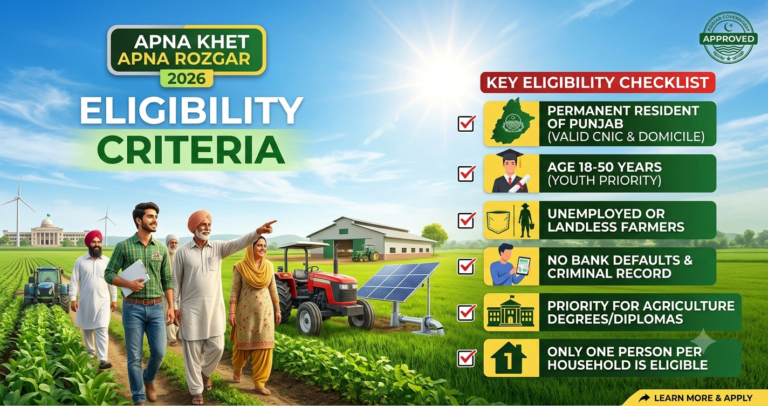
According to the official Punjab Government website (punjab.gov.pk), eligible applicants must meet all of the following:
- Monthly electricity consumption of 0–200 units, verified against the electricity bill for the month of June 2024, which remains the baseline reference month established by the scheme.
- Sanctioned load of up to 2 kW on the domestic electricity connection.
- A valid CNIC registered to a Punjab address.
- The electricity bill must be in the applicant’s name or a direct family member’s name at the same residence.
- Applicants must be residents of Punjab province.
The scheme covers domestic consumers across several tariff categories, including Life Line consumers (0–50 units and 51–100 units), Protected consumers (0–100 units and 101–200 units), and Unprotected consumers within the same consumption brackets.
Who Is Excluded
The official portal explicitly excludes the following categories:
- Domestic consumers involved in electricity theft at any point.
- Consumers with defective electricity meters.
- Consumers with multiple meters at a single residence.
- Consumers with a payment default record — specifically, more than three late payments in any 12-month period.
Commercial and industrial connections are not eligible regardless of consumption level.
Priority Categories
According to official announcements and corroborating sources, the scheme gives preferential consideration to women-led households, widows, persons with disabilities, and residents of rural and underserved areas — groups that face compounding disadvantages in accessing energy infrastructure.
Step-by-Step: How to Apply
There are two official registration channels. Both are free of charge. Any platform asking for a fee is unofficial and should be avoided.
Method 1 — Online via the Official Portal
- Open a browser and navigate to the official scheme portal: cmsolarscheme.punjab.gov.pk
- On the registration page, enter your 13-digit CNIC number (without dashes).
- Enter your electricity bill reference number — this is the 14-digit number printed on your monthly DISCO (electricity distribution company) bill.
- Fill in additional household details as prompted (address, contact number, family information).
- Review all entries carefully before submitting. Errors in the CNIC or reference number will result in a failed verification.
- Upon successful submission, you will receive a reference number via SMS on your registered mobile number. Keep this for tracking your application status.
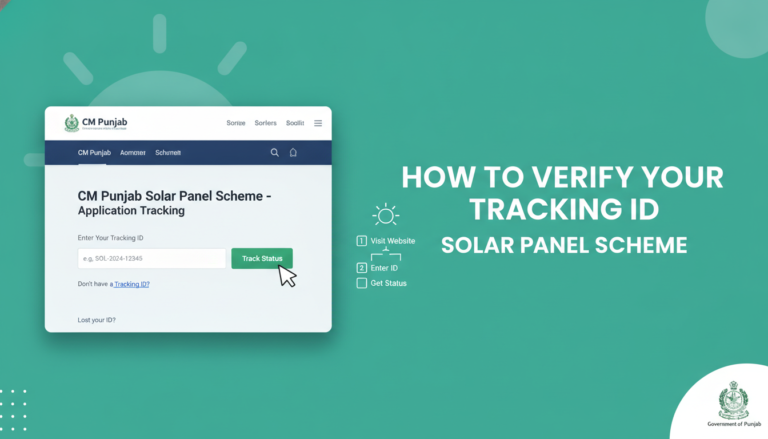
- To check your application status at any time, return to cmsolarscheme.punjab.gov.pk and enter your CNIC or reference number.
Method 2 — Via SMS
For applicants without reliable internet access, registration is also possible through SMS:
- Open your mobile phone’s messaging application.
- Type your Reference Number followed by a space and your CNIC number.
- Send this message to 8800.
- You will receive a confirmation reply with your application status.
Method 3 — Via Bank of Punjab Branch
For those who need in-person assistance, Bank of Punjab (BOP) branches across the province have been designated as facilitation points. Applicants can visit their nearest BOP branch, request the solar scheme registration form, and submit it with their bill reference number and CNIC. Branch staff are authorised to assist with the process.
Once an application is selected through the computerised balloting process, the applicant will be notified by SMS with details about the installation schedule.
Required Documents
When registering online or at a Bank of Punjab branch, applicants will need the following:
- Original CNIC of the applicant
- Electricity bill for verification purposes (the reference number must be legible and current)
- A valid mobile phone number for SMS communication and notifications
- Proof of residence — this may include a utility bill, property ownership document, or a landlord’s No-Objection Certificate (NOC) if the property is rented
- For Bank of Punjab in-person applications: photocopies of the above documents alongside originals
Applicants are advised to double-check that their CNIC address matches the address on the electricity bill. A mismatch is one of the most common reasons for application rejection.
Common Mistakes to Avoid
Based on patterns reported across official and credible sources, the following errors are most frequently made by applicants:
1. Using unofficial websites or third-party apps Dozens of unofficial websites use the scheme’s name to drive traffic or, in some cases, to collect personal information fraudulently. The Government of Punjab has repeatedly warned the public to use only cmsolarscheme.punjab.gov.pk and the SMS service to 8800. Registration through any other platform does not constitute a valid application.
2. Entering incorrect CNIC or reference numbers Both numbers must be entered exactly as they appear on official documents — no dashes, spaces, or partial entries. A single digit error will cause the system to reject the application or assign it to the wrong account.
3. Applying with a bill that shows consumption above 200 units The eligibility check is automated. If the bill reference number entered corresponds to a consumption record above 200 units, the application will be disqualified at the verification stage. Applicants whose consumption occasionally spikes above 200 units should note that the official baseline is the June 2024 bill — not the current month’s bill.
4. Relying on agents or middlemen Several unofficial agents have been reported to charge fees in exchange for “guaranteeing” scheme selection. The scheme is entirely free, and selection is determined by computerised balloting. No individual or agent has any influence over the process.
5. Not keeping the mobile number active All communication — including balloting results and installation scheduling — is delivered via SMS to the number provided at registration. An inactive or changed number will result in missed notifications.
6. Applying multiple times from the same address Multiple applications from a single household address are flagged during verification and may result in disqualification of all entries from that address.
Frequently Asked Questions
Conclusion
The scheme’s extension through December 2026 comes at a time when electricity tariffs in Pakistan have risen sharply, and load-shedding continues to affect both urban and rural areas. For households at the lower end of the consumption scale, a 550W or 1.1 kW solar kit will not eliminate the electricity bill entirely — but for a family running fans, lights, and basic appliances through the day, the reduction in daytime grid consumption can translate into meaningful monthly savings.
What the CM Punjab Free Solar Panel Scheme will not do is provide energy independence or replace a grid connection. Families with higher consumption needs, or those looking for systems capable of running air conditioners or powering home-based businesses, fall outside its scope. For those households, the Bank of Punjab solar financing route or private solar investment remains the more appropriate path.
For those who do qualify, the scheme offers a rare combination: a verified government program, a free service with no hidden charges, and a straightforward digital application process. The main barrier, for most eligible families, is simply knowing the scheme exists and using the right portal.