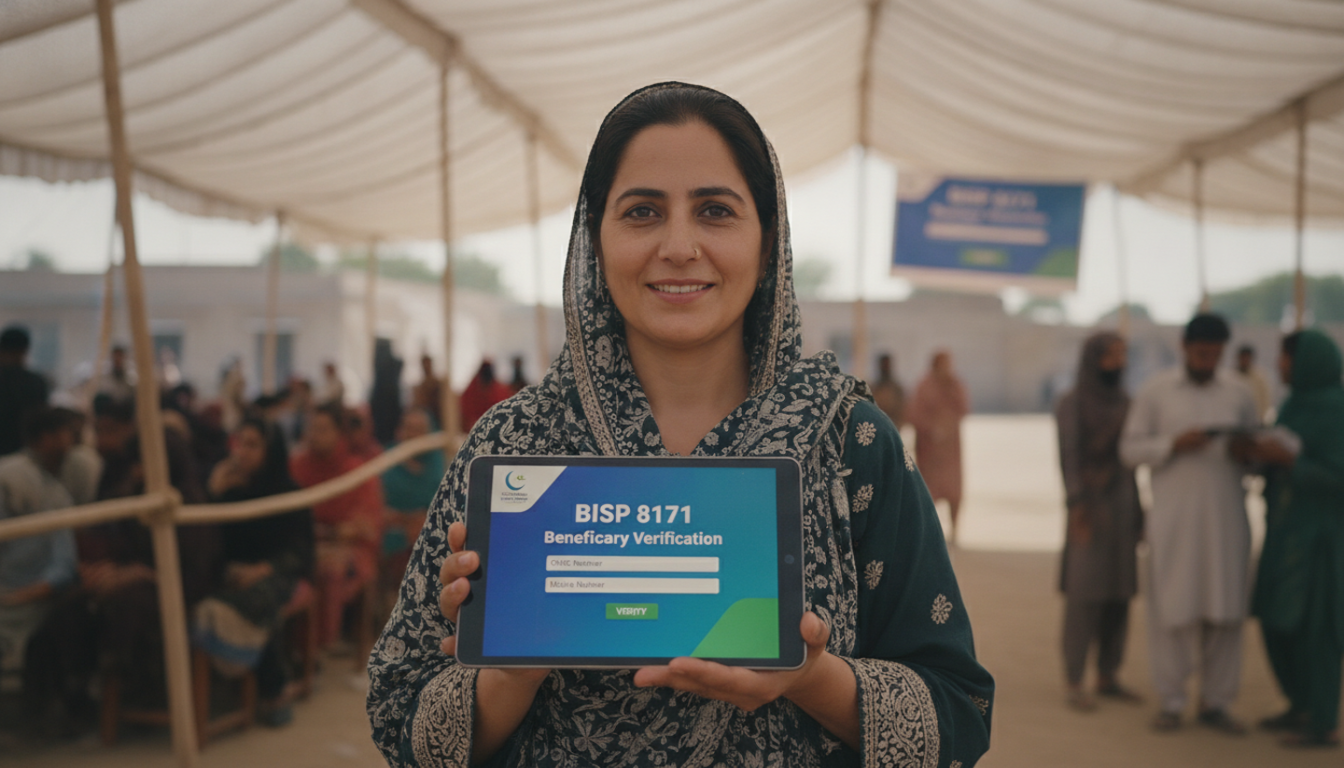
Fatima Bibi, a widow from rural Punjab, had been receiving quarterly payments under the Benazir Kafalat Program for two years when the transfers suddenly stopped. Her mobile wallet showed no new credit. She traveled forty kilometers to the nearest city, only to learn at the BISP Tehsil Office that her BISP 8171 Beneficiary Verification status had been flagged for re-verification — and that she could have checked this from home, instantly, by sending her CNIC number to 8171 or visiting the official 8171 web portal. She had simply not known the tool existed.
Stories like Fatima’s are common across Pakistan. Millions of low-income families are enrolled in BISP’s programs, yet many remain unaware of how to verify their status, what triggers a hold on payments, or how to correct an error in their records. This guide explains the BISP 8171 beneficiary verification system — how it works, who qualifies, and how to navigate it step by step.
What Is BISP 8171 Beneficiary Verification?
The Benazir Income Support Programme (BISP) is Pakistan’s largest federal social safety net, currently delivering quarterly cash assistance to millions of low-income households through its flagship Benazir Kafalat Program. The short code 8171 is the government’s dedicated service channel for this program — a number citizens can SMS to receive an instant status update on their eligibility and payments.
BISP 8171 Beneficiary Verification, in practical terms, refers to the process by which BISP confirms that a registered household remains eligible for financial assistance. It involves two distinct but related systems:
- The 8171 SMS Service: A text message service where citizens send their 13-digit Computerized National Identity Card (CNIC) number to 8171 and receive an automated reply indicating their registration status, PMT score category, and payment information.
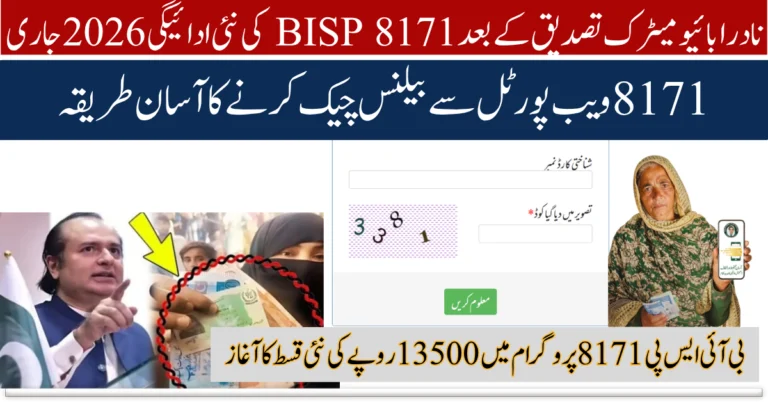
- The 8171 Web Portal (accessible at 8171.bisp.gov.pk): An online dashboard where the same CNIC check can be performed with more detailed results, including payment history and any pending verification flags.
A separate Beneficiary Validation Portal exists at 8171validation.bisp.gov.pk for deeper verification use cases, including NADRA data cross-checks.
According to official announcements, the 8171 web portal was re-launched and upgraded in 2025 with enhanced security features, faster response times, and multi-language support — making it more accessible to beneficiaries in remote areas who previously had to travel to BISP offices to get information.
Eligibility Criteria
Eligibility for BISP’s Benazir Kafalat Program — and by extension, for being a recognized beneficiary in the 8171 verification system — is determined through a structured process rather than a simple income declaration. The following are the key criteria, as outlined by the official BISP website (bisp.gov.pk):
PMT Score Threshold
The central eligibility measure is the Proxy Means Test (PMT) Score, a household poverty index calculated on a scale of 0 to 100. The lower the score, the greater the household’s financial need. According to BISP’s official documentation, the current PMT cut-off score for eligibility under Benazir Kafalat is 32, a threshold approved by the BISP Board at its 52nd meeting held on 23 September 2021. Households scoring 32 or below are considered eligible for cash assistance.
An exception applies: households with a differently-abled (disabled) member qualify with a PMT score of up to 37.
How the PMT Score Is Calculated
The PMT score is derived from data collected during the National Socio-Economic Registry (NSER) survey — a door-to-door enumeration exercise conducted by BISP across Pakistan. Survey enumerators collect more than 20 data points per household, including:
- Monthly household income and expenses
- Number of dependents and family members
- Type and condition of housing (pucca vs. kuchha construction)
- Ownership of assets such as vehicles, land, livestock, or electronics
- Educational attainment of household members
- Health conditions, including chronic illness or disability
- Utility consumption (electricity and gas bills)
A household with low or no income, basic housing, several dependents, and no significant assets will receive a lower PMT score — increasing its likelihood of qualifying.
Additional Eligibility Requirements
Beyond the PMT threshold, applicants must meet the following conditions:
- Must be a Pakistani citizen with a valid, computerized CNIC
- The primary beneficiary must be female — BISP directs payments to women as the designated household head for the program
- The CNIC must be registered and verifiable through NADRA
- The household must not already be registered under a duplicate entry
Transgenders with CNICs from NADRA explicitly marking their gender as transgender are also eligible, following a 2023 policy inclusion approved by the BISP Board. For this category, PMT cut-off restrictions are relaxed, and all transgenders who complete the survey successfully are eligible to apply.
Step-by-Step: How to Verify Your Beneficiary Status
Method 1 — SMS to 8171
- Open the messaging application on any mobile phone.
- Type your 13-digit CNIC number (without dashes or spaces).
- Send the message to 8171.
- Within seconds, you will receive an automated reply in Urdu or English confirming your registration status, PMT score category, and whether a payment has been issued or is pending.
This service is available 24 hours a day, 7 days a week, and is free of standard SMS charges (though network operators’ terms may vary).
Method 2 — 8171 Web Portal
- Open a browser and navigate to the official portal: 8171.bisp.gov.pk
- Enter your 13-digit CNIC number in the designated field (no dashes or spaces).
- Complete the CAPTCHA verification code shown on screen.
- Click the “Check Eligibility” or “Submit” button.
- The system will display your current eligibility status, payment history, and any outstanding verification requirements.
The portal is accessible around the clock and does not require account registration.
Method 3 — Visit a BISP Tehsil Office
For more complex queries — such as disputed PMT scores, address changes, or re-survey requests — applicants must visit their nearest BISP Tehsil Office in person. The official BISP website at bisp.gov.pk provides a directory of tehsil offices by district. Physical visits remain mandatory for new registrations; the 8171 portal and SMS service are verification tools only and do not process fresh applications.
Required Documents
Whether visiting a BISP Tehsil Office for initial registration, re-survey, or a payment dispute, the following documents are typically required according to official BISP guidelines:
- Original CNIC of the applicant (female household head)
- CNICs of all adult household members
- B-Forms (Form-B) for children under 18
- Proof of residence (utility bill, rental agreement, or domicile certificate)
- A valid mobile number registered in the applicant’s name (for payment delivery via JazzCash, EasyPaisa, or partner bank transfer)
- Bank account details, if payment is to be received via HBL (Punjab, Sindh, Balochistan) or Bank Alfalah (KP, Gilgit-Baltistan, AJK)
Photocopies of all documents should be brought alongside originals.
Common Mistakes to Avoid
Beneficiaries and applicants frequently encounter problems that are preventable. Based on patterns reported at BISP offices, the following errors are most common:
1. Providing inaccurate or incomplete NSER survey data Overstating income, understating assets, or leaving questions blank can result in an incorrect PMT score — either falsely inflating or deflating a household’s eligibility rating. Providing false information is also a disqualifying violation.
2. Not updating records after life changes The death of the primary earner, loss of employment, or displacement due to a natural disaster all affect PMT calculations. Families who experience such changes should visit their nearest Tehsil Office to request a Dynamic Re-Survey (DNR), which updates their household data and can revise the PMT score.
3. Using unofficial portals or third-party apps Numerous unofficial websites and mobile applications claim to offer BISP eligibility checks or registration. Authorities have publicly warned that these platforms are not affiliated with BISP and cannot process, approve, or alter any government records. The only legitimate channels are the official SMS service (8171), the government portal (8171.bisp.gov.pk), and BISP Tehsil Offices.
4. Sharing personal information with unknown callers Fraudsters have impersonated BISP officials to obtain CNIC numbers, OTP codes, and bank account details. BISP does not make unsolicited calls asking for such information. Never share your CNIC, OTP, or financial details over the phone with unverified callers.
5. Multiple family members registering from the same address The NSER system is household-based. Multiple separate applications from a single address are flagged as potential duplicates and are subject to rejection or suspension pending investigation.
6. Ignoring re-verification SMS messages When BISP sends an SMS requesting that a beneficiary update their survey information, it is mandatory to act on it promptly. Ignoring these messages can result in payment suspension until the re-verification is completed.
Frequently Asked Questions
Conclusion
The BISP 8171 Beneficiary Verification system represents one of the more practical advances in Pakistan’s social protection infrastructure — a tool that puts critical information directly in the hands of those who need it most, without requiring a long journey to a government office or dependence on a middleman.
For millions of low-income families, particularly women in rural areas, knowing how to use this system is not a minor convenience — it is the difference between receiving timely support and waiting months through confusion and bureaucratic delay. A single SMS to 8171 or a two-minute check on the official portal at 8171.bisp.gov.pk can confirm eligibility, flag a payment hold, or reveal that a re-survey is needed before the situation becomes a crisis.
The system is not without its challenges. Fraudulent portals, misinformation circulating through social media, and a general lack of digital literacy in underserved communities continue to undermine the program’s reach. The burden on families to keep their NSER data current — and to respond promptly to re-verification requests — also places real demands on people already stretched thin.


One Comment