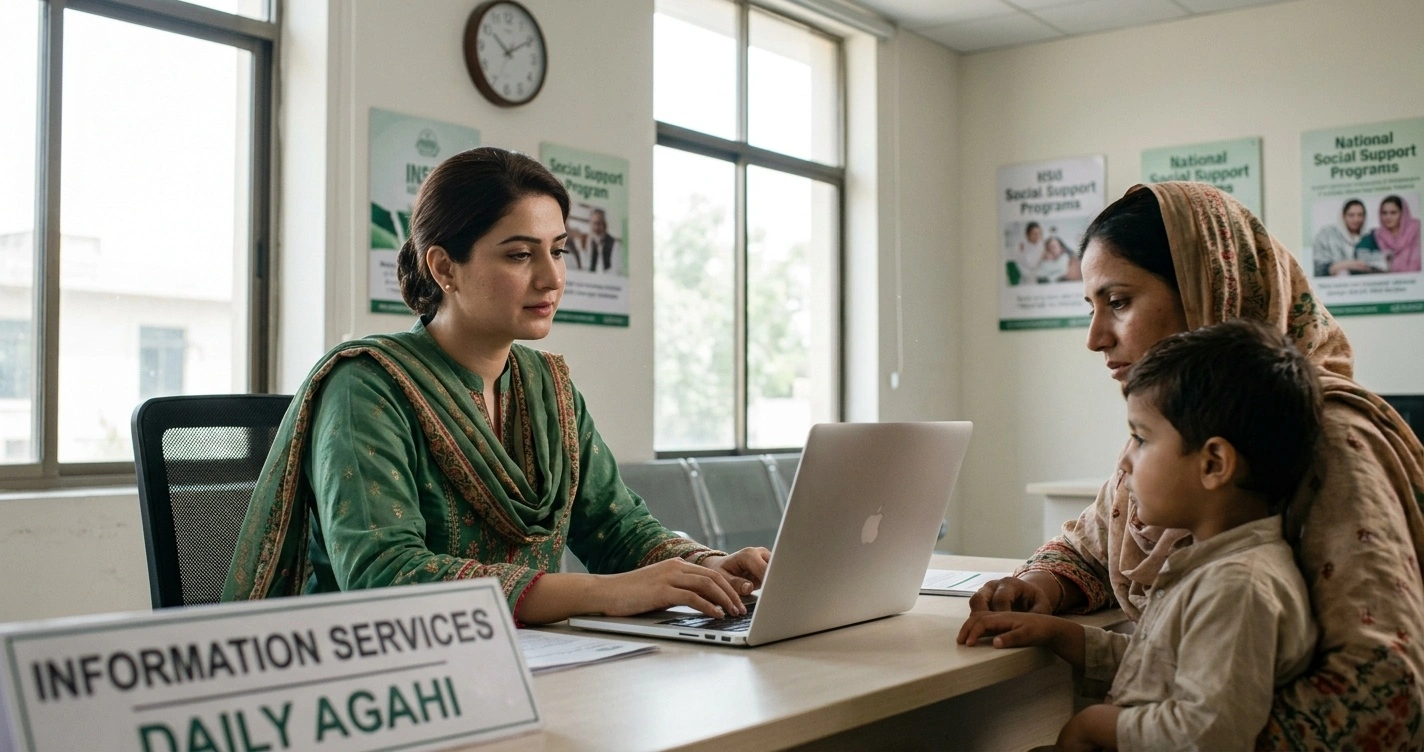
A household earning less than Rs. 25,000 a month and unsure whether it qualifies for government cash support has exactly one reliable starting point in 2026: the BISP 8171 Web Portal 2026. This single system, run jointly with NADRA, now decides whether nearly nine million Pakistani families receive their quarterly Rs. 14,500 stipend, and getting any step of the process wrong — a mistyped CNIC, a missed biometric visit, an outdated NSER survey — can mean months of delay.
This guide breaks down the entire system end to end: where it came from, how the scoring actually works, what to do at every stage, and where the program still falls short.
Quick Reference Box
| Detail | Information |
|---|---|
| Portal | 8171.bisp.gov.pk |
| SMS Shortcode | 8171 |
| Current Quarterly Payment | Rs. 14,500 (Benazir Kafalat) |
| Eligibility Tool | PMT score via NSER survey |
| PMT Cutoff (General) | 32 |
| PMT Cutoff (Disability) | 37 |
| Partner Banks | HBL, Bank Alfalah |
| 2025–26 BISP Budget | Rs. 716 billion |
| Active Beneficiary Households | Approx. 9 million |
Background: Where BISP Came From and Why It Still Matters
Pakistan’s organized social protection effort did not begin in 2008. The Zakat and Ushr Ordinance of 1980 created the first national framework for redistributing wealth to the poor through local committees, followed by Pakistan Bait-ul-Mal in 1992, which funded education, health, and emergency grants. Both systems stayed fragmented and small in scale, with total social assistance spending sitting around Rs. 11 billion as late as 2007.
Everything changed in 2008. Global food and fuel prices hit a 30-year high that year, and the incoming government of Prime Minister Yousaf Raza Gillani, acting on the advice of President Asif Ali Zardari, launched the Benazir Income Support Programme in July 2008 — named after former Prime Minister Benazir Bhutto, assassinated the previous year. The starting stipend was modest: Rs. 1,000 per family per month, aimed at cushioning the poorest households against the economic shock.
By 2011, the program had matured into three distinct arms: Benazir Kafaalat (the core unconditional cash transfer), Benazir Taleemi Wazaif (education stipends tied to school enrollment), and the Nashonuma Programme (nutritional support for mothers and young children). Biometric verification was added soon after to curb duplicate and “ghost” beneficiaries, a known weak point in the early years.
In 2019, the program was folded into the broader Ehsaas framework under the PTI government, expanding its digital infrastructure significantly. By around 2023, administrative oversight reverted back to the BISP brand, while keeping the NSER database and 8171 portal built during the Ehsaas years. The federal government’s 2025–26 budget pushed BISP’s allocation to Rs. 716 billion, a roughly 20% jump from the prior year, reflecting its position as the country’s third-largest budgetary line item.
Core Mechanics: How Eligibility Is Actually Decided
Nothing about BISP eligibility is manual or discretionary in the way an application form would be. The entire system runs on a statistical model called the Proxy Means Test (PMT), applied through household data collected in the National Socio-Economic Registry (NSER).
How the PMT Score Works
Each surveyed household receives a score between 0 and 100, built from observable proxies for poverty rather than self-declared income alone:
- Housing conditions — construction material, number of rooms, ownership status
- Asset ownership — livestock, vehicles, land, durable goods
- Household composition — number of dependents, employment status of adults
- Education levels within the household
- Utility access — electricity, gas, and water connections
A lower score signals deeper poverty. The BISP Board sets the cutoff based on available fiscal space; the current general cutoff sits at 32, while households with a person with a disability are evaluated against a relaxed cutoff of 37.
Who Qualifies
| Criteria | Detail |
|---|---|
| Registration | Household must appear in the NSER database |
| PMT Score | At or below 32 (37 for disability cases) |
| Identity | Valid CNIC from NADRA; women must hold their own CNIC to receive payment |
| Household Headship | Priority for female-headed households, widows, and divorced women |
| Government Employment | Disqualified if any household member holds a government job |
| Overseas Wealth | Disqualified if a household member has significant assets or income abroad |
| Special Inclusion | Transgender applicants can register at Benazir Registration Centers with relaxed PMT restrictions |
Money moves exclusively to women in the household wherever possible — a deliberate design choice meant to strengthen female decision-making power over family finances, not just deliver aid.
Disbursement Infrastructure
Payments clear through two partner banks split by region: HBL handles Punjab, Sindh, and Balochistan, while Bank Alfalah covers Khyber Pakhtunkhwa, Gilgit-Baltistan, and Azad Jammu & Kashmir. Every payout requires a Biometric Verification System (BVS) match at the point of collection — a fingerprint scan, and increasingly a face scan, against the NADRA record on file.
Step-by-Step: From Checking Status to Receiving Payment
Skipping steps or doing them out of order is the single biggest reason applicants get stuck in “pending” status for months. Follow this sequence exactly.
Step 1: Check Your Current Status First
Before assuming you need to register, find out if your household is already in the system.
- Open a messaging app and type your 13-digit CNIC number, no dashes or spaces
- Send it to the short code 8171
- Read the reply carefully — it will state Eligible, Not Eligible, or Not Registered
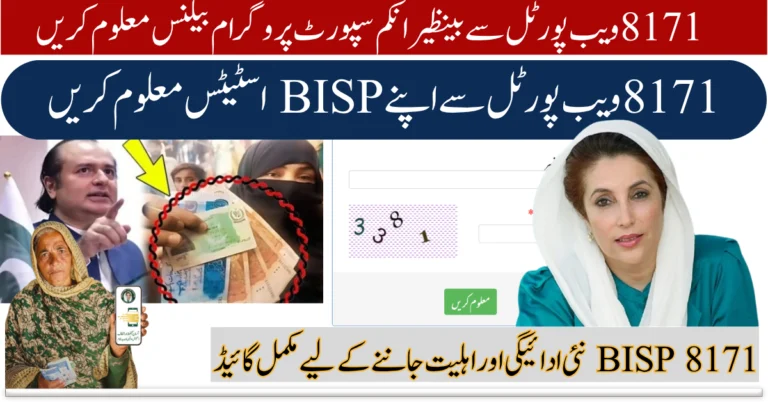
Alternatively, visit 8171.bisp.gov.pk, enter the same CNIC number, solve the captcha, and click the eligibility check button for an instant on-screen result.
Step 2: If “Not Registered,” Visit a Tehsil Office
A web check alone cannot enroll you. New applicants must:
- Locate the nearest BISP Tehsil Office (385 exist nationwide, alongside 33 divisional offices and 6 regional offices)
- Bring an original CNIC, proof of residence, and a medical or disability certificate if relevant
- Sit for the NSER Dynamic Survey, where an enumerator records household assets, income proxies, and living conditions directly into the system
- Complete biometric enrollment — fingerprints and, depending on the office, a face scan
Households in remote districts can request a visit from Mobile Registration Vans, which conduct the same survey door-to-door for elderly or housebound applicants.
Step 3: Wait for NADRA Cross-Verification
Submitted survey data is checked against NADRA’s civil registry to confirm identity details and rule out duplicate entries. This stage is where most delays occur and typically takes a few weeks.
Step 4: Confirm Eligibility Again
Once verification clears, recheck your status via SMS or the portal. A status change to “Eligible” will include your assigned payment cycle.
Step 5: Collect Payment With Biometric Confirmation
Visit any BISP camp, HBL Konnect point, Bank Alfalah agent, or designated ATM (including newly added Bank of Punjab ATMs) with your original CNIC. Biometric matching at the counter releases the Rs. 14,500 quarterly payment directly.
Benefits, Challenges, and Practical Fixes
What the System Gets Right
- Removes middlemen — the SMS and web checks eliminate the need for an “agent” to confirm status, cutting a known source of exploitation
- Targets the right households reasonably well — the PMT model, while imperfect, scores observable poverty markers rather than relying purely on self-reported income
- Puts money directly into women’s hands, with documented effects on household food security and school enrollment for children
- Scales nationally through a dense office network rather than concentrating services in major cities only
Where It Still Falls Short
- Exclusion errors persist. Genuinely poor households without electricity bills, formal housing documents, or easy office access can score above the cutoff despite real need, simply because the PMT proxies don’t capture their situation accurately.
- Regional imbalance in coverage has been a long-running criticism, with some provinces and districts showing far higher beneficiary density than others relative to population.
- Verification delays. NADRA cross-checks and biometric re-confirmation can stretch a “pending” status for weeks, leaving families without clarity on when payment will actually arrive.
- Fraud attempts targeting beneficiaries, including fake agents demanding fees for “faster processing,” despite registration and verification being entirely free.
Actionable Workarounds
- If your survey score seems wrong, request a re-survey at your Tehsil office rather than repeatedly checking the portal — the data itself needs correction, not just a recheck.
- Keep your mobile number updated with BISP, since most status changes and payment notices arrive by SMS first.
- Report any individual demanding payment for registration directly to the BISP complaint cell, never through informal channels.
Future Outlook: What’s Likely Next for BISP
Expect continued movement toward a conditional cash transfer model layered on top of the existing unconditional Kafaalat payments, tying part of the support to school attendance and health checkups for children — a direction BISP has already signaled through expansion plans tied to human capital development. BISP 8171 Web Portal 2026, Biometric de-duplication will likely tighten further; a 2023 audit alone removed roughly 850,000 ineligible recipients, and similar cleanups are expected to continue as NADRA data integration deepens. Given the pattern of incremental quarterly increases — from Rs. 13,500 to Rs. 14,500 in early 2026 — further inflation-linked adjustments are probable within the next budget cycle, alongside expanded ATM and digital wallet access for collection.
Final Word
BISP’s 8171 system has turned a process that once required physical queues, paperwork, and reliance on local agents into something a household can check from a basic mobile phone in under a minute. It is not flawless — scoring errors, regional gaps, and verification delays remain real friction points — but the shift toward biometric accuracy and direct digital access has measurably reduced fraud and middleman exploitation compared to the program’s earlier years. For the millions of families depending on this Rs. 14,500 quarterly lifeline, knowing exactly how the system scores, verifies, and pays out is the difference between getting support on time and losing months to confusion.




One Comment