Last Updated: May 2026 | By DailyAgahi.com
You filled the form. You uploaded your documents. You pressed “Submit.” And now you are stuck — refreshing the same portal page again and again, wondering whether your application for the Apni Chhat Apna Ghar scheme was even received, let alone approved.
This is the reality for thousands of families across Punjab right now. People who have waited months for a home loan that could change their lives are sitting in the dark because they do not know how to properly check their application status — or what to do when the status says something they do not understand.
Some applicants log into the portal and see “Under Verification” but have no idea what is being verified or how long it takes. Others see “Field Visit Pending” and panic, thinking something went wrong. And a large number of people cannot even log in because they forgot their password or entered the wrong CNIC during registration.
Check the eligibility and online registration process for the federal housing scheme offering subsidized loans for families across Pakistan.
This guide fixes all of that. We are going to show you exactly how to check your CM Punjab Apna Ghar scheme status online, explain what every status update means, cover the complete scheme from eligibility to payment, and give you honest advice on what to do at every stage. All information is verified from the official Punjab government portal (punjab.gov.pk/apni-chhat-apna-ghar), PHATA (Punjab Housing & Town Planning Agency), and credible news sources.
What Is the Apni Chhat Apna Ghar (ACAG) Scheme?
The Apni Chhat Apna Ghar (ACAG) scheme — which translates to “Your Roof, Your Home” — is a flagship housing program launched by Chief Minister Punjab Maryam Nawaz Sharif in August 2024. It is the largest interest-free housing loan initiative in Punjab’s history.
The core idea is simple: thousands of families across Punjab own a small piece of land but cannot afford to build a house on it. They remain trapped paying rent, living in incomplete structures, or staying in overcrowded joint family homes. The ACAG scheme gives these families an interest-free loan of up to Rs. 1.5 million (Rs. 15 lakh) so they can construct a proper house on land they already own.
The program is executed by the Punjab Housing & Town Planning Agency (PHATA) under the Housing, Urban Development and Public Health Engineering Department (HUD&PHED). (punjab.gov.pk)
Key Facts at a Glance
| Feature | Details |
|---|---|
| Scheme Name | Apni Chhat Apna Ghar (ACAG) |
| Launched By | Chief Minister Maryam Nawaz Sharif |
| Launch Date | August 2024 |
| Current Phase | Phase 2 (2026) |
| Loan Amount | Up to Rs. 1,500,000 (Rs. 15 lakh) |
| Interest Rate | 0% — Completely interest-free |
| Government Subsidy | 60% of the loan (government pays this portion) |
| Beneficiary’s Share | 40% (repaid in monthly installments) |
| Monthly Installment | Approximately Rs. 14,000 |
| Repayment Period | 5-7 years |
| First 3 Months | Installments waived (grace period) |
| Target | 100,000 housing units across Punjab |
| Phase 2 Target | 160,000 houses by June 2026 |
| Coverage | All 36 districts of Punjab |
| Executing Agency | PHATA (Punjab Housing & Town Planning Agency) |
| Official Portal | acag.punjab.gov.pk |
| Helpline | 0800-09100 (Toll-Free) |
Check the official deadline and final submission dates for the housing scheme to ensure your application is submitted before the closing window.
How Is This Different from PM Apna Ghar?
There is a lot of confusion between two similarly named schemes. Here is the difference:
| Feature | CM Punjab Apni Chhat Apna Ghar | PM Apna Ghar (Federal) |
|---|---|---|
| Level | Provincial (Punjab only) | Federal (all Pakistan) |
| Portal | acag.punjab.gov.pk | apnaghar.gov.pk |
| Loan Type | Interest-free construction loan | Bank-financed housing (90:10 model) |
| Target | Plot owners needing construction funds | First-time home buyers |
| Down Payment | None (interest-free loan) | 10% of property value |
| Government Subsidy | 60% of loan amount | Subsidized markup rates |
| Launched By | CM Maryam Nawaz Sharif | PM Shehbaz Sharif |
This article is specifically about the Punjab provincial scheme (Apni Chhat Apna Ghar) and its status check process. If you are looking for the PM federal scheme, that operates through a completely separate portal.
How to Check Your Apni Chhat Apna Ghar Application Status Online
This is the most important section of this article. Here are all the methods available to track your application:
Method 1: Official ACAG Portal (Primary Method)
Step 1: Open your browser (phone or computer) and go to: acag.punjab.gov.pk
Step 2: Click on the “Login” button. If you registered previously, use the email/phone number and password you created during registration.
Step 3: Once logged into your dashboard, you will see your complete application profile. Look for the “Application Status” section — this shows your current stage in the approval process.
Step 4: Your status will be displayed as one of several categories (explained in detail in the next section). Note the date of the last status update.
Step 5: If there are any notifications, alerts, or required actions (like uploading additional documents), they will appear on your dashboard.
Forgot Your Password? Click “Forgot Password” on the login page. The system will send a reset link to your registered mobile number or email. If your phone number has changed, call the helpline at 0800-09100 for assistance.
Method 2: SMS Notifications (Automatic)
The ACAG system sends official SMS notifications to the mobile number you registered with your application. You will receive messages when your application moves from one stage to the next, when a field verification visit is scheduled, when your balloting result is announced, or when your loan disbursement is approved.
Important: Keep your registered mobile number active at all times. If you change your SIM or phone number, update it immediately through the portal or by calling 0800-09100. Missing an SMS notification can cause you to miss critical deadlines.
Method 3: Toll-Free Helpline
Call 0800-09100 from any phone network. The helpline is toll-free (no charges). Provide your CNIC number and application reference number, and the operator will tell you your current status and any pending actions. This method is best for applicants who are not comfortable with online portals.
Method 4: Visit PHATA or Bank of Punjab Office
If all else fails, you can visit your nearest PHATA (Punjab Housing & Town Planning Agency) office or Bank of Punjab branch office. Bring your original CNIC and your application reference number. The staff can look up your status in the system and guide you on next steps.
What Each Application Status Means (Complete Guide)
When you check your status, the portal shows a specific stage. Many applicants get confused by these terms. Here is a plain-language explanation of every possible status:
| Status | What It Means | What You Should Do |
|---|---|---|
| Application Submitted | Your online form has been received by the system. It has not yet been reviewed. | Wait. No action needed. Your application is in the queue for initial review. |
| Under Initial Review | A PHATA officer is checking your basic information — CNIC validity, land ownership details, PMT score verification. | Wait. This review typically takes 1-3 weeks. Ensure all uploaded documents are clear and complete. |
| Documents Incomplete | Your application is missing required documents or uploaded files are unclear/unreadable. | Log in to your dashboard immediately. Check which documents need to be re-uploaded and submit clear copies. |
| CNIC Verification in Progress | Your CNIC details are being cross-checked with the NADRA database. | Wait 5-10 working days. If this stage lasts more than 3 weeks, call 0800-09100. |
| PMT Score Verification | Your poverty score is being verified through the NSER (National Socio-Economic Registry). | Wait. If your PMT score is above 60, you may be moved to “Ineligible.” |
| Land Verification Pending | PHATA is verifying your plot ownership through the Punjab Land Record Authority (PLRA). | Make sure your property documents (Fard/Registry) are genuine and up to date. |
| Field Visit Pending | A government team has been assigned to physically visit your plot to verify its existence, location, and ownership. | Keep your phone on. The team may call to schedule the visit. Be available at the property address. |
| Field Visit Completed | The physical verification of your plot has been done. Results are being compiled. | Wait for the next status update. If the visit found issues (wrong address, disputed land), you may receive a notification. |
| Balloting Stage | Your application has passed all verifications and is now in the computerized balloting pool. Selection is random to ensure fairness. | Wait for the balloting result. This is the stage where luck plays a role — qualified applicants are selected by computer-generated draw. |
| Approved / Selected | Congratulations — your application has been approved. You have been selected to receive the interest-free loan. | Wait for instructions about loan disbursement. You will receive an SMS with details about when and how your funds will be released. |
| Loan Disbursement Stage | Your loan amount is being processed for release through the Bank of Punjab. | Visit the Bank of Punjab branch as instructed. Bring original CNIC and all property documents for final signing. |
| Ineligible / Rejected | Your application does not meet the eligibility criteria — PMT score too high, land ownership issues, or other disqualifying factors. | Check the specific reason on your dashboard. If you believe there is an error, you can file an appeal at your nearest PHATA office. |
Pro Tip: Check your dashboard at least once a week. Some status changes require action within a limited time window — for example, uploading missing documents or being available for a field visit. If you miss the window, your application may be moved to the back of the queue.
Complete Eligibility Criteria
Who IS Eligible
To qualify for the cm punjab apna ghar scheme status check online, you must meet ALL of the following conditions:
- Punjab Resident: You must be a permanent resident of Punjab province. Your CNIC must be issued from a Punjab address.
- Head of Family: According to NADRA records, you must be the head of your household (nuclear family, not extended/joint family).
- Land Ownership: You must already own a plot of land where you intend to build your house. The plot size limits are: up to 5 marla in urban/city areas, or up to 10 marla in rural/village areas.
- PMT Score Below 60: Your Proxy Means Test score (calculated from the NSER database based on your income and assets) must be 60 or below.
- No Existing House: You must not already own a constructed house in your name. This scheme is for people who have land but no house.
- Monthly Family Income Below Rs. 60,000: Your total household income must fall within the low-to-middle income range.
- Not a Bank Defaulter: You must not have any defaulted loans with any bank or financial institution.
- Clean Criminal Record: You must not have convictions for anti-state activities or serious crimes.
- Valid CNIC: Your CNIC must be valid and not expired. The family head CNIC must match NADRA’s family tree records.
Who Is NOT Eligible
| Category | Reason |
|---|---|
| Non-Punjab residents | Provincial scheme — Punjab CNIC required |
| People who already own a house | Scheme is for those without a constructed home |
| Plot owners with more than 5 marla (urban) or 10 marla (rural) | Exceeds the land size limit |
| PMT score above 60 | Above the poverty threshold for this scheme |
| Bank defaulters | Financial risk — cannot receive government loan |
| Family income above Rs. 60,000/month | Exceeds income threshold |
| Applicants with criminal convictions | Does not meet clean record requirement |
| People without land ownership | You must own the plot where you want to build |
| Those with expired CNIC | NADRA verification will fail |
Important Note: The scheme is NOT for buying a house or buying land. It is specifically for building/constructing a house on land you already own. If you do not own land, look into the related Apni Zameen Apna Ghar (AZAG) program, which provides free plots to extremely poor families. Phase 1 of AZAG offered 2,000 free plots.
Required Documents
Have these ready before you start or update your application:
- Valid CNIC (Front and Back) — Must not be expired. This is the most critical document.
- Family Head CNIC — If you are not the family head per NADRA records, provide the family head’s CNIC as well.
- Land Ownership Proof — Fard (land record extract) from the Punjab Land Record Authority (PLRA) or property registry documents. These must be verified and genuine.
- Recent Photograph — Passport-sized photograph of the applicant.
- NSER Registration Proof — If you have completed the National Socio-Economic Registry survey, keep your registration details handy.
- Utility Bill — Electricity or gas bill showing your current Punjab address.
- Mobile Number on Own CNIC — Active and registered to your own identity for receiving SMS updates.
Document Checklist
| Document | Required For | Status |
|---|---|---|
| Applicant’s CNIC (front + back) | All applicants | ☐ Ready |
| Family head CNIC | NADRA family verification | ☐ Ready |
| Property Fard / Registry | Land ownership proof | ☐ Ready |
| Passport-size photograph | Application form | ☐ Ready |
| Utility bill (recent) | Address verification | ☐ Ready |
| Active mobile SIM on own CNIC | SMS notifications | ☐ Ready |
Warning: Never submit fake land documents. PHATA cross-checks every property record with the Punjab Land Record Authority (PLRA). If your documents are found to be fraudulent, you will be permanently disqualified and may face legal action.
Step-by-Step Application Process
Online Registration (Primary Method)
Step 1: Go to the official portal: acag.punjab.gov.pk
Step 2: Click “Registration” and create an account using your CNIC number, full name, date of birth, and an active mobile number. Create a password you will remember.
Step 3: After account creation, log in and fill the Citizen Registration Form. Enter your personal details, permanent and present address, property details (plot dimensions and location), monthly income, and number of dependents.
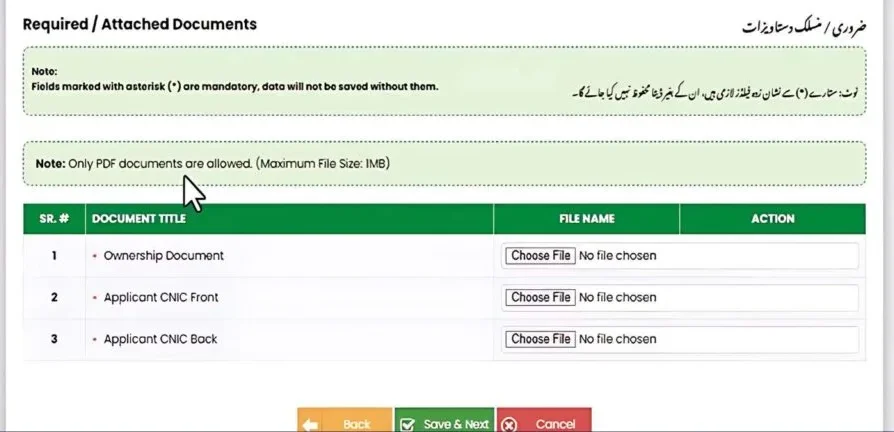
Step 4: Upload clear scans or photographs of your CNIC (front and back), property ownership documents (Fard/Registry), and your photograph.
Step 5: Review every detail carefully. One wrong digit in your CNIC or plot number can cause rejection. Double-check before clicking “Submit.”
Step 6: After submission, you will receive a confirmation SMS with your application/tracking number. Save this number — you need it for all future status checks.
Offline Registration (For Those Without Internet)
Step 1: Visit your nearest PHATA district office or Bank of Punjab branch.
Step 2: Bring all original documents along with photocopies.
Step 3: A government representative will help you fill the application form.
Step 4: Your documents will be verified on the spot and submitted into the system.
Step 5: You will receive a confirmation slip with your application number.
Phone Registration (Helpline)
Call the toll-free helpline 0800-09100. A representative will guide you through the registration process over the phone. This is especially useful for elderly applicants or those in remote areas.
Financial Benefits and Savings
The ACAG scheme offers financial benefits that no private bank in Pakistan can match:
Loan and Installment Structure
| Detail | Amount/Terms |
|---|---|
| Maximum Loan Amount | Rs. 1,500,000 (Rs. 15 lakh) |
| Interest Rate | 0% (completely interest-free) |
| Government Pays | 60% of the loan amount |
| You Repay | 40% of the loan (Rs. 600,000) |
| Monthly Installment | Approximately Rs. 14,000 |
| First 3 Months | Installments waived (grace period) |
| Repayment Period | 5-7 years |
| Recovery Rate | 99.9% (confirms the scheme is working) |
Why This Matters
Think about it this way: many families in Punjab pay Rs. 10,000-20,000 per month in rent. With this scheme, you pay roughly Rs. 14,000 per month — but instead of giving that money to a landlord forever, you are building your own house. After 5-7 years, you own it permanently. Your rent drops to zero for the rest of your life.
On a Rs. 15 lakh loan from a commercial bank, you would typically pay Rs. 8-10 lakh in interest alone over 7 years. With ACAG, you pay zero interest. The government absorbs 60% of the cost, and you repay only 40%. That is roughly Rs. 9 lakh in savings compared to a regular bank loan.
Three Execution Models
The government uses three different construction models under the scheme:
Model 1 — State Land Development: PHATA partners with developers to construct homes on government-owned land. About 10,000 units are planned under this model.
Model 2 — Public-Private Partnership: Developers build housing communities with government oversight, shared equity, and subsidized pricing.
Model 3 — Individual Construction Loan (Most Popular): This is the model most applicants use. You own a plot, you receive the interest-free loan, and you build your house yourself or through a contractor of your choice. This gives families full control over their home’s design and construction.
Important Dates and Latest Updates (May 2026)
August 2024: CM Maryam Nawaz officially launched the Apni Chhat Apna Ghar scheme. Phase 1 registration began through the ACAG portal.
Late 2024 – Early 2025: Phase 1 applications were reviewed, verified, and computerized balloting was conducted. First batch of approved beneficiaries began receiving loan disbursements.
2026 (Phase 2): Registration expanded significantly. The government announced a target of 160,000 houses by June 2026. Phase 2 includes expanded coverage to 30+ districts, special provisions for joint families and women applicants, and improved digital verification processes.
May 2026 (Current): Phase 2 registration is ongoing. Applications are being accepted through the ACAG portal. Verification and balloting continue in rolling cycles. Loan disbursements are active for approved candidates. District-wise selection lists are being uploaded periodically.
No Fixed Last Date: As of May 2026, there is no officially announced closing date for registration. However, applications are processed in phases and quotas may fill up by district. The strong advice is to apply early.
Real Stories: Life Before and After the Scheme
Note: These are realistic scenarios reflecting actual circumstances faced by applicants. Names are changed for privacy.
Tariq from Multan — From Rs. 12,000 Rent to His Own Home
Tariq is a fruit seller in Multan who earns approximately Rs. 35,000 a month. He has been paying Rs. 12,000 in rent for a two-room house for the past eight years. His father left him a 5-marla plot in a village on the outskirts of the city, but Tariq never had enough savings to start construction.
When the ACAG scheme was announced, his wife helped him apply through the portal. Their PMT score was 42 — well within the eligibility range. After three months of verification and a field visit, their application was approved. They received the construction loan of Rs. 15 lakh.
Tariq hired a local contractor and started building. His monthly installment is Rs. 14,000 — just Rs. 2,000 more than the rent he was already paying. But now, every rupee goes toward a house he will own in six years.
Lesson: If your monthly rent is close to Rs. 14,000, this scheme essentially converts your rent into home ownership.
Fatima from Rahim Yar Khan — A Widow Who Almost Missed Her Chance
Fatima owns a 7-marla plot in a rural area near Rahim Yar Khan. After her husband died, she could not afford to build on it. She heard about the scheme from a neighbor but assumed it was only for men or married couples.
She was wrong. The scheme is open to all family heads — and as a widow heading her household, she was fully eligible. She called the helpline (0800-09100) because she did not have internet access, and the operator guided her through the phone registration process. After verification, she was selected in the balloting and received her loan.
Lesson: Widows, divorced women, and female heads of household can absolutely apply. Do not let assumptions stop you from checking your eligibility.
Common Mistakes and How to Avoid Them
Mistake 1: Entering Wrong CNIC Number During Registration Even one wrong digit means a different identity is pulled up from NADRA. The entire verification process fails. Always double-check your 13-digit CNIC before submitting.
Mistake 2: Uploading Blurry or Incomplete Documents If your property Fard or CNIC scan is too dark, too blurry, or cut off at the edges, the reviewer will mark your application as “Documents Incomplete.” Use good lighting, photograph documents flat on a table, and make sure all four corners are visible.
Mistake 3: Not Checking Status Regularly Some status changes require action within a specific time window (for example, uploading missing documents or confirming availability for a field visit). If you ignore your dashboard for weeks, you may miss the deadline and your application could be pushed back.
Mistake 4: Changing Phone Number Without Updating the Portal All official SMS notifications go to your registered number. If you get a new SIM, immediately update your number through the portal or by calling 0800-09100.
Mistake 5: Applying Without Valid Land Documents Your property documents must be verified by the Punjab Land Record Authority (PLRA). If your plot is not registered in your name, or if there is a dispute, your application will be rejected at the land verification stage. Sort out your land ownership records before applying.
Mistake 6: Paying “Agents” for Application Processing Some people claim they can “fast-track” your ACAG application for Rs. 5,000-10,000. This is fraud. The entire process is digital and transparent — no middleman can influence it. Registration is free.
Mistake 7: Applying with More Than the Maximum Plot Size If you own more than 5 marla in a city or 10 marla in a village, you do not qualify. Some applicants try to hide additional property — the system checks PLRA records and will catch this.
Mistake 8: Having a PMT Score Above 60 Your PMT score is calculated from NSER data. If you have not completed the NSER survey or if your score is above 60, you will be marked ineligible. If your financial situation has changed, request a Dynamic Survey update at your BISP Tehsil Office to recalculate your score.
Frequently Asked Questions (FAQs)
Conclusion: Your Home Is Closer Than You Think
Paying rent is like pouring water into sand — the money disappears every month and you have nothing to show for it at the end. The Apni Chhat Apna Ghar scheme gives you a way out of that cycle. Rs. 15 lakh, interest-free, with Rs. 14,000 monthly installments that are often less than what you are already paying in rent. The government pays 60% of the cost. You keep 100% of the house.
If you have already applied, check your status today at acag.punjab.gov.pk. If your status requires action — upload missing documents, prepare for a field visit, or update your phone number — do it now, not next week.
If you have not applied yet and you own a small plot in Punjab, what are you waiting for? Registration is free. The process is online. The helpline is toll-free (0800-09100). There is no confirmed last date, but quotas fill up. The sooner you apply, the sooner your family moves from paying rent to owning a home.