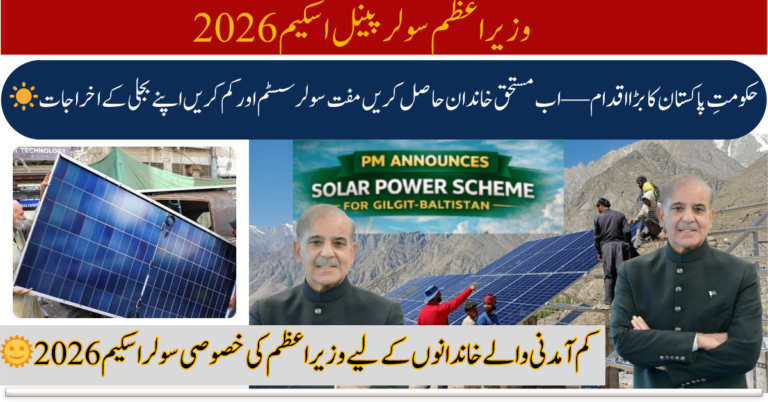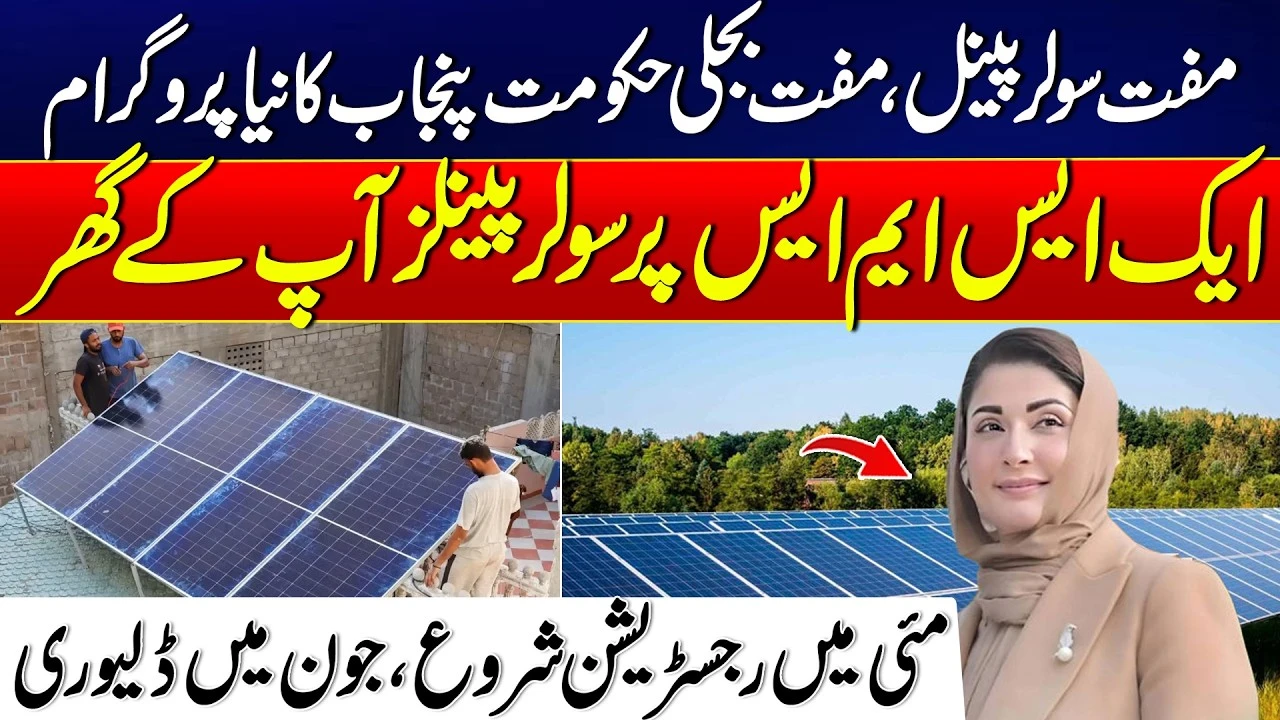
The CM Punjab Free Solar Panel Scheme 2026 — officially known as the Roshan Gharana Program — is a landmark government initiative launched under the leadership of Chief Minister Maryam Nawaz Sharif to provide free solar energy systems to low-income domestic households across the province of Punjab, Pakistan. The scheme is designed to give up to 100,000 solar systems free of cost to poor households consuming between 0 and 200 electricity units per month, distributed through a transparent balloting process.
In 2024, the Government of Punjab launched one of its most ambitious renewable energy initiatives — the CM Punjab Free Solar Panel Scheme. Under the leadership of Chief Minister Maryam Nawaz Sharif, the program aims to make solar energy accessible to low-income households across the province, reduce electricity costs, and promote environmental sustainability. In 2026, this visionary scheme has evolved further, expanding benefits and reopening registrations for eligible citizens.
The scheme directly responds to Pakistan’s deepening energy crisis. Electricity costs in Pakistan have risen significantly in recent years, adding financial stress to households. This scheme directly addresses that burden by providing solar systems that can drastically reduce monthly bills, often saving families PKR 3,000 – PKR 6,000 per month or more.
Solar energy is clean and renewable. By shifting a portion of Punjab’s residential consumption to solar power, the province takes a meaningful step toward reducing fossil fuel dependence and lowering greenhouse gas emissions. The scheme prioritizes women-led households, widows, disabled citizens, and rural residents, ensuring the benefits reach the most vulnerable segments of society.
🌟 Official Portal: cmsolarscheme.punjab.gov.pk | cmsolarscheme.com
📱 SMS Registration: Send your Reference Number followed by your CNIC to 8800
🏛️ Authority: Government of Punjab, Energy Department, Pakistan
📊 Total Systems: 100,000 free solar installations across Punjab
Key Statistics at a Glance: Understanding the Scale, Reach, and Financial Impact of the Punjab Free Solar Scheme
100KFree Solar Systems to be Distributed
200Max Monthly Units to Qualify
2 kWMaximum Sanctioned Load Allowed
₨6KMonthly Savings per Family (est.)
8800SMS Registration Shortcode
A total of 52,019 customers who use up to 100 units of electricity per month will receive a free 550-watt solar system, while consumers who use up to 200 units per month will receive a larger system at no cost.
Punjab Free Solar Scheme 2026 Eligibility Criteria: Who Qualifies, What Conditions Must Be Met, and How the Government Verifies Your Application
The eligibility criteria for the CM Punjab Free Solar Panel Scheme 2026 are clearly defined to ensure that benefits flow exclusively to deserving, low-income domestic households. Understanding these conditions before you apply is crucial, as the government’s portal automatically cross-checks your data against official distribution company (DISCO) records the moment you enter your details.
The Punjab solar scheme has strict eligibility requirements. These are checked automatically when you apply through the government portal. You must be a resident of Punjab province with a valid CNIC reflecting a Punjab address. Your electricity bill must show average consumption within the 0–200 unit range. Higher consumption disqualifies you. Your sanctioned load with the DISCO must be below 2 kilowatts. You must have a current, active connection with a distribution company — LESCO, MEPCO, FESCO, GEPCO, or PESCO. Each national identity card is entitled to one solar kit. Multiple applications from the same household are flagged and rejected.
Core Mandatory Requirements
- Permanent Resident of Punjab — Your CNIC must reflect a verified Punjab address. Non-Punjab residents cannot apply under this scheme.
- Active Domestic Electricity Connection — You must hold a valid, active residential connection with LESCO, MEPCO, FESCO, GEPCO, or PESCO. Commercial, industrial, or rental properties are excluded.
- Monthly Consumption of 0–200 Units — Eligibility is based on your June 2024 electricity bill. Consuming more than 200 units in that reference month disqualifies you automatically.
- Sanctioned Load of Up to 2 kW — Consumers having a sanctioned load up to 2 KW will be eligible for the scheme.
- Valid CNIC — A valid, biometrically-verified National Identity Card is mandatory. Your CNIC will be linked to the solar system to prevent theft or resale.
- One System Per Household Per CNIC — Each household is entitled to only one free solar system. Multiple applications from one address or under one CNIC are automatically rejected.
- Clean Payment History — Domestic consumers involved in payment default (more than 3 late payments in 12 months) are not eligible.
- No Electricity Theft Record — Any history of electricity theft on your connection immediately disqualifies your application.
📌 Important Note on Reference Month: Your electricity bill for June 2024 is used to determine your eligibility. Even if your consumption has changed since then, the June 2024 bill remains the official benchmark for all applicants. Make sure you have this bill available before registering.
Special Priority Groups
Eligibility is not only based on consumption but also considers household protection status. Protected consumers and those on lifeline tariffs are given preference, ensuring that families with limited financial means receive the benefits. This criterion reflects the government’s commitment to supporting underprivileged households and promoting equitable access to renewable energy resources.
Understanding the Six Consumer Categories: How NEPRA Tariff Classifications Determine Your Priority and the Solar Package You Receive
The scheme does not treat all eligible households the same. It is structured around six distinct consumer categories drawn from NEPRA’s existing domestic tariff classifications. Domestic consumers having monthly consumption of up to 200 units under the following categories are eligible: 51–100 Units (Life Line); 0–100 Units (Protected); 0–100 Units (Un-protected); 101–200 Units (Protected); and 101–200 Units (Unprotected). Life Line consumers using up to 50 units are also included in the scheme.
| # | Consumer Category | Monthly Consumption | Tariff Type | Solar System Provided | Eligible? |
|---|---|---|---|---|---|
| 1 | Life Line | Up to 50 Units | Subsidized Lifeline | 550-Watt System | ✓ Yes |
| 2 | Life Line | 51–100 Units | Subsidized Lifeline | 550-Watt System | ✓ Yes |
| 3 | Protected | 0–100 Units | Protected Tariff | 550-Watt System | ✓ Yes |
| 4 | Unprotected | 0–100 Units | Standard Tariff | 550-Watt System | ✓ Yes |
| 5 | Protected | 101–200 Units | Protected Tariff | 1100-Watt System | ✓ Yes |
| 6 | Unprotected | 101–200 Units | Standard Tariff | 1100-Watt System | ✓ Yes |
| 7 | Any Category | 200+ Units | Any | Not Applicable | ✗ No |
Up to 50 Units (Lifeline Category) qualifies automatically for smaller systems, prioritizing minimal users. 51–100 Units (Lifeline Category) extends benefits to slightly higher consumers with free 550-watt setups. 0–100 Units (Protected Category) ensures protected users receive systems without cost. 0–100 Units (Unprotected Category) includes unprotected low-users in the free distribution. 101–200 Units (Protected Category) targets protected mid-range consumers for 1100-watt systems.
Who Is NOT Eligible for the Punjab Free Solar Scheme 2026? A Clear List of Disqualifying Conditions That Will Automatically Reject Your Application
Just as important as knowing who qualifies is understanding who is disqualified. The Punjab government has implemented strict automated screening that instantly rejects applications that fall into any of the following categories. Commercial, industrial, or rental properties are not eligible for this scheme, which is strictly limited to domestic residential consumers.
⚠️ Disqualifying Conditions — Your Application Will Be Rejected If:
- Electricity Theft History: Domestic consumers involved in electricity theft shall not be eligible. This is checked automatically against DISCO records.
- Defective Meter: Domestic consumers having defective meters shall not be eligible. Get your meter repaired or replaced before applying.
- Multiple Meters at One Address: Domestic consumers having multiple meters at a single residence shall not be eligible.
- Payment Default: More than 3 late payments within the last 12 months disqualifies you from participating.
- Consumption Above 200 Units: Based on your June 2024 bill. Any reading above 200 units results in automatic disqualification.
- Sanctioned Load Above 2 kW: Households with a higher approved load are not targeted by this scheme.
- Non-Punjab Residents: Your CNIC address must be a valid Punjab address — residents of other provinces cannot apply.
- Commercial/Industrial Connections: Only pure residential domestic connections are eligible.
What Solar System Will You Receive? A Detailed Breakdown of the Free Equipment, Specifications, and Components Provided Under Each Package
The solar systems distributed under this scheme are not just panels — they are complete, standalone solar solutions designed to meaningfully reduce household electricity consumption. High-efficiency solar panels (1 kW to 3 kW based on consumption), a certified inverter system, battery backup to support night usage and load-shedding, professional installation and safe electrical wiring, net metering eligibility (where permitted), and warranty coverage for panels and inverters are all included.
| Package | Monthly Consumption | System Capacity | Includes Battery? | Est. Monthly Savings |
|---|---|---|---|---|
| Package A | 0–100 Units (Lifeline/Protected/Unprotected) | 550 Watts | Yes | PKR 2,000–3,500 |
| Package B | 101–200 Units (Protected/Unprotected) | 1,100 Watts | Yes | PKR 3,500–6,000 |
The carbon emissions reduction from 100,000 installations is estimated at up to 57,000 tonnes annually, making this not just a financial relief program but also one of Punjab’s most impactful environmental initiatives to date.
Required Documents for the Punjab Solar Scheme 2026 Application: Everything You Must Have Ready Before You Start the Registration Process
Gathering your documents in advance is the single most effective way to avoid delays or errors during online registration. The government’s verification system cross-references your submitted information against multiple databases including NADRA, DISCO billing records, and residential verification data. Inconsistencies — even small ones — can result in your application being flagged or rejected.
- Valid CNIC (Computerized National Identity Card) — Your 13-digit CNIC number. It must reflect your current Punjab address and must be active and not expired.
- Latest Electricity Bill (Specifically June 2024 Reference) — You need the 14-digit Reference Number printed at the top of your electricity bill. June 2024’s bill is the benchmark, but your latest bill helps verify your ongoing connection status.
- Mobile Number Registered Against Your CNIC — Required for SMS confirmation and scheme status updates.
- Proof of Residence — In most cases, your CNIC address suffices. If you are a tenant, you may need a landlord’s No Objection Certificate (NOC) or rental agreement.
- Active Electricity Connection Details — Your distribution company name (LESCO, MEPCO, FESCO, GEPCO, or PESCO) and account details as shown on your bill.
💡 Pro Tip: Keep your June 2024 electricity bill stored digitally (photograph or PDF). The 14-digit Reference Number on that bill is your primary identifier throughout the entire application and verification process.
Step-by-Step Guide: How to Apply for the CM Punjab Free Solar Panel Scheme 2026 Online, by SMS, and Through Facilitation Centers
The Punjab government has designed three accessible registration pathways to ensure that even citizens without reliable internet access can participate. Whether you register online, via SMS, or in-person at a Bank of Punjab branch, the underlying verification process is the same.
Method 1: Online Registration via Official Web Portal
- Visit the Official Portal — Go to cmsolarscheme.punjab.gov.pk. Always use the official URL to avoid scam websites.
- Create an Account or Log In — Register using your CNIC number and active mobile phone number. You will receive an OTP (One-Time Password) for verification.
- Enter Your CNIC & Reference Number — The system automatically verifies your eligibility by cross-checking your consumption data, connected load, and CNIC against DISCO records.
- Fill in Household Details — Enter your complete residential address, household size, distribution company name, and rooftop availability for installation.
- Upload Documents — Upload scanned copies or clear photographs of your CNIC and electricity bill.
- Submit Application & Save Tracking ID — After submission, you will receive a unique Tracking ID via SMS. Use it to monitor your application status.
Method 2: SMS Registration (For Citizens Without Internet Access)
- Format Your Message — Type your 14-digit electricity Reference Number, add a space, then type your 13-digit CNIC number. Ensure no extra spaces or errors.
- Send to 8800 — Send the formatted message to the number 8800. This is the designated code for the scheme’s SMS registration.
- Receive Confirmation SMS — After sending the SMS, you will receive a confirmation message indicating that your registration has been successfully received. Keep this confirmation for your records.
Method 3: Bank of Punjab / Facilitation Centers
For applicants without digital access, Bank of Punjab branches and government facilitation centers offer in-person assistance for submitting applications. Simply visit your nearest branch with your CNIC and electricity bill, and staff will guide you through the process.
The Balloting and Physical Verification Process: How the Punjab Government Selects Winners and Schedules Solar Installations Across Districts
Not every eligible applicant receives a solar system immediately. Given that 100,000 systems are being distributed across a province with millions of eligible households, the government has implemented a transparent, phased computerized balloting system to ensure fairness. Results are announced in phases. Not all eligible applicants receive systems immediately — distribution is staggered across districts.
- Eligibility Screening — Upon submission, the system automatically screens your details against DISCO billing data, NADRA records, and scheme databases.
- Balloting — A lottery system selects eligible consumers. The draw is computerized and independently overseen to prevent favoritism.
- Document Verification — Government officials review your submitted documents and check them against WAPDA/LESCO databases. They verify your consumption patterns, payment history, and residential status.
- Physical Inspection — In some cases, officials may conduct a brief site visit to confirm your location, existing wiring, and rooftop suitability for installation.
- SMS Notification & Installation Scheduling — Selected beneficiaries receive SMS notifications with their installation dates. Government teams conduct physical verification, solar installation is scheduled within days of approval, and beneficiaries receive SMS updates about each step.
⏱️ Timeline: The verification process for the CM Punjab Solar Panel Scheme 2026 typically takes 2–3 weeks. The entire process from application to installation can take 1–3 months, depending on demand.
You can track your application status at any time by visiting the official portal and entering your CNIC number. The system will display whether your application is under review, selected in the ballot, or pending distribution. Use only official government-announced application channels (https://cmsolarscheme.punjab.gov.pk/) to avoid fraudulent sites.
Key Benefits of the Punjab Free Solar Scheme 2026: Financial Savings, Energy Independence, Environmental Impact, and Long-Term Value for Every Eligible Family
Beyond the immediate financial relief, the CM Punjab Free Solar Panel Scheme delivers a wide range of tangible and long-term advantages to its beneficiaries. Understanding these benefits helps applicants appreciate the full value of what they are receiving — not just today, but over the 20–25 year lifespan of a properly maintained solar system.
Financial Benefits
This scheme directly addresses electricity cost burden by providing solar systems that can drastically reduce monthly bills, often saving families PKR 3,000 – PKR 6,000 per month or more. For a low-income family spending the majority of their monthly income on utilities, this represents a transformative financial shift.
Energy Reliability
With battery storage, homes stay powered even during outages. This is particularly significant in rural Punjab districts where grid load-shedding can last 10–16 hours per day, disrupting children’s education, small home-based businesses, and daily household routines.
Environmental Impact
Solar energy is clean and renewable. By shifting a portion of Punjab’s residential consumption to solar power, the province takes a meaningful step toward reducing fossil fuel dependence and lowering greenhouse gas emissions. The combined annual carbon reduction from 100,000 installations is projected at 57,000 tonnes.
Net Metering Eligibility
Under the current NEPRA prosumer regulations, self-consumed solar saves consumers Rs. 55–65 per unit. Where net metering is permitted, excess electricity generated during the day can be exported back to the grid, further offsetting bills.
Property Value
Solar installations often increase home value and appeal. In an era where energy costs and load-shedding are top concerns for home-buyers in Punjab, a property with a working solar system commands a measurable premium.
Conclusion
The CM Punjab Free Solar Panel Scheme 2026 — also known as the Roshan Gharana Program — is far more than a subsidy. It represents a fundamental shift in how the Punjab government approaches energy poverty, household welfare, and environmental responsibility simultaneously. By targeting low-income domestic consumers using 0–200 electricity units per month, maintaining a sanctioned load under 2 kW, and holding a valid CNIC registered in Punjab, the scheme reaches exactly the households most burdened by Pakistan’s electricity crisis.
The six consumer categories — from Lifeline users consuming as few as 50 units per month to Unprotected consumers using up to 200 — reflect a nuanced, data-driven approach to distribution. The transparent computerized balloting, automated DISCO record verification, and physical inspection process together build a system where merit and genuine need, not personal connections, determine who benefits.
If you meet the eligibility criteria, the message from the Punjab government is clear: apply now. Slots are limited, demand is high, and early applicants are processed first within each balloting phase. Visit cmsolarscheme.punjab.gov.pk, send an SMS to 8800, or visit your nearest Bank of Punjab facilitation center. The sun rises for everyone — make sure your family is powered by it.