Thousands of young entrepreneurs across Punjab are searching for one thing right now: a reliable, interest-free way to fund a business idea without surrendering property as collateral or paying crippling commercial markup rates. The CM Punjab Youth Business Loan Scheme, rolled out under the provincial government’s wider Asaan Karobar framework, was built to answer exactly that need. It targets first-time founders, freelancers, shopkeepers, and small manufacturers across all 36 districts of Punjab, offering financing structured around the Qarz-e-Hasna model — meaning no interest, no hidden markup, and a repayment plan designed around what a small business can realistically afford.
This guide breaks down everything a serious applicant needs: who qualifies, how much you can borrow, what documents to prepare, and where the scheme fits within Punjab’s broader economic relief strategy.
| Quick Facts | Details |
|---|---|
| Scheme Type | Interest-free (Qarz-e-Hasna) business loan |
| Eligible Age | 21 to 45 years |
| Loan Range | PKR 50,000 to PKR 1,000,000 (varies by category and partner bank) |
| Coverage | All 36 districts of Punjab |
| Collateral | Not required for smaller tiers |
| Application Mode | Fully online via official Punjab government portal |
| Priority Groups | Women entrepreneurs, freelancers, IT and digital service businesses |
Background: Why Punjab Needed a Dedicated Youth Loan Program
Punjab’s labor market carries a structural imbalance that has built up over more than a decade: a young, fast-growing population entering the workforce faster than formal jobs are created. University graduates, technical diploma holders, and skilled tradespeople routinely report the same obstacle — they have the skill and the business idea, but not the starting capital. Commercial bank lending in Pakistan has historically treated young, collateral-poor applicants as high risk, pushing many toward informal lenders charging punishing rates.
The federal government’s earlier Prime Minister’s Youth Business and Agriculture Loan Scheme addressed part of this gap nationally, working through banks such as the National Bank of Pakistan, First Women Bank, and Bank of Punjab. But provincial administrations recognized that a parallel, locally administered channel could reach applicants the federal scheme missed, particularly in smaller towns and rural tehsils where banking infrastructure is thin.
The CM Punjab Youth Business Loan Scheme 2026 grew out of that recognition. It sits alongside other Punjab welfare initiatives — the Asaan Karobar Card, the Kissan Card for farmers, the Solar Panel Scheme, and the Honhaar Scholarship Program — as part of a coordinated push to put direct financial tools in the hands of citizens rather than routing support through layers of bureaucracy. Sialkot’s surgical instruments and sports goods clusters, Faisalabad’s textile trade, and Lahore’s growing freelance and IT economy were all cited as sectors the scheme was specifically designed to support, alongside dairy, livestock, and other small-scale manufacturing businesses common in rural Punjab.
Eligibility Criteria and Loan Structure
Not every applicant qualifies automatically, and the requirements matter because incomplete applications are the single biggest reason for rejection. The basic eligibility framework is built around four pillars: citizenship, age, residency, and business viability.
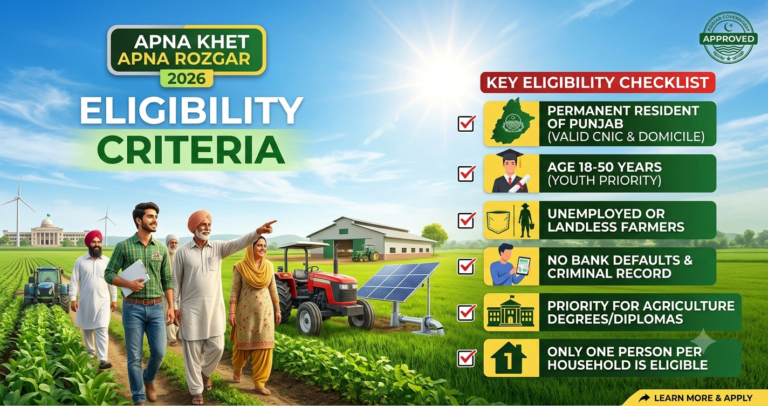
Who Can Apply
- Age: Applicants must fall between 21 and 45 years old at the time of application.
- Residency: Must hold a valid CNIC confirming permanent residence in Punjab.
- Employment status: Government employees are generally excluded; the scheme targets private citizens seeking self-employment.
- Business plan: A documented business plan or project summary is mandatory, even for small loan tiers.
- Existing or new business: Both first-time founders and owners looking to expand an existing small enterprise can apply, though the documentation burden differs.
Comparing the Loan Tiers
| Tier | Loan Amount | Typical Use Case | Collateral Required |
|---|---|---|---|
| Starter Tier | PKR 50,000 – 200,000 | First-time micro-business, home-based shop, freelance setup | None |
| Growth Tier | PKR 200,001 – 500,000 | Small retail, service businesses, IT/digital ventures | Minimal — guarantor-based |
| Expansion Tier | PKR 500,001 – 1,000,000 | Established small business scaling operations | Bank-assessed, may require partial guarantee |
A point worth underlining for working professionals: the Starter and Growth tiers are the ones most accessible to recent graduates and first-time applicants, since they avoid heavy collateral requirements and have a faster verification cycle. The Expansion tier, by contrast, involves a more thorough financial assessment because the amounts disbursed are higher and repayment risk increases accordingly.
Female applicants are explicitly prioritized in processing order under the scheme’s published criteria, reflecting a province-wide push to raise women’s participation in formal entrepreneurship. IT, e-commerce, and digital service businesses also receive favorable treatment, acknowledging how much of Punjab’s youth economic activity has shifted toward freelancing and online commerce over the past several years.
Step-by-Step Application Process
Applying correctly the first time saves weeks of delay. Here is the sequence as designed by the program.
- Visit the official Punjab government portal. Do not use third-party “agent” websites that ask for advance fees — the scheme has no application charge, and the only legitimate entry point is the official provincial portal.
- Create your applicant profile. You will need your CNIC number, a working mobile number linked to your CNIC, and an active email address for status updates.
- Select your business category. Choose from the listed sectors — retail, services, IT/freelance, manufacturing, agriculture-adjacent, or livestock/dairy — since this determines which tier and partner institution reviews your file.
- Upload your business plan. This should include a short description of the business, expected monthly revenue, how the loan amount will be used (equipment, inventory, setup costs), and a basic repayment projection. Keep this realistic; reviewers flag overly optimistic projections.
- Attach supporting documents. Typically required: CNIC copy (front and back), recent passport-size photograph, proof of residence, and — where applicable — proof of any existing business registration or trade license.
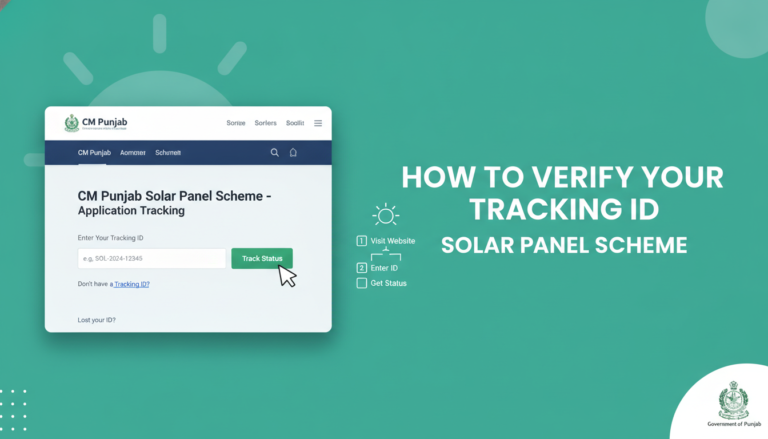
- Submit and record your reference number. Every successful submission generates a tracking number. Save it; this is how you will check status and respond to any verification requests.
- Await verification. A designated partner bank or provincial committee reviews the application, which may include a phone call or in-person visit to confirm details on the business plan.
- Attend the interview or evaluation, if scheduled. Some tiers, especially Growth and Expansion, require applicants to briefly explain their business plan to a loan officer.
- Receive approval notification. Approved applicants are notified via SMS and the registered email, with instructions on disbursement.
- Funds disbursed to your bank account. Disbursement is electronic; no cash handling is involved, which is part of the scheme’s transparency design.
Processing time varies by district and current application volume, but applicants should expect several weeks between submission and disbursement rather than instant approval — a fact several first-time applicants find frustrating if they go in expecting same-week funding.
Benefits, Challenges, and Practical Solutions
What Works Well
- Zero interest burden removes the single biggest cost that discourages young borrowers from formal lending.
- Low collateral requirement at the entry tiers opens the door to applicants with no property or fixed assets.
- Sector flexibility means freelancers and digital businesses are treated as legitimately as physical retail shops.
- Digital tracking of applications reduces the opportunities for informal “facilitation fees” that plagued older, paper-based government schemes.
Where Applicants Run Into Trouble
The most common failure point is a weak or vague business plan. Reviewers reject applications that read like generic templates rather than a specific, costed plan for a specific business. The fix is straightforward: include real numbers — expected startup costs, a simple monthly revenue estimate, and exactly what the loan amount will be spent on.
A second recurring issue is document mismatches — a CNIC address that doesn’t match the proof of residence, or a phone number not registered under the applicant’s own name. Triple-check that every document uses identical, current details before submission.
Third, fraudulent intermediary websites have multiplied around every government loan scheme in Pakistan, charging “processing fees” for a service that is free on the official portal. Applicants should treat any request for upfront payment as an immediate red flag and verify the URL against the official government domain before entering any CNIC or banking details.
Finally, rural connectivity gaps make a fully digital application difficult for some eligible applicants. Where this is a barrier, designated bank branches and facilitation desks are generally available to assist with the online submission in person.
Future Outlook: What Comes Next
Provincial youth loan schemes in Pakistan tend to expand in scope once early disbursement cycles prove manageable default rates, and Punjab’s program is expected to follow that pattern over the next one to two years — likely with higher ceiling amounts for the Expansion tier and tighter integration with SMEDA’s free business advisory services. Expect continued emphasis on women entrepreneurs and IT-sector applicants, two groups the provincial government has repeatedly singled out for priority treatment. Digital verification is also likely to tighten further, both to speed up processing and to close the loopholes that fraudulent facilitators currently exploit. Applicants who build a credible track record on smaller Starter-tier loans will likely find a smoother path toward larger financing in future cycles.
Final Word
The CM Punjab Youth Business Loan Scheme represents a genuine, low-barrier entry point into formal entrepreneurship for thousands of young Punjabis who previously had nowhere to turn but high-interest informal lenders. Its real value lies not in the headline loan amount but in what it removes from the equation: interest payments, heavy collateral, and the opacity that used to define government lending programs. Applicants who treat the business plan section seriously, keep documentation consistent, and apply only through the official portal stand the best chance of moving from idea to funded business within a single application cycle.