A woman in a remote Punjab district with sixteen years of education and zero access to a paid digital job is exactly who the CM Punjab SEHR Program 2026 was built for — and so is a widow in Multan who never finished school but wants a beautician certificate that actually opens doors. Skill Enhancement Through Home Reach launched specifically to close that gap, pairing free training with equipment, stipends, and a path toward real income rather than just a certificate to frame.
This guide breaks down all three SEHR training tracks straight from the Women Development Department’s own program page — eligibility by track, what “home reach” actually means in practice, and exactly how registration and shortlisting work.
Quick Reference Box
| Detail | Information |
|---|---|
| Full Name | Skill Enhancement Through Home Reach (SEHR) |
| Administered By | Women Development Department (WDD), Government of Punjab |
| Executing Partner (Digital Track) | Punjab Skills Development Fund (PSDF) |
| Target Beneficiaries | 5,365 women |
| Budget | Rs. 970 million |
| Training Tracks | Digital Skills, Beautician, Hospitality |
| Helpline | 1043 |
| Official Page | wdd.punjab.gov.pk/SEHR |
Background: Why “Home Reach” Became the Program’s Whole Design Principle
Punjab’s Women Development Department has run smaller-scale skills and support initiatives for years — Working Women Hostels, Women Development Centers, and digital literacy pushes among them — but each carried the same structural flaw: women in remote and semi-urban areas still had to travel to access them. For a woman managing a household alone, facing family restrictions on mobility, or simply living too far from a training center, that travel requirement was often the actual barrier, not a lack of interest in learning a skill.
Chief Minister Maryam Nawaz Sharif framed SEHR as a direct answer to that problem, formally announcing the program and describing its goal as turning Punjab’s female population into an active economic asset rather than leaving that potential untapped. The province committed Rs. 970 million to the effort, with a stated target of training 5,365 women in beautification services, hospitality, and digital technology. The Chief Minister specifically highlighted job placement support as part of the package, alongside the training itself.
The program’s design reflects priorities written directly into Punjab’s broader growth strategy, aligning explicitly with Sustainable Development Goals 1, 4, 5, 8, and 10 — poverty reduction, education, gender equality, decent work, and reduced inequality. Enrollment runs through community mobilization, meaning local leaders, district administration staff, and WDD field officers actively identify and reach out to eligible women rather than relying solely on women finding the program themselves, a deliberate choice given how many potential candidates have limited internet access or awareness of government programs in the first place.
Core Mechanics: Three Tracks, Three Very Different Eligibility Bars
“Home Reach” doesn’t mean the same thing across all three tracks, and understanding that distinction matters before applying.
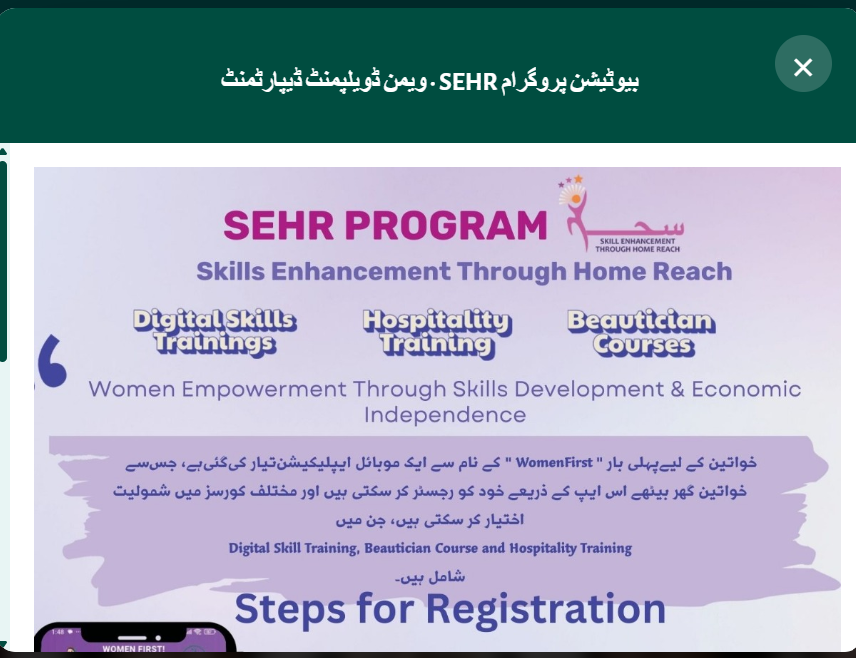
Digital Skills Track (“Mein Digital”)
This is the only track delivered genuinely from home — entirely online, sponsored by WDD and executed through the Punjab Skills Development Fund.
- Duration: 6 months
- Training mode: Online classes only
- Course content: English language, digital skills, content creation, e-commerce, soft skills
- Support provided: Laptop, internet device, internet data package, and a monthly stipend of Rs. 5,000
- Restricted to: Rural women only
- Education requirement: Minimum 16 years of education or equivalent — effectively a bachelor’s degree level
Beautician Track
- Duration: 2 months
- Training mode: In-person only, not online or hybrid
- Course content: Nail art, skin care, hair care, and makeup
- Education requirement: Minimum literate
- Priority groups: Widows, divorced women, and low-income applicants
Hospitality Track
- Duration: 3 months
- Training mode: In-person only, not online or hybrid
- Course content: Hospitality sector training, including service-industry fundamentals
- Education requirement: Minimum Matric
- Priority groups: Widows, divorced women, and low-income applicants
Full Eligibility Comparison
| Criteria | Digital Skills | Beautician | Hospitality |
|---|---|---|---|
| Age | 90% quota up to 30 years; 10% above 30 | 18–45 years | 18–45 years |
| Residency | Rural women only | All of Punjab | All of Punjab |
| Education | 16 years (degree level) | Minimum literate | Minimum Matric |
| Mode | Fully online | In-person only | In-person only |
| Duration | 6 months | 2 months | 3 months |
| Financial Support | Rs. 5,000/month stipend + equipment | None specified | None specified |
The name “Home Reach” applies most literally to the digital track, where training genuinely happens inside the applicant’s home. For Beautician and Hospitality, it means the program travels closer to women’s communities through district-level batches rather than requiring a single distant training hub — not that an instructor visits each individual household.
Step-by-Step: How to Register and Get Selected
Step 1: Identify the Right Track for Your Profile
Match your education level and residency status against the eligibility table above before applying. A rural woman with a bachelor’s degree should target the Digital track; a woman with limited formal education, particularly a widow or divorcee, is better positioned for Beautician or Hospitality.
Step 2: Visit the Official WDD Portal
- Go to wdd.punjab.gov.pk/SEHR
- Review the three track sections — Digital Skills, Beautician, Hospitality
- Click “Register Now” under your chosen track
Step 3: Complete the Registration Form
Provide accurate personal details, including full name, CNIC number, age, education level, and contact information. Inconsistent or inaccurate details at this stage are a common reason applications get filtered out before shortlisting even begins.
Step 4: Watch for Community Mobilization Outreach
Because enrollment also runs through local leaders and district administration staff, some women are contacted directly rather than applying cold through the portal. If a WDD representative or local official reaches out about SEHR, that outreach is part of the program’s standard design, not an irregularity.
Step 5: Attend Shortlisting — Test or Interview
Shortlisting for all three tracks runs through an eligibility check followed by a test or interview. Official WDD notices have specified exact interview dates, times, and locations by city — Faisalabad and Multan batches, for example, ran multi-day interview windows at announced venues. Applicants are explicitly required to bring their original CNIC to any in-person interview.
Step 6: Begin Training Once Selected
Digital track participants start six months of fully online classes with their provided laptop and internet package. Beautician and Hospitality participants attend in-person sessions at their assigned batch location for the program’s set duration.
Step 7: Complete Certification
All three tracks end with a test-based evaluation, after which successful participants receive a recognized certification confirming completed training.
Benefits, Challenges, and Practical Solutions
What This Program Gets Right
- Removes the mobility barrier directly for digital-track participants, who never need to leave home to train or use the equipment they’re given
- Stacks real financial support — laptop, internet device, data package, and a monthly stipend — on top of the training itself, rather than offering instruction alone
- Builds in explicit priority for widows, divorced women, and low-income applicants across the in-person tracks, targeting genuinely vulnerable groups rather than a general applicant pool
Where the Design Creates Real Friction
- The math is tight. A target of 5,365 trained women across an entire province with tens of millions of working-age women means competition for seats will be intense, regardless of how many people technically qualify.
- The Digital track’s education bar excludes the women who often need it most. Requiring 16 years of education for the one track that offers equipment and a stipend leaves less-educated rural women — frequently in greater financial need — limited to unpaid, shorter in-person tracks instead.
- In-person tracks still require travel to a batch location, which can replicate the very mobility barrier the program’s branding suggests it eliminates, just at a more local scale than before.
- A wave of unofficial websites has already begun publishing speculative “registration portal” guides for SEHR, some pointing to links that aren’t the actual WDD domain.
What Actually Solves These Problems
- Apply as early as a batch opens in your district rather than waiting, given the limited seat count relative to demand.
- If your education level falls short of the Digital track’s requirement, the Beautician or Hospitality tracks remain genuinely accessible options rather than a lesser substitute.
- Treat only wdd.punjab.gov.pk/SEHR as the authoritative registration source, and verify any third-party “apply now” link against that domain before entering personal information.
- Confirm batch dates and locations through the 1043 helpline if a local notice seems unclear or unverifiable.
Future Outlook: Where SEHR Is Likely Headed
With an overall program window stretching across 24 months and current batches rolling out city by city — Faisalabad and Multan among the first — expect continued geographic expansion into additional districts rather than a single province-wide launch. The explicit emphasis on job placement, not just training, points toward likely partnerships with hospitality and beauty-industry employers willing to absorb graduates directly. Given the Chief Minister’s direct public involvement in the launch, a seat-target increase or program extension is plausible if early batches show strong completion and placement rates, following a pattern visible across several of Punjab’s other women-focused initiatives this year.
Final Word
SEHR’s real innovation isn’t the training content itself — digital marketing, beautician skills, and hospitality fundamentals are taught in plenty of places — it’s the decision to route delivery through community mobilization and local batches instead of assuming women can simply show up at a distant training center on their own. That design choice matters more for who actually benefits than any single course module does. Whether a woman qualifies for the equipped, stipend-paying Digital track or one of the shorter in-person tracks built specifically with widows and low-income applicants in mind, the path forward starts with the same accurate registration and a willingness to attend the shortlisting test or interview when it’s scheduled.



One Comment