Last Updated: May 2026 | By: DailyAgahi Team
Are you a BISP beneficiary who went to collect your payment — and the biometric machine rejected your fingerprint? Or are you confused about how the NADRA biometric system connects with BISP 8171 and whether you even qualify for the Rs. 14,500 installment?
You are not alone. Thousands of families across Pakistan face this exact problem every quarter. They travel long distances, stand in queues for hours, and then hear the worst words: “Aapki biometric verification fail ho gayi.”
This guide is written to solve that problem once and for all. Whether you are a new applicant, an existing beneficiary, or someone whose payment was blocked due to fingerprint issues — this article covers everything you need to know about the NADRA Biometric BISP 8171 Payment system in 2026.
We will explain the process in simple, step-by-step language so that anyone can understand it — no matter your education level or technical background.
What Is the NADRA Biometric BISP 8171 Payment System?
The Benazir Income Support Programme (BISP) is Pakistan’s largest social protection program. It provides quarterly cash payments to low-income families — primarily to women who are registered as the head of their household.
To make sure that only genuine, deserving people receive this money, BISP uses a biometric verification system that is directly linked to the National Database and Registration Authority (NADRA). “Ready to see if your funds have been released? Use our official tool to check BISP balance online by CNIC and ensure you have received the latest installment.”
Here is how the system works in simple terms:
- Step 1: Your information is stored in NADRA’s database when you get your CNIC (Computerized National Identity Card) made. This includes your fingerprints and photograph.
- Step 2: When you go to collect your BISP payment at a campsite, bank, ATM, or authorized agent, the machine scans your fingerprint.
- Step 3: The machine checks your fingerprint against NADRA’s records. If the fingerprint matches, your identity is confirmed and you receive your money.
- Step 4: If the fingerprint does not match, the system blocks the payment to prevent fraud.
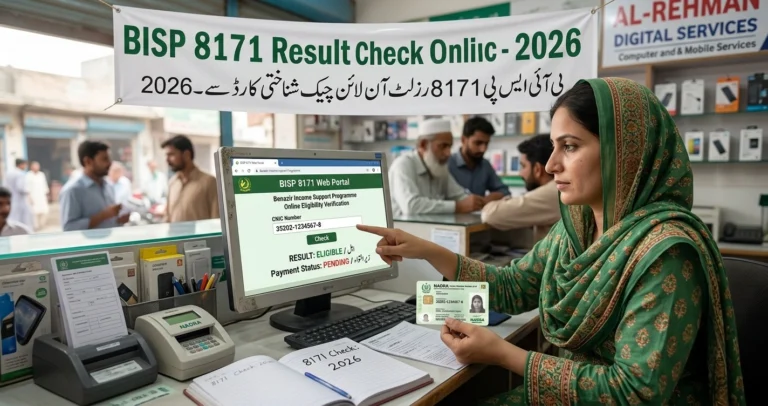
The 8171 number is the official helpline and SMS service where you can check your eligibility, payment status, and get updates about the program. You can either send an SMS to 8171 or visit the web portal at 8171.bisp.gov.pk.
Why Does This System Exist?
Before biometric verification was introduced, there were widespread problems with the BISP program. Middlemen and agents used to collect payments on behalf of beneficiaries and take a cut. Ghost beneficiaries (people who did not exist or had died) were receiving payments. Political interference affected who received support and who did not.
The biometric system eliminated most of these issues. Now, only the person whose fingerprint is registered in NADRA can withdraw the payment. This has made the system significantly more transparent and fair.
Key Programs Under BISP That Use Biometric Verification
| Program Name | What It Provides | Payment Amount (2026) |
|---|---|---|
| Benazir Kafaalat | Quarterly cash support to women | Rs. 14,500 per quarter |
| Benazir Taleemi Wazaif | Education stipend for children | Rs. 2,000 – 4,000 per child |
| Benazir Nashonuma | Nutrition support for pregnant women and infants | Conditional cash + supplements |
| BISP Emergency Cash | One-time disaster relief | Varies by emergency |
| Ramzan Relief Package | Subsidized food items during Ramadan | Conditional benefit |
Pro Tip: The Kafaalat payment has been increased from Rs. 13,500 to Rs. 14,500 in 2026. A further increase to Rs. 19,500 has been committed to the IMF and is expected to begin from January 2027.
Complete Eligibility Criteria for BISP 8171 Payment
Not everyone qualifies for BISP payments. The government uses a data-driven system to identify the most deserving families. Here is a complete breakdown of who is eligible and who is not.
Who IS Eligible?
To qualify for the BISP Kafaalat payment in May 2026, you must meet ALL of the following conditions:
- You must be a Pakistani citizen with a valid, active CNIC.
- You must be a woman (the program targets female heads of household).
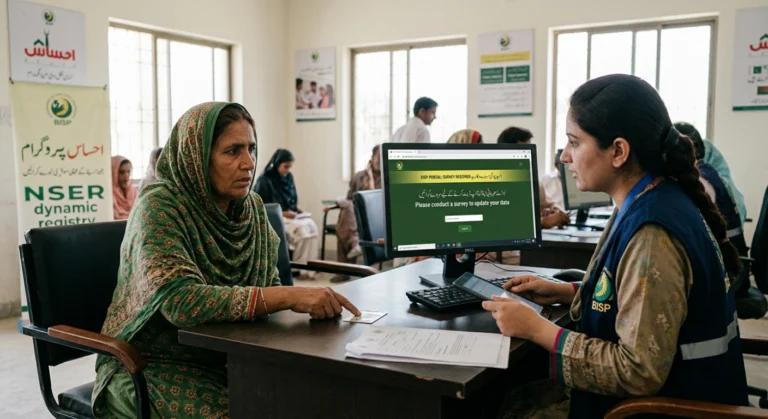
- Your family must be registered in the National Socio-Economic Registry (NSER) through the dynamic survey.
- Your PMT (Proxy Means Test) score must be 32 or below.
- Your CNIC must not be expired — it must be current and valid.
- Your biometric data (fingerprints) must be updated and active in NADRA’s system.
- Your mobile number must be registered under your CNIC for receiving SMS notifications.
- You must have completed the NSER dynamic survey within the last 3 years.
Who Is NOT Eligible?
Even if you are low-income, you will be disqualified if any of the following applies:
- Your PMT score is above 32.
- Any family member is a government employee (especially high-ranking positions).
- Your family owns a registered vehicle (car, tractor, etc.).
- Your family owns large agricultural land or commercial property.
- Your CNIC is expired or blocked.
- Your NSER survey data is older than 3 years and has not been updated.
- You have a record of frequent international travel.
- Your monthly electricity consumption consistently exceeds 200-300 units.
- You provided false information during the survey (this can lead to permanent disqualification).
Understanding the PMT Score
The PMT (Proxy Means Test) score is the most critical factor in your eligibility. It is a number generated from the NSER survey data that reflects your family’s economic condition. Here is how different score ranges are treated:
| PMT Score Range | Category | Eligibility Status |
|---|---|---|
| 0 – 20 | Ultra-Poor | Highest priority — eligible for Kafaalat + Ramzan Relief + all programs |
| 21 – 32 | Vulnerable / Poor | Eligible for Kafaalat, Taleemi Wazaif, health insurance (Sehat Card) |
| 33 – 40 | Lower-Middle | NOT eligible for Kafaalat — may qualify for interest-free loans, solar panel subsidies |
| Above 40 | Not Poor (by criteria) | Not eligible for any BISP program |
Warning: Your PMT score can change even after you are registered. If you buy a motorcycle, build a cemented house, or a family member gets a job, your score may increase above 32 — and your payments will stop automatically. Always be aware of how lifestyle changes affect your score.
Required Documents
When visiting any BISP office, NADRA center, or payment collection point, always carry the following documents. Missing even one can cause delays.
For Checking Eligibility and Registration
- Original CNIC (valid, not expired) of the female beneficiary
- Children’s B-Forms (birth certificates issued by NADRA)
- Registered mobile phone with active SIM linked to CNIC
- Any previous BISP correspondence or SMS confirmations
For Collecting Payment
- Original CNIC (mandatory — no photocopy accepted)
- Registered mobile phone (for OTP verification at some locations)
For Resolving Biometric Issues
- Original CNIC
- Registered mobile number
- Payment confirmation SMS from 8171 (if received)
- Children’s B-Forms (if applicable)
- Any medical certificate (if fingerprints are damaged due to medical condition)
Pro Tip: Always keep a photocopy of your CNIC and B-Forms at home separately. If your original documents are lost, you can use the photocopy to apply for replacements at NADRA without delay.
Step-by-Step Application and Verification Process
There are three ways to check your BISP eligibility and payment status. We will explain each one in detail.
Method 1: Online Portal (Recommended)
This is the fastest and easiest method if you have access to a smartphone or computer with internet.
- Step 1: Open your phone’s browser (Chrome, Safari, or any browser).
- Step 2: Go to the official website: 8171.bisp.gov.pk
- Step 3: You will see a form asking for your CNIC number. Enter your 13-digit CNIC number without dashes (for example: 3520212345678).
- Step 4: Enter the captcha code shown on the screen. This is a security check to prove you are a real person, not a computer.
- Step 5: Click the “Check / Submit” button.
- Step 6: The system will display your status. It will show one of these results: your eligibility status (Eligible / Ineligible), your payment status (Released / Pending / Not Available), and your PMT score category.
- Step 7: If it shows “Eligible” and payment is “Released,” you can go to collect your payment with biometric verification.
Method 2: SMS Service (Best for Rural Areas)
If you do not have internet access, the SMS method works on any basic phone — even a simple keypad phone.
Step 1: Open the Messages app on your phone.
Step 2: Type your 13-digit CNIC number (without dashes).
Step 3: Send this message to 8171.
Step 4: Wait for a reply message. It usually comes within a few minutes. The reply will tell you whether you are eligible and whether your payment has been released.
Important: The 8171 SMS service works on all networks — Jazz, Zong, Telenor, and Ufone. There is no special SIM required. Standard SMS charges apply.
Method 3: Visit BISP Tehsil Office (For Complex Issues)
If you are facing issues that cannot be resolved online or via SMS — such as biometric failure, missing registration, or incorrect data — you must visit your nearest BISP Tehsil Office in person.
Step 1: Find your nearest BISP Tehsil Office. You can ask at your local government office or search online.
Step 2: Visit the office during working hours (usually 9 AM to 4 PM, Monday to Friday). Go early in the morning to avoid long queues.
Step 3: Bring all required documents (CNIC, B-Forms, mobile phone).
Step 4: Explain your issue to the BISP officer. They can check your complete record, update your information, request a re-survey, resolve biometric verification failures, and register a formal complaint.
Step 5: Get a written acknowledgment or reference number for your complaint. This is your proof that you visited and submitted your issue.
How to Collect Your BISP Payment Through Biometric Verification
Once your payment status shows “Released” on the 8171 portal or SMS reply, follow these steps to collect your money.
Available Collection Points
You can collect your payment from any of these authorized locations:
- BISP Campsites/Payment Centers — Set up in each district during payment distribution phases.
- Partner Bank Branches — Banks like HBL, Bank Alfalah, and UBL have designated BISP counters.
- ATMs with Biometric Support — Some ATMs are equipped with fingerprint scanners for BISP withdrawals.
- Authorized Retail Agents — Selected shops and franchises (like JazzCash or Easypaisa agents) authorized by BISP.
The Payment Collection Process
Step 1: Go to any authorized payment center with your original CNIC.
Step 2: Show your CNIC to the operator or agent.
Step 3: The operator will enter your CNIC number into the system.
Step 4: Place your thumb (fingerprint) on the biometric scanner.
Step 5: The machine will verify your identity by matching your fingerprint with NADRA’s database.
Step 6: If verification is successful, you will receive your full payment amount in cash.
Step 7: Always collect a printed receipt. This receipt is your proof of payment. It helps you verify that no illegal deductions were made.
Critical Warning: BISP services are completely FREE. No one should charge you any fee, commission, or percentage for checking your status or collecting your payment. If anyone asks for money, they are committing fraud. Report them to the BISP helpline immediately.
Benefits of the Biometric Verification System
The NADRA biometric system provides significant advantages for both beneficiaries and the government. Here is a comparison of the old system versus the new biometric system:
| Feature | Old System (Before Biometric) | New Biometric System (2026) |
|---|---|---|
| Identity Verification | Manual, paper-based | Digital fingerprint + facial recognition |
| Fraud Prevention | Weak — middlemen could collect on behalf | Strong — only registered person can withdraw |
| Payment Speed | Slow, sometimes weeks | Fast, usually same-day |
| Transparency | Limited audit trail | Complete digital record |
| Ghost Beneficiaries | Common problem | Almost eliminated |
| Accessibility | Only at specific offices | ATMs, banks, agents, campsites |
| Error Resolution | Very slow | Faster through NADRA-BISP coordination |
| Cost to Beneficiary | Often required paying agents | Completely free |
Additional Benefits in 2026
Beyond the core Kafaalat payment, eligible families can access several additional benefits. These include Benazir Taleemi Wazaif (education stipends for school-going children with minimum 70% attendance), the Nashonuma Program (nutrition support for pregnant women and infants), Ramzan Relief Packages (subsidized essential food items during Ramadan), and priority access during emergency cash distributions after natural disasters. The NADRA facial biometric system, launched in January 2026, also means that people who previously could not pass fingerprint verification — especially elderly citizens and laborers with worn fingerprints — now have an alternative way to verify their identity using facial recognition.
Important Dates, Deadlines & Latest Updates (May 2026)
Staying updated on the latest BISP news is crucial. Here are the most important updates as of May 2026:
Payment Amount: The current Kafaalat installment is Rs. 14,500 per quarter. This was increased from Rs. 13,500 earlier in 2026.
Upcoming Increase: The government has committed to the IMF that the payment will increase to Rs. 19,500 starting January 2027. The total program budget is also being expanded to cover approximately 1.02 crore (10.2 million) families.
NSER Survey Deadline: Beneficiaries whose last NSER survey was conducted more than 3 years ago must complete an updated dynamic survey. Those who did not update by December 2025 were removed from the program, but re-registration windows have been opened in April-May 2026 for previously excluded families.
Biometric System Upgrade: In 2026, BISP and NADRA upgraded biometric scanners across the country with higher-accuracy fingerprint devices and introduced facial recognition as an alternative verification method in selected districts.
NADRA Facial Biometric Certificate: Since January 20, 2026, citizens can obtain a facial biometric verification certificate from any NADRA Registration Center. This certificate is accepted for banks, SIM registration, and government services — including BISP payment collection.
New Beneficiaries: An additional 2 lakh (200,000) new families are expected to be added to the program by the end of 2026.
Phase 4 Payments: Phase 4 payment distribution is ongoing across Pakistan, with new districts being added in each phase.
Pro Tip: Check the 8171 portal every 2-3 days during payment distribution periods. Sometimes payments are released in phases by district, so your payment may appear a few days after the official announcement.
Common Mistakes and Their Solutions
Many beneficiaries lose their payments or face unnecessary delays because of avoidable mistakes. Here are the most common problems and exactly how to solve them.
Mistake 1: Fingerprint Verification Failure
Why it happens: Faded fingerprints (common in elderly people and manual laborers), dry or cracked skin, dirty hands, outdated biometric records at NADRA, or malfunctioning biometric machines.
Solution: Clean and moisturize your hands before scanning. Try using a different finger. Visit a different payment center (machines vary by location). If the problem persists, go to your nearest NADRA Registration Center and request a biometric data update. After updating at NADRA, wait 24-48 hours for the system to sync, then try again.
Mistake 2: Expired CNIC
Why it happens: Many beneficiaries do not realize their CNIC has expired.
Solution: Check the expiry date on your CNIC immediately. If it is expired, visit your nearest NADRA office and apply for renewal. You cannot receive any BISP payment with an expired CNIC. This is non-negotiable.
Mistake 3: Not Updating NSER Survey Data
Why it happens: BISP registration is valid for 3 years. After that, your data becomes outdated and you may be removed from the program.
Solution: Visit your BISP Tehsil Office and complete the dynamic survey update. Bring your CNIC and children’s B-Forms. The process usually takes 10-30 days to reflect in the system.
Mistake 4: Trusting Unofficial Agents or Websites
Why it happens: Scammers create fake websites, WhatsApp groups, and social media pages claiming they can register you for BISP or fix your eligibility for a fee.
Solution: BISP registration and all services are 100% free. Never pay anyone. Never share your CNIC number, OTP, or mobile codes with strangers. Only use the official website 8171.bisp.gov.pk.
Mistake 5: Mobile Number Not Linked to CNIC
Why it happens: If your phone number is not registered under your CNIC at your mobile network, you will not receive important SMS notifications from 8171.
Solution: Visit your nearest mobile franchise (Jazz, Zong, Telenor, or Ufone) and verify that your SIM is registered under your CNIC. If not, complete the biometric SIM registration process.
Mistake 6: Ignoring “Ineligible” Status Without Taking Action
Why it happens: Some beneficiaries check the portal, see they are ineligible, and simply give up.
Solution: If you believe your status is wrong, visit the BISP Tehsil Office immediately. Request a re-survey. If your financial condition has genuinely worsened (job loss, medical emergency, death of breadwinner), a new survey can adjust your PMT score and restore your eligibility.
Mistake 7: Not Collecting a Receipt After Payment
Why it happens: In the rush to collect money, many beneficiaries forget to ask for a receipt.
Solution: Always insist on a printed receipt. Check the receipt to confirm the full amount was given and no unauthorized deductions were made. If the amount is less than what was shown on the portal, report it to the BISP helpline immediately.
Frequently Asked Questions (FAQs)
Conclusion — Take Action Today
The NADRA Biometric BISP 8171 Payment system is designed to help Pakistan’s most vulnerable families receive financial support in a secure, transparent, and fraud-free manner. Whether you are receiving the Rs. 14,500 Kafaalat payment, education stipends for your children, or nutrition support — the biometric verification process is your gateway to these benefits.
Here is what you should do right now:
Check your status immediately. Go to 8171.bisp.gov.pk or send your CNIC to 8171 via SMS. Know where you stand.
Verify your documents. Make sure your CNIC is not expired and your mobile SIM is registered under your CNIC.
Update your records. If your NSER survey is older than 3 years, visit the BISP Tehsil Office and complete the dynamic survey before your eligibility lapses.
Fix biometric issues early. Do not wait until payment day to discover that your fingerprint is not working. Visit NADRA proactively and update your biometric data, or get the new Facial Biometric Verification Certificate.
Stay alert against fraud. Never share your CNIC, OTP, or personal information with anyone claiming to be a BISP agent. All services are free. If someone asks for money, they are a scammer.
The government has committed to expanding the program and increasing the payment amount to Rs. 19,500 by January 2027. Staying registered, keeping your data updated, and understanding the system will help you and your family continue receiving this important support.
Your rights are protected by this system — but only if you stay informed and take action.