Losing the main breadwinner of a family is one of the most devastating experiences any household can go through. In Pakistan, thousands of widows and orphan children face financial ruin every year because their primary earning member is no longer there. Bills pile up, children struggle to stay in school, and daily expenses become an overwhelming burden. If you are a widow living in Punjab, or if you know someone who is, the CM Punjab Rehmat Card 2026 could be the lifeline your family needs.
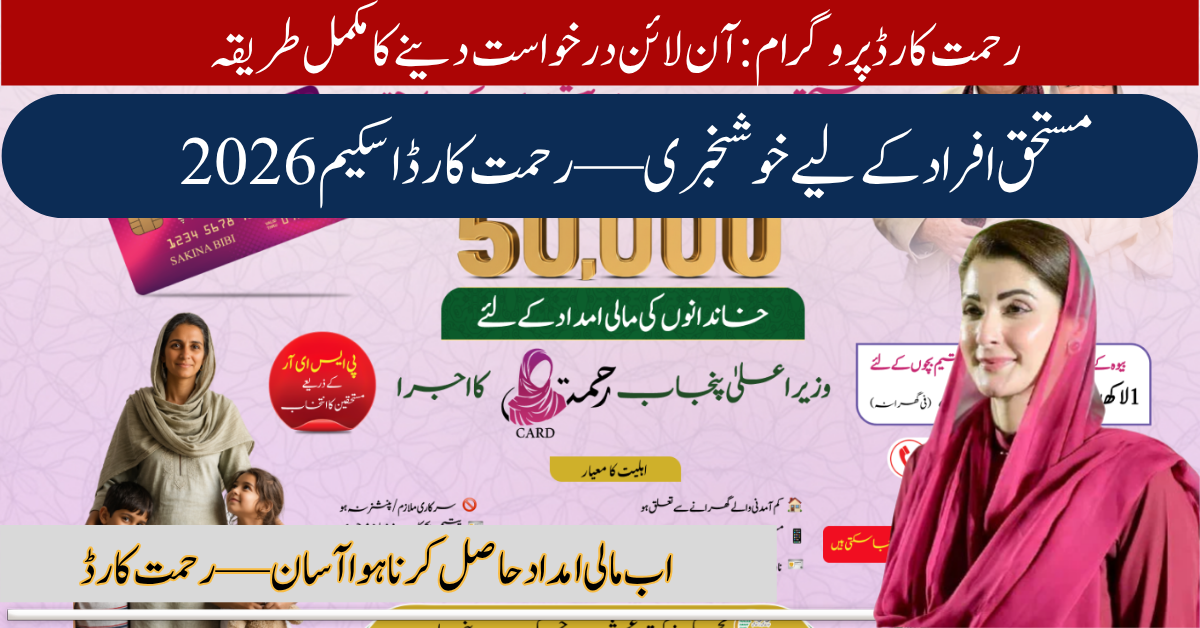
The Rehmat Card is a major welfare initiative launched by the Government of Punjab under Chief Minister Maryam Nawaz Sharif. It provides direct financial assistance of up to Rs. 100,000 for eligible widows and Rs. 25,000 per orphan child, with a maximum family benefit of Rs. 150,000. The best part is that you can apply for it online from your home — no need to run to government offices or deal with middlemen.
But here is the problem: hundreds of websites are sharing incomplete, outdated, or even fake information about the Rehmat Card. Many people are confused about who can apply, what documents are needed, what the official website is, and whether the registration is even open yet. Some have already lost their chance because they submitted incorrect applications or fell for scam websites.
This guide will clear all your confusion. We will walk you through every single step of the application process — online, through the mobile app, via helpline, and in person at district offices. We will also cover eligibility criteria, required documents, common mistakes that cause rejections, and the latest updates as of May 2026. Everything is explained in simple language that anyone can follow.
What Is the Rehmat Card Scheme? Full Details
The CM Punjab Rehmat Card (also written as Rahmat Card) is a social welfare program run by the Zakat and Ushr Department, Government of Punjab. It was introduced under the concept of “Sarkari Kafalat” — meaning state patronage for the most vulnerable members of society.
The program specifically targets two groups of people who are among the most disadvantaged in our society: widows who have lost their husbands, and children who have lost one or both parents (orphans). These families often have no stable source of income and are at high risk of falling into extreme poverty.
How Is the Rehmat Card Different from BISP?
Many people confuse the Rehmat Card with the Benazir Income Support Programme (BISP). While both are welfare programs, they are fundamentally different:
| Feature | Rehmat Card (Punjab) | BISP / Benazir Kafalat |
|---|---|---|
| Scope | Punjab province only | Nationwide (all Pakistan) |
| Target Group | Widows and orphan children specifically | All low-income families |
| Payment Type | One-time lump sum grant | Quarterly recurring payments |
| Amount for Widows | Rs. 100,000 (one-time) | Rs. 13,500 – 14,500 per quarter |
| Amount for Orphans | Rs. 25,000 per child | Through Taleemi Wazaif program |
| Maximum per Family | Rs. 150,000 | Varies by household |
| Managing Department | Zakat and Ushr Department, Punjab | BISP (Federal) |
| Selection Criteria | PSER data + NADRA verification | PMT score via NSER |
| Payment Method | Biometric-enabled bank account / digital wallet | Biometric payment at camps or banks |
This comparison should make it clear that the Rehmat Card is a separate, Punjab-specific initiative. You can potentially benefit from both programs if you meet their respective eligibility criteria.
Why Was the Rehmat Card Launched?
In many parts of Punjab, especially in rural areas and small towns, when the male head of a household passes away, the entire family faces an immediate financial crisis. Widows often have limited education, few employment opportunities, and several children to feed and educate. Many of these women are forced to depend on relatives or charity for survival, which affects both their dignity and their children’s future.
The Rehmat Card program was created to break this cycle. Instead of providing small monthly payments that barely cover basic expenses, the government decided to provide a significant one-time grant that can serve as capital for the family. A widow can use Rs. 100,000 to pay off debts, invest in a small business like tailoring or livestock, or cover her children’s school fees for an entire year.
The Punjab Government has allocated a budget of Rs. 5 billion for this program, with the first phase targeting 50,000 families across the province.
Complete Eligibility Criteria: Who Can and Cannot Apply
Before you start the application process, you must check whether you are eligible. The government has set strict criteria to ensure that the benefits reach only the most deserving families.
Who IS Eligible
- Widows residing in Punjab: The applicant must be a woman whose husband has passed away. Her widow status must be officially registered in the NADRA database (reflected on her CNIC).
- Orphan children under 18 years: Children who have lost one or both parents are eligible for support. Priority is given to double orphans (children who have lost both parents) and children living with a widowed mother.
- Low-income households: Preference is given to families with low poverty scores as assessed through the Punjab Socio-Economic Registry (PSER).
- Valid Punjab CNIC holders: The applicant must hold a valid, non-expired CNIC showing Punjab as the place of residence.
- Zakat-eligible individuals: The program operates under the Zakat and Ushr Department, so applicants should meet Zakat eligibility requirements (meaning they should be financially needy).
Who Is NOT Eligible
- Women whose husbands are alive (even if separated or divorced — unless they also qualify under a different category)
- Residents of provinces other than Punjab (Sindh, KPK, Balochistan, Islamabad, AJK, and GB residents cannot apply)
- Applicants with expired or blocked CNICs
- Women whose CNIC does not reflect “Widow” as their marital status in NADRA records
- Families already receiving substantial monthly stipends from other major provincial welfare programs (additional verification may be required)
- Government employees and their dependents
- Households with high poverty scores in the PSER database
- People who provide false or fabricated information during the application process
| Eligibility Factor | Eligible | Not Eligible |
|---|---|---|
| Marital Status | Widow (NADRA-verified) | Married, divorced (unless widowed), single |
| Province | Punjab resident | Any other province |
| CNIC Status | Valid and active, showing widow status | Expired, blocked, or not updated |
| Income Level | Low-income, Zakat-eligible | High income, government employee |
| Children | Orphans under 18 years | Children with both parents alive |
| PSER Registration | Registered with low poverty score | Not registered or high poverty score |
| Other Benefits | May still qualify (subject to verification) | Receiving major conflicting provincial benefits |
Pro Tip: If your CNIC still shows your marital status as “Married” even though your husband has passed away, your application will be automatically rejected during the NADRA verification step. Visit your nearest NADRA office FIRST and get your marital status updated to “Widow” before applying for the Rehmat Card. This single step saves many women from unnecessary rejection.
Required Documents: What You Need Before Applying
Having all your documents ready before starting the application will save you time and prevent your application from being delayed or rejected. Here is the complete list:
| Document | Purpose | Important Notes |
|---|---|---|
| Valid CNIC of the Applicant (Widow) | Identity and residency verification | Must show “Widow” as marital status. Must not be expired. |
| Husband’s Death Certificate | Proof of widow status | Must be verified by NADRA or issued by the Union Council. |
| CNIC Copy of Deceased Husband | Additional verification | Helps cross-check NADRA records. |
| B-Forms of Children | Verification of orphan children | Required for each child under 18 claiming the Rs. 25,000 grant. |
| Family Registration Certificate (FRC) | Proof of family composition | Issued by NADRA. Shows all registered family members. |
| Domicile Certificate | Proof of Punjab residency | Confirms permanent Punjab residency. |
| Recent Electricity or Gas Bill | Address verification | Must be recent (within 3 months) and match CNIC address. |
| Mobile Number (Registered on Applicant’s CNIC) | OTP verification and SMS notifications | The SIM must be registered in the widow’s own name, not a relative’s. |
| Passport-Size Photograph | Application form attachment | Recent, clear photo with white background. |
| PSER Survey Record (if available) | Poverty score verification | If your household was part of the PSER survey, keep any reference handy. |
Warning: Do not submit blurry, cropped, or illegible scans of your documents when applying online. If the verification team cannot read your documents clearly, your application will be delayed or rejected. Use a scanner or a phone camera in good lighting to take clear pictures.
Step-by-Step Application Process: All Methods Explained
The Punjab Government has made multiple ways available for applying, so that everyone — whether they have internet access or not — can submit their application.
Method 1: Online Application Through the Official Web Portal (Recommended)
This is the fastest and most convenient method. You can complete the entire process from home using a smartphone or computer.
Step 1: Visit the Official Portal. Open your browser and go to the official Rehmat Card registration website. The official portal is managed by the Zakat and Ushr Department, Government of Punjab. The URL is rahmatcard.punjab.gov.pk. Always make sure the web address ends with .punjab.gov.pk — this confirms it is a genuine government website. Do not trust any other website claiming to offer Rehmat Card registration.
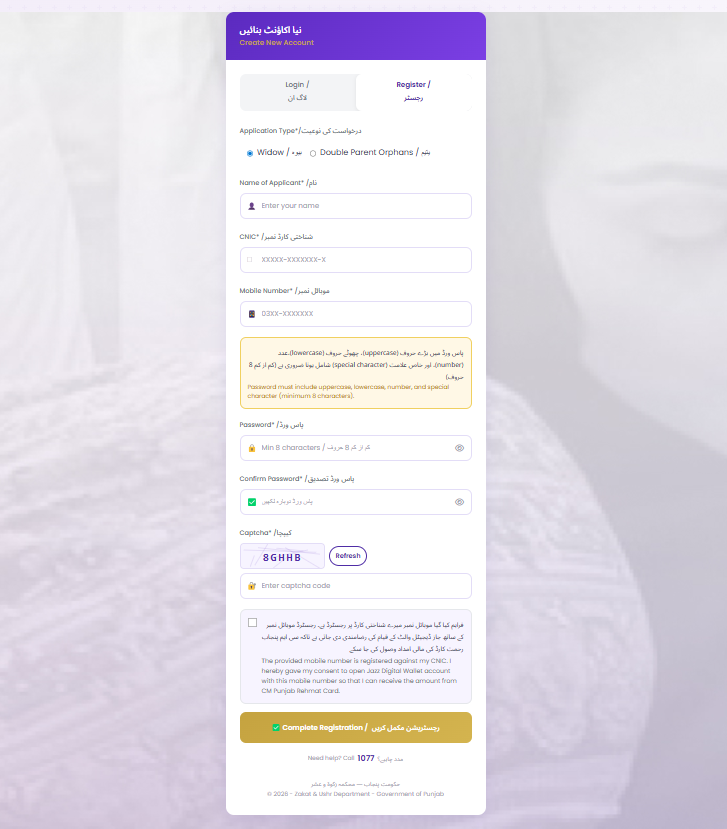
Step 2: Create Your Account. On the portal, click the “Register” option. You will need to enter your 13-digit CNIC number (without dashes or spaces) and your registered mobile phone number. The system will send a 4-digit OTP (One-Time Password) to your phone via SMS. Enter this code to verify your identity.
Step 3: Set Up Your Password. After OTP verification, you will be asked to create a password for your account. Choose something simple that you can remember, but do not share it with anyone.
Step 4: Log In and Fill the Application Form. Once your account is created, log in using your CNIC and password. You will see a detailed application form. Fill in all the required fields carefully:
- Personal details: your full name, father’s name, husband’s name, date of birth, address, tehsil, and district
- Family details: number of children, their names, ages, and B-Form numbers
- Financial status: your current source of income (if any), monthly household expenses
- PSER survey information (if applicable)
Step 5: Upload Your Documents. Attach clear scanned copies or photos of your CNIC, husband’s death certificate, children’s B-Forms, utility bill, and any other required documents. Make sure each file is readable and correctly oriented.
Step 6: Review and Submit. Before clicking “Submit,” carefully review every field. Even small errors — a wrong digit in your CNIC, a misspelled name, or a missing document — can cause your application to be rejected. Once you are satisfied that everything is correct, click “Submit.”
Step 7: Save Your Reference Number. After successful submission, you will receive an Application Reference Number (format: RC-2026-XXXXXX). Write this number down and keep it safe. You will need it to track your application status later. You will also receive a confirmation SMS on your registered mobile numb
Method 2: Through the Rehmat Card Mobile App
The Government of Punjab has also launched an official mobile application for the Rehmat Card program. This app makes it even easier to apply, especially for people who are more comfortable using phones than browsers.
How to use the app:
- Download the “CM Punjab Rahmat Card” app from the Google Play Store. Make sure the developer is listed as the government or PITB (Punjab Information Technology Board).
- Open the app and sign up using your CNIC number.
- Fill in the application form, attach your documents, and submit.
- You can also use the app to check your application status at any time and receive push notifications about updates.
Warning: Only download the official app. Many fake apps with similar names exist on the Play Store. Check the developer name, reviews, and download count before installing. If in doubt, use the web portal instead.
Method 3: Through the Helpline (For People Without Internet)
If you do not have internet access or are not comfortable with technology, you can apply through the official government helpline.
- Call 1077 (the official Zakat and Ushr Department helpline)
- A trained support agent will guide you through the registration process over the phone
- You will need to provide your CNIC number, personal details, and family information verbally
- The agent will enter your information into the system on your behalf
- You will receive a confirmation SMS once your application is registered
Pro Tip: Call during working hours (Monday to Friday, 9 AM to 5 PM) for the shortest wait times. The helpline may be very busy during peak registration periods, so be patient and try again if you cannot get through on the first attempt.
Method 4: In-Person at District Zakat and Ushr Offices (Offline)
For those who prefer face-to-face assistance, every district and tehsil in Punjab has Zakat and Ushr offices where trained staff can help you apply.
What to do:
- Visit your nearest Zakat and Ushr office with all your original documents and photocopies.
- Ask for the Rehmat Card application form.
- A staff member will help you fill out the form if needed.
- Submit the completed form along with all required documents.
- Collect your acknowledgment receipt and reference number.
- Wait for verification and approval notification via SMS.
This method is especially useful for:
- Elderly widows who are not familiar with technology
- Applicants who have questions about their eligibility
- People who need help gathering or correcting their documents
- Cases where the online system is showing errors or is temporarily down
How to Check Your Application Status
After submitting your application, you will naturally want to know whether it has been approved or is still being processed. Here are three ways to check:
Online Portal: Visit the official portal and click on “Track Status.” Enter your CNIC number and click “Submit.” The system will display your current status — Approved, Pending, Under Verification, or Rejected.
Mobile App: Open the Rehmat Card app, log in with your credentials, and your application status will be visible on the dashboard.
SMS Method: Send your 13-digit CNIC number (without dashes) to 8171 via SMS. You will receive a reply with your application status and any relevant details.
Benefits and Financial Assistance: What You Actually Get
The Rehmat Card is not just a symbolic gesture — it provides real, meaningful financial assistance that can change a family’s life. Here is what eligible beneficiaries receive:
For Widows: A one-time grant of Rs. 100,000. This amount is designed to serve as capital that a widow can use for immediate needs or long-term stability. The money can be used for paying off debts, covering medical expenses, investing in a small home-based business (tailoring, embroidery, livestock, or a small shop), paying school fees for children, or covering daily household expenses during a difficult period.
For Orphan Children: A grant of Rs. 25,000 per child for children who have lost one or both parents. This amount helps cover education costs, school supplies, uniforms, healthcare, and basic needs.
Maximum Family Benefit: A family can receive up to Rs. 150,000 in total (Rs. 100,000 for the widow plus Rs. 25,000 for each eligible orphan child, subject to the family cap).
How Will You Receive the Payment?
Once your application is approved and verified, you will receive an SMS notification from the government confirming that your Rehmat Card is ready and funds have been deposited. The payment can be collected through:
- Bank of Punjab (BoP) ATMs using biometric verification (thumb scan)
- Designated bank branches (Bank of Punjab, HBL, or Bank Alfalah depending on your area)
- Authorized retail agents with biometric verification machines
- Digital wallets linked to your CNIC (the government is increasingly encouraging digital disbursement for security and convenience)
Important: Always collect the full amount yourself. Never send someone else to collect on your behalf, and never share your CNIC, OTP, or biometric data with anyone claiming to help you withdraw the money.
Important Dates, Deadlines, and Latest Updates (May 2026)
Staying up to date with the latest developments is crucial. Here is what we know as of May 2026:
- Registration Status: The Rehmat Card registration process has been launched. The official portal at rahmatcard.punjab.gov.pk is live with Register, Login, and Track Status options available.
- First Phase Target: The government plans to support 50,000 families in the first phase across all districts of Punjab.
- Budget: Rs. 5 billion has been allocated for the Rehmat Card program.
- Distribution Timeline: According to reports, disbursement of funds is expected to begin after Eid 2026 for approved applicants in the first phase.
- Verification Process: Applications are being verified through PSER (Punjab Socio-Economic Registry) data, NADRA records, and the Proxy Means Test (PMT). This process may take several weeks depending on the volume of applications.
- Selection Method: The government is using a data-driven approach. Budget is allocated to District Zakat Committees based on population, and beneficiary selection relies on PSER data to identify the most deserving families.
- Mobile App Available: The official CM Punjab Rahmat Card app is available on Google Play Store for easy registration and status tracking.
Warning: The government has not announced a specific “last date” for registration as of this writing. However, since the program has a fixed budget and a target of 50,000 families in the first phase, it is wise to apply as early as possible. Waiting too long could mean that funds are fully allocated before your application is processed.
Common Mistakes and How to Avoid Them
Applications for the Rehmat Card get rejected or delayed every day because of preventable mistakes. Here are the most common ones and exactly how to avoid them:
Mistake 1: CNIC does not show “Widow” status. This is the number one reason for rejection. If your husband passed away but you never updated your CNIC at NADRA, the automated verification system will flag your application. Visit NADRA, get the death of your husband registered, and update your CNIC to reflect your correct marital status before applying.
Mistake 2: Mobile SIM not registered in the applicant’s name. The OTP for online registration is sent to your phone. If your SIM card is registered under your brother’s, son’s, or any other person’s CNIC, the system cannot verify your identity. Get a SIM registered in your own name before starting the application. This is a requirement of the biometric payment system as well.
Mistake 3: Missing or incomplete husband’s death certificate. A death certificate verified by NADRA or issued by the Union Council is mandatory. If you do not have one, obtain it before applying. Without this document, there is no way to verify your widow status.
Mistake 4: Uploading blurry or unreadable document scans. When applying online, many people take poor-quality photos of their documents. If the text is not clearly visible, the verification team will reject the upload. Use good lighting, hold the camera steady, and make sure the entire document is visible in the frame.
Mistake 5: Entering incorrect CNIC numbers. A single wrong digit in your CNIC or your children’s B-Form numbers will cause verification failure. Double-check every number before submitting.
Mistake 6: PSER registration missing. If your household was not covered during the PSER survey, you may face issues during verification. Visit the PSER registration desk at the Assistant Commissioner’s office in your district and update your socio-economic data.
Mistake 7: Applying through fake or unofficial websites. Dozens of unofficial websites and apps are using names like “Rehmat Card Registration” to collect personal data from unsuspecting people. Only use the official government portal (rahmatcard.punjab.gov.pk) or the official app from the Play Store. Never share your CNIC details on any unofficial website.
Mistake 8: Paying agents or middlemen. The entire Rehmat Card application process is completely free. No registration fee, no processing fee, no “speed-up” fee. If anyone asks you for money to help you register, they are committing fraud. Report them to the helpline at 1077.
Frequently Asked Questions (FAQs)
Conclusion: Do Not Wait — Apply Today
The How Can I Apply for Rehmat Card Online 2026? is one of the most significant welfare programs Punjab has introduced for widows and orphan children. With Rs. 100,000 for widows and Rs. 25,000 per orphan child, this is not just pocket money — it is enough to pay off debts, keep children in school, or start a small business that can provide income for years to come.
The program has a fixed budget of Rs. 5 billion and a first-phase target of 50,000 families. This means spots are limited. The earlier you apply, the better your chances of being included in the initial rounds of disbursement, which are expected after Eid 2026.
Here is what you should do right now:
First, check that your CNIC is valid and shows “Widow” as your marital status. If it does not, visit NADRA immediately and get it updated.
Second, gather all your documents: CNIC, husband’s death certificate, children’s B-Forms, family registration certificate, domicile, and a recent utility bill.
Third, visit the official portal at rahmatcard.punjab.gov.pk, create your account, and submit your application. If you do not have internet, call 1077 or visit your nearest Zakat and Ushr office.
Fourth, save your reference number and check your status regularly.
Share this guide with every widow in your family, neighborhood, and community. Many deserving women do not know about this program or do not know how to apply. By spreading the word, you can help someone rebuild their life.
Always verify information from official sources. The official portal is rahmatcard.punjab.gov.pk, the Zakat Department website is zakat.punjab.gov.pk, and the Punjab Government portal is punjab.gov.pk/rahmat-card. For help, call the helpline at 1077.