Last Updated: May 2026 | By DailyAgahi.com
Imagine a woman in a small town in Punjab. Her husband passed away six months ago. She has three young children. The rent is due, the school fees are unpaid, and the gas bill has been sitting on the shelf for weeks. Relatives helped for a while, but that support is drying up. She does not know where to turn next.
This is not a made-up story. This is the reality for thousands of widows across Punjab — women who were managing fine until life took away the one person their family depended on. And for their children, losing a father often means losing their chance at education, at a normal childhood, at a future.
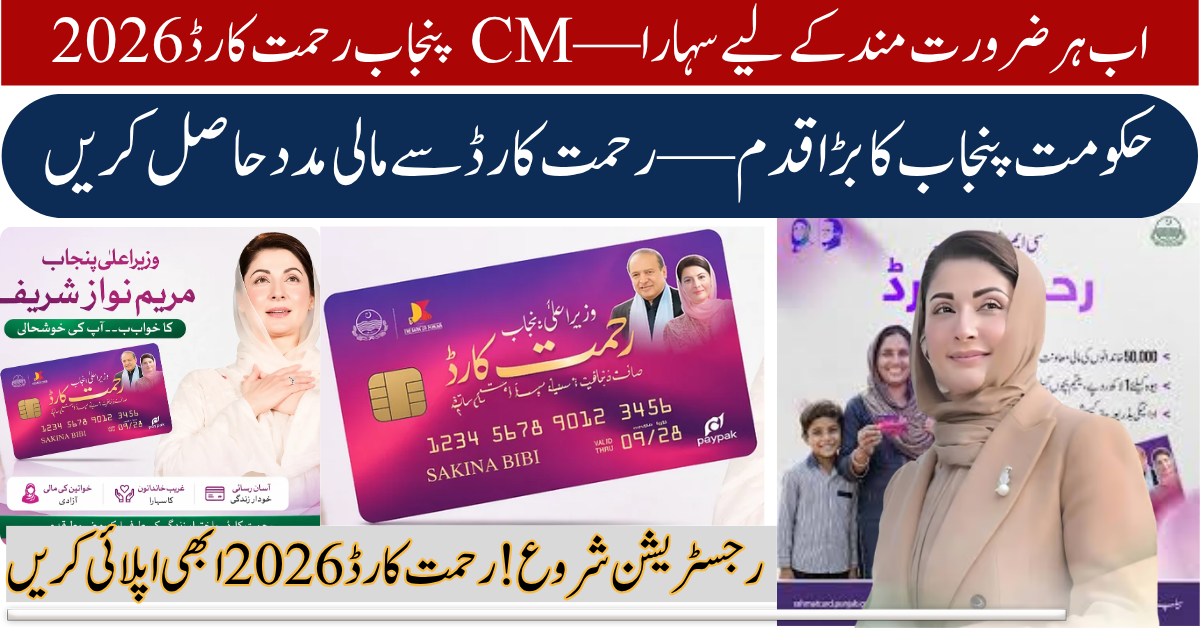
The CM Punjab Rehmat Card 2026 was created for exactly these families. It is one of the largest welfare programs the Punjab government has ever launched specifically for widows and orphan children. According to the official announcement by Radio Pakistan (March 5, 2026), Chief Minister Maryam Nawaz approved this initiative to enable widows and orphans to lead dignified lives — with financial grants of Rs. 100,000 for each eligible widow and Rs. 25,000 per orphan child.
Apna Ghar Scheme Online Apply: Last Date & Eligibility – If you are looking for your own home, check out Maryam Nawaz’s low-cost housing project details and apply before the deadline.
But here is the problem — there is so much wrong, copied, and confusing information on the internet that many deserving families either miss the opportunity completely or fall victim to fraud and fake agents.
That is exactly why we have put together this detailed, verified guide. Every number, every fact, and every step in this article is cross-checked against official government sources. We have kept the language simple so that anyone can understand it — whether you are applying yourself, helping a neighbor, or guiding an elderly family member.
Read this article completely. It could genuinely change a family’s life.
What Is the CM Punjab Rehmat Card 2026?
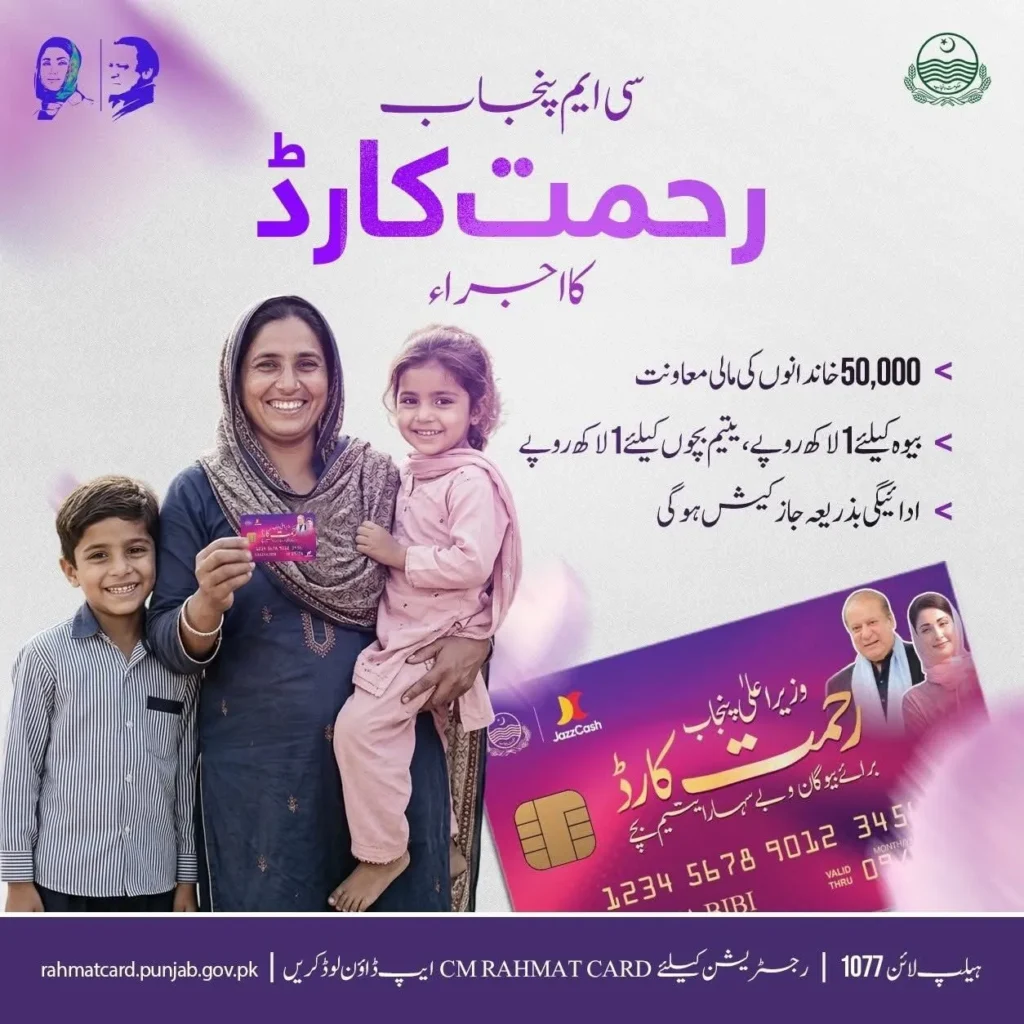
The CM Punjab Rehmat Card is a social welfare initiative approved by Chief Minister Maryam Nawaz Sharif in March 2026. According to the official press release by the Directorate General Public Relations (DGPR), Punjab Government (dgpr.punjab.gov.pk), this program falls under the concept of Sarkari Kafalat (State Patronage), where the government takes direct responsibility for supporting families that have lost their primary earning member.
Radio Pakistan’s official report (March 5, 2026) confirmed that the Chief Minister chaired a meeting in Lahore and approved the project for immediate launch after Eid-ul-Fitr. (Source: radio.gov.pk)
This program is different from older welfare schemes in one major way: instead of giving small monthly payments, the Rehmat Card provides a large one-time financial grant to help widows become financially independent. The idea is to give enough capital so a widow can start a small business, pay for her children’s education, or cover medical and household expenses.
CM Punjab E-Bike Scheme Last Date & Registration – Punjab government is giving interest-free electric bikes to students. Check the deadline and installment plan details here to secure your bike.
Key Facts at a Glance
| Feature | Details |
|---|---|
| Program Name | CM Punjab Rehmat Card (also called Bewa Sahara Card) |
| Launched By | Chief Minister Maryam Nawaz Sharif, Government of Punjab |
| Announced | March 5, 2026 |
| Target Group | Widows and orphan children across Punjab |
| Financial Assistance for Widows | Rs. 100,000 (one-time grant) |
| Financial Assistance per Orphan Child | Rs. 25,000 per child |
| Maximum Possible Amount | Up to Rs. 150,000+ (depending on number of children) |
| First Phase Target | 50,000 families (Source: DGPR Punjab) |
| Distribution Timeline | Started/expected after Eid-ul-Fitr 2026 |
| Payment Method | Direct bank transfer (no middleman) |
| Registration Fee | Completely FREE |
Who Does It Help?
The scheme has two main parts:
Bewa Card (Widow Card): This part is specifically for women who have lost their husbands and are struggling financially. Each eligible widow receives Rs. 100,000 as a one-time financial grant.
Yateem Card (Orphan Card): Children who have lost their father (or both parents) are eligible for Rs. 25,000 per child. This money is meant to support their education, healthcare, and daily needs.
So if a widow has three orphan children, her family could receive Rs. 100,000 + (3 × Rs. 25,000) = Rs. 175,000 in total.
Complete Eligibility Criteria for Rehmat Card 2026
The Punjab government has set strict eligibility rules to make sure the money reaches only those who truly deserve it. Before you apply, carefully read every condition below.
Who IS Eligible?
You can apply for the Rehmat Card if you meet ALL of the following conditions:
- Punjab Resident: You must be a permanent resident of Punjab province. Your CNIC must be issued from a Punjab address.
- Widow Status: The primary applicant must be a widow. Your status must be officially registered as “Widow” in the NADRA database.
- Death Certificate: You must have a verified death certificate of your late husband, issued by either NADRA or the Union Council.
- Low Income / Low PMT Score: Your family must fall in the low-income category. The government uses the Proxy Means Test (PMT) through the Punjab Socio-Economic Registry (PSER) to check your poverty level. Families with PMT scores below 32 are given priority.
- No Government Job: Neither the applicant nor any immediate family member should hold a government job or receive a government pension.
- Valid CNIC: You must have a valid, unexpired Computerized National Identity Card (CNIC).
- Registered Mobile Number: Your mobile SIM must be registered on your own CNIC. This is necessary for receiving SMS updates and verification codes.
Who Is NOT Eligible?
This is just as important. Many people waste time applying without checking these disqualification criteria first:
| Category | Reason for Ineligibility |
|---|---|
| Government employees or pensioners | Already receiving government income |
| High-income families | PMT score is above the threshold |
| Non-Punjab residents | This is a Punjab-only provincial scheme |
| Women who have remarried | No longer classified as widow in NADRA records |
| Applicants with incomplete or fake documents | Automatically disqualified during verification |
| CNIC holders from other provinces | Even if living in Punjab, CNIC must be from Punjab |
| Those providing false information | Leads to permanent disqualification and possible legal action |
Pro Tip: If your CNIC address is from another province but you have been living in Punjab for years, visit your nearest NADRA office first and get your address updated before applying. This one small step can save you weeks of rejection and confusion.
Required Documents for Rehmat Card Application
Having your documents ready before you start the application process will save you a lot of time and stress. Here is the complete checklist:
- Applicant’s Original CNIC — Must be valid and not expired. Make sure the photo and details are clear.
- Photocopy of CNIC — Keep at least 2-3 extra copies ready.
- Husband’s Death Certificate — This must be verified by NADRA or issued by the Union Council. Without this, your application will be rejected immediately.
- Husband’s CNIC Copy (if available) — Not always mandatory, but having it speeds up verification.
- Children’s B-Forms or CNICs — For each orphan child you are claiming Rs. 25,000 for, you need to provide their NADRA B-Form (for children under 18) or CNIC (for those 18+).
- Proof of Residence — Utility bills (electricity, gas, or water bill) in your name or your late husband’s name showing a Punjab address.
- Mobile Number — Must be registered on the applicant’s own CNIC. The government sends verification codes and status updates through SMS.
- Recent Passport-Size Photographs — Keep 2-4 photos ready, even though the online portal may not require them. Offline offices often ask for them.
- PSER Registration Details — If you have already been registered in the Punjab Socio-Economic Registry (through any previous survey), keep that record handy.
Document Preparation Checklist
| Document | Status | Notes |
|---|---|---|
| Applicant’s CNIC (original + copy) | ☐ Ready | Must be valid and Punjab-issued |
| Husband’s Death Certificate (NADRA/UC) | ☐ Ready | This is the most critical document |
| Children’s B-Forms or CNICs | ☐ Ready | One for each orphan child |
| Utility Bill (electricity/gas/water) | ☐ Ready | Shows Punjab address |
| Registered Mobile SIM on own CNIC | ☐ Ready | Required for OTP and updates |
| Passport-Size Photographs (2-4) | ☐ Ready | For offline applications |
| Husband’s CNIC copy | ☐ Ready | Optional but helpful |
Warning: Never submit fake or altered documents. The system is integrated with NADRA and automatically cross-checks every detail. If any document is found to be fraudulent, you will be permanently blacklisted from this and future welfare programs.
Step-by-Step Application Process
The Punjab government has made multiple registration channels available so that everyone can apply, whether they have internet access or not.
Method 1: Online Registration (Recommended)
This is the fastest and most convenient method.
Step 1: Visit the Official Portal Go to the official Punjab government Rehmat Card registration portal. Make sure you are on a genuine government website (look for “.gov.pk” or “.punjab.gov.pk” in the URL). Avoid unofficial websites that ask for money.
Step 2: Enter Your CNIC Number On the registration page, type your 13-digit CNIC number without dashes or spaces.
Step 3: Verify Your Mobile Number The system will send an OTP (One-Time Password) to the mobile number registered on your CNIC. Enter this code to proceed.
Step 4: Fill Out the Application Form Provide the following details accurately: your full name (as per CNIC), father’s or husband’s name, complete address, number of dependent children, and family income details.
Step 5: Upload Documents Scan or photograph your required documents (CNIC, death certificate, children’s B-Forms) and upload clear copies.
Step 6: Review and Submit Double-check every single detail before clicking “Submit.” One wrong digit in your CNIC can delay your application by weeks.
Step 7: Save Your Reference Number After submission, you will receive a reference or tracking number. Save this number — you will need it to check your application status later.
Method 2: SMS-Based Registration
For those who do not have internet access or are not comfortable with online forms:
Step 1: Open the messaging app on your phone.
Step 2: Type your 13-digit CNIC number (without dashes).
Step 3: Send this SMS to 8171.
Step 4: You will receive a reply confirming whether your CNIC is registered in the system or if further steps are needed.
Step 5: Follow the instructions in the reply SMS. You may be asked to visit a nearby registration center for document verification.
Important Note: Sending an SMS to 8171 may require a minimum balance of Rs. 15 on your SIM. The status check itself is free, but your mobile operator may charge standard SMS rates.
Method 3: Offline Registration (Walk-In)
If you are not comfortable with technology at all, this option is for you:
Step 1: Visit your nearest District Zakat & Ushr Office or e-Khidmat Markaz (Punjab Khidmat Center).
Step 2: Bring all your original documents along with photocopies.
Step 3: A staff member will help you fill out the application form.
Step 4: You will undergo biometric verification (thumbprint scanning) to confirm your identity.
Step 5: Your documents will be checked and submitted on your behalf.
Step 6: You will receive an acknowledgment slip with a tracking number.
Step 7: Wait for an SMS confirmation about your application status.
How to Check Your Application Status
After applying, you can track your application through three methods:
Online: Log into the official portal using your CNIC and check the “Application Status” section.
SMS: Send your CNIC number to 8171 and receive a status update via reply message.
Helpline: Call the official toll-free helpline 0800-02345 (confirmed by Punjab Government complaint cell — Source) and ask for your application status by providing your CNIC.
Your application status will show one of these results: Approved (you will receive payment soon), Pending (still under review), or Rejected/Ineligible (does not meet criteria).
Processing typically takes 2-4 weeks after a complete submission with all documents.
Benefits and Financial Support Under Rehmat Card
The Rehmat Card is not just a handout — it is designed to be a financial foundation for widows and orphans to rebuild their lives. Here is a breakdown of what eligible families receive, as per the official government announcement (DGPR Punjab):
Financial Benefits Summary
| Beneficiary Category | Amount (PKR) | Purpose |
|---|---|---|
| Eligible Widow | Rs. 100,000 | Self-employment, household expenses, healthcare |
| Each Orphan Child | Rs. 25,000 per child | Education, healthcare, daily needs |
| Maximum per Family | Up to Rs. 150,000+ | Depends on number of orphan children |
What Can You Use the Money For?
The government encourages widows to use this financial assistance wisely. Common uses include:
Starting a small business — Many widows use the Rs. 100,000 to open a small shop, start a tailoring business, sell homemade food items, or invest in livestock. This creates a sustainable income source.
Children’s education — School fees, books, uniforms, and tuition costs are the most immediate need for orphan families. The Rs. 25,000 per child can cover several months of educational expenses.
Healthcare expenses — Medical bills are one of the biggest financial burdens on low-income families. This fund can help cover essential treatments.
Household essentials — Food, rent, utility bills, and other daily necessities that become difficult to manage without a breadwinner.
Debt clearance — Many widows accumulate debts after their husband’s death. This grant can help settle urgent debts and provide breathing room.
How Is the Money Delivered?
The Punjab government follows a strict “No Middleman” policy. Payments are made directly through bank transfers or digital wallets linked to the applicant’s CNIC. No agent, broker, or middleman is involved in the payment process.
Fraud Warning: If anyone claims they can “speed up” your payment for a fee, they are running a scam. The entire process is free, and no one needs to be paid. Report such individuals to the helpline immediately.
Real Stories: How the Rehmat Card Can Change Lives
Note: The following stories are based on realistic scenarios that reflect the actual circumstances of thousands of widows and orphan families across Punjab. Names and locations have been changed to protect privacy. These are not official government case studies, but they represent the kind of impact this program is designed to create.
Nasreen Bibi — A Widow Who Could Finally Feed Her Children Without Borrowing
Nasreen lives in a small house in Bahawalpur. Her husband, a daily wage laborer, passed away in late 2025 after a sudden illness. She was left with four children — the eldest just 12 years old. For months, Nasreen survived by borrowing flour and lentils from neighbors and relatives. Her children stopped going to school because she could not afford Rs. 500 per month per child for fees and notebooks.
When her local Union Council office informed her about the Rehmat Card, she was skeptical. She had heard about government schemes before that never reached people like her. But a social worker helped her gather her documents — her CNIC, her husband’s death certificate, and B-Forms for all four children. She applied at the District Zakat Office.
Four weeks later, she received an SMS: approved. The total amount — Rs. 100,000 for herself plus Rs. 25,000 for each of her four children — came to Rs. 200,000, deposited directly into her bank account.
Nasreen used Rs. 60,000 to buy a sewing machine and fabric to start a small tailoring business from home. She used Rs. 40,000 to clear debts. The remaining Rs. 100,000 went toward school readmission fees, uniforms, and six months of groceries.
Today, she earns Rs. 15,000-20,000 a month from tailoring orders in her neighborhood. Her children are back in school.
What made the difference: Nasreen did not wait. She prepared her documents early, applied as soon as registration opened, and used the money wisely — splitting it between immediate needs and a long-term income source.
Amina’s Two Orphan Grandchildren — How a Grandmother Used the Yateem Card
Amina Khatoon, 62, lives in a village near Sargodha. Her son and daughter-in-law both passed away in a road accident, leaving behind two young grandchildren — a boy aged 8 and a girl aged 5. Amina had no income. She depended entirely on a small pension her late husband left behind, which barely covered food.
When the Rehmat Card registration began, a neighbor’s daughter helped Amina apply online. Since Amina was the legal guardian of the children (registered through the Union Council), she was able to apply for the Yateem Card component. She received Rs. 25,000 for each child — a total of Rs. 50,000.
Amina used the money to enroll both children in a nearby government school, buy school bags and shoes, and keep aside Rs. 20,000 as an emergency fund for medical needs. It was not a fortune, but for a 62-year-old grandmother raising two orphans alone, it was the first time in two years that she felt she could breathe.
What made the difference: Even though Amina was not a widow herself, as the legal guardian of orphan children, she qualified for the Yateem Card component. Many people do not know this — guardians of orphans can also apply.
Rukhsana — The Widow Who Almost Lost Her Chance Due to a Common Mistake
Rukhsana from Faisalabad lost her husband three years ago. She had been meaning to update her NADRA records but never got around to it. When the Rehmat Card was announced, she rushed to apply online — only to be rejected immediately. The reason? Her NADRA record still showed her marital status as “Married.”
She panicked, thinking the opportunity was gone. But after calling the helpline (0800-02345), she learned that she could update her records at NADRA, reapply, and still be considered. It took her two weeks to get the death certificate verified and her marital status changed to “Widow” in the NADRA system. She reapplied, and this time her application went through.
Lesson for readers: Do not assume your records are correct. Visit NADRA and verify that your marital status, address, and family details are up to date BEFORE you apply. This one step prevents the most common rejection reason.
What These Stories Teach Us
These three scenarios represent real patterns that welfare offices across Punjab see every day. The families that benefit the most from the Rehmat Card share three things in common: they prepared their documents early, they applied through official channels only, and they used the financial assistance for both immediate relief and long-term stability.
If you see yourself or someone you know in these stories, take action today. The money is there. The system is working. But it only helps those who step forward and apply.
Important Dates, Deadlines, and Latest Updates (May 2026)
Keeping track of dates and updates is important so you do not miss any deadline. Here is what we know as of May 2026:
March 5, 2026: Chief Minister Maryam Nawaz officially approved the Rehmat Card program during a high-level meeting in Lahore. This was confirmed through an official press release by DGPR Punjab (dgpr.punjab.gov.pk) and reported by Radio Pakistan (radio.gov.pk).
March 2026: The program was formally announced with details about eligibility, benefits, and the registration process.
After Eid-ul-Fitr 2026: The registration process and distribution of funds for the first phase of 50,000 families was scheduled to begin.
April 2026: The official Rehmat Card portal went live, and registration centers across Punjab began accepting applications.
May 2026 (Current): Registration is ongoing. Families that have completed verification are beginning to receive payment confirmations via SMS. The government has also announced plans to support up to 100,000 orphan children across Punjab.
What is Coming Next? Although the current assistance is announced as a one-time grant, the digital card system is designed to allow the government to introduce future monthly stipends or additional support if the policy is extended. Keep checking official sources for updates.
Pro Tip: Do not wait until the last minute to apply. The earlier you submit your application with complete documents, the sooner your verification will be processed and the sooner you will receive your payment.
Common Mistakes and How to Avoid Them
Based on reports from applicants and support centers, here are the most common mistakes that delay or disqualify applications — and how you can avoid each one:
Mistake 1: CNIC Is Expired Many widows have not renewed their CNIC in years. If your card is expired, your application will be automatically rejected. Visit NADRA at least 2-3 weeks before applying to get it renewed.
Mistake 2: Widow Status Not Updated in NADRA If your husband has passed away but NADRA records still show you as “married,” your application will fail. You need to visit NADRA with the death certificate and get your marital status updated to “Widow.”
Mistake 3: Missing Death Certificate This is the single most common reason for rejection. Many families never bothered to get an official death certificate from NADRA or the Union Council. Without it, you cannot apply. Get it issued before starting the process.
Mistake 4: Mobile Number Not Registered on Own CNIC If your SIM card is registered on someone else’s CNIC, you will not receive OTPs or status updates. Visit your mobile operator’s franchise and get the SIM transferred to your own CNIC.
Mistake 5: Entering Wrong CNIC Number Even a single wrong digit means a different person’s record is pulled up. Always double-check your 13-digit CNIC number before submitting.
Mistake 6: Falling for Scams and Fake Agents Some people set up fake websites or call themselves “Rehmat Card agents” and charge Rs. 500-2000 for “processing.” This is 100% fraud. Registration is completely free. Never pay anyone.
Mistake 7: Not Checking Application Status Many people submit the application and then just wait forever. Check your status at least once a week through the portal, SMS (8171), or helpline (0800-02345). If there is an issue, you can resolve it early instead of waiting months.
Mistake 8: Submitting Incomplete Documents If even one required document is missing, your application goes into a “pending” loop. Use the checklist provided above and make sure every document is ready before you start.
Mistake 9: Applying from a Non-Punjab CNIC If your CNIC shows an address from Sindh, KPK, or Balochistan, you are not eligible even if you are living in Punjab. Update your CNIC address at NADRA first.
Mistake 10: Not Keeping a Record of the Application Always save your reference number, take screenshots of your online submission, and keep copies of all submitted documents. If something goes wrong, these records will help you file a complaint.
CM Punjab Apna Khet Apna Rozgar Scheme 2026. Learn how to register online for this agriculture initiative and check the last date to avail these benefits for your farming business.
How the Rehmat Card Compares to Other Welfare Programs
The Punjab government runs several welfare programs. Understanding how they differ helps you know which ones you qualify for:
| Feature | Rehmat Card 2026 | BISP (Benazir Income Support) | Himmat Card | Kissan Card |
|---|---|---|---|---|
| Province | Punjab only | All Pakistan (Federal) | Punjab only | Punjab only |
| Target Group | Widows & orphans | Low-income families | Persons with disabilities | Farmers |
| Amount | Rs. 100,000 (widow) + Rs. 25,000/child | Rs. 10,500/quarter (varies) | Varies | Varies |
| Type | One-time grant | Recurring quarterly payments | Financial support | Agricultural support |
| Can Apply Together? | Yes (can complement BISP) | Yes | Yes (if eligible) | Not applicable |
Key Point: The Rehmat Card is a provincial (Punjab) scheme, while BISP is a federal scheme. You can potentially benefit from both if you meet the eligibility criteria for each. However, priority under the Rehmat Card is given to families that are not already receiving substantial support from other major programs.
Frequently Asked Questions (FAQs)
Conclusion: Do Not Let This Opportunity Pass
The CM Punjab Rehmat Card 2026 is a genuinely meaningful program that can change lives. For widows who are struggling to feed their children, pay rent, or afford medical treatment, this Rs. 100,000 grant plus Rs. 25,000 per child can provide the breathing room needed to get back on their feet.
But here is what matters most: you have to take action. Prepare your documents today. Update your CNIC if needed. Get the death certificate issued if you have not already. Visit the official portal or your nearest Zakat and Ushr office and submit your application.
Do not rely on agents. Do not pay anyone. Do not trust random WhatsApp links or unofficial websites. Use only the official government portal and helpline (0800-02345).
If you know a widow or orphan family in your neighborhood, village, or community who might not know about this scheme, share this article with them. Sometimes the people who need help the most are the ones who hear about it last.
This is your right. Claim it with dignity.
Official Sources Referenced in This Article
| Source | Link |
|---|---|
| DGPR Punjab (Official Press Release) | dgpr.punjab.gov.pk/node/67811 |
| Radio Pakistan (Government Media) | radio.gov.pk — March 5, 2026 |
| Punjab Government Official Helpline | 0800-02345 (Toll-Free) |
| SMS Status Check | Send CNIC to 8171 |
Always verify from these official sources before making any decisions. Do not trust unofficial websites, WhatsApp forwards, or social media pages claiming to process applications.


Arz Muhammad
03073695710
45204-8125206-3