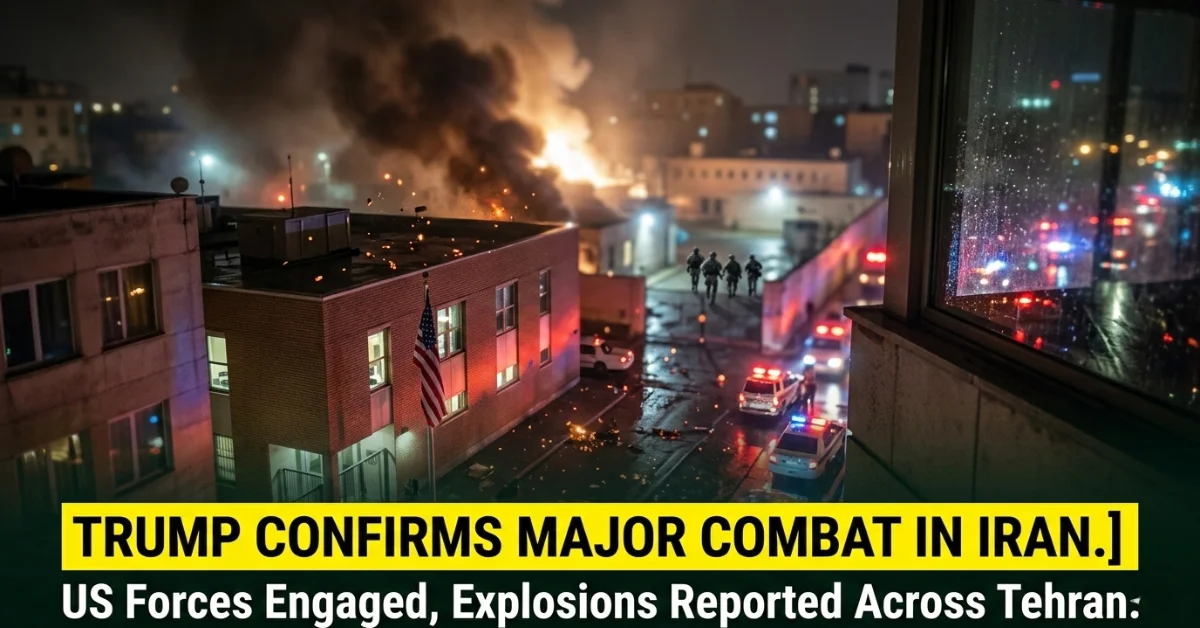
On February 28, 2026, at 2:37 AM EST, US Attacks Iran 2026: Tehran Explosions President Donald Trump confirmed in a video message shared on Truth Social that “A short time ago, the United States military began major combat operations in Iran.”
This is not a symbolic statement. This is not a political threat made on social media. This is the President of the United States announcing that American military forces are actively engaged in armed combat against Iran—a nuclear-armed nation with 90+ million people and a sophisticated military.
Get your cash! Maryam Ko Batain 10,000 Relief 2026 – Check your CNIC eligibility and apply online today.
For Pakistani readers, this moment carries profound implications. Pakistan said it opposes any external interference in Iran and urged all parties to exercise restraint and emphasized the need for dialogue to avoid a wider regional conflict. But statements of opposition don’t change the reality: the United States military is now in open conflict with Iran, and the ripples will reach Pakistan directly.
This comprehensive guide explains what Trump’s announcement means, why the US military moved from preparing for strikes to executing them, what this could mean for Pakistan’s security and economy, and what could happen next.
What Is Happening Right Now? The February 28, 2026 Escalation Explained
Trump’s Announcement
The strikes in Iran are described as significant and are not small strikes, according to two U.S. officials. Iranian state media has reported explosions in two locations in central Tehran. After starting what Israel called a “preemptive strike,” an Israeli spokesperson said retaliation was expected and Israel has declared a state of emergency. Iran has vowed that if attacked it would retaliate against American and Israeli bases in the region, warning of a “devastating war.”
The language matters here. “Major combat operations” is precise military terminology. It means:
- Active, ongoing engagement by combat forces
- Not limited strikes (like the June 2025 Operation Midnight Hammer)
- A campaign expected to involve multiple phases
- Use of the massive military buildup Trump assembled
Relive the action! New Zealand vs Sri Lanka T20 2026 Highlights – See how the Kiwis secured a 61-run victory and knocked out the hosts.
The Immediate Military Picture
The buildup includes two aircraft carriers: one in the Mediterranean, to the west of Iran, and the other in the Arabian Sea, to the south of Iran. They are among more than a dozen U.S. warships in the region, according to military analysts tracking the U.S. forces. The U.S. also has at least a couple of hundred warplanes in the Middle East. Each aircraft carrier has around 75 warplanes, and another 50 fighter jets were recently flown to the region, according to flight-tracking groups.
This is the largest U.S. military concentration in the Middle East since 2003.
How We Got Here: The Chain of Events Leading to Combat Operations
The path to “major combat operations” wasn’t inevitable. Let me trace how the situation escalated:
January 2026: The Protests and Crackdown
In the final week of January, President Donald Trump used Truth Social to issue a series of public warnings directed at Iran, marking one of the most visible escalations in U.S. messaging during the crisis. On 28 January 2026, Trump declared that “a massive Armada is heading to Iran”, describing it as moving “with great power, enthusiasm, and purpose.”
The triggers for Trump’s messaging were mass protests inside Iran over economic collapse and government crackdown. On January 8, 2026, the Iranian authorities cut all internet access to the country while Iranian authorities responded with a crackdown, and on January 8, 2026, cut all internet access to the country. Human Rights Watch found evidence of a coordinated escalation in the use of lethal force beginning January 8, with protesters and bystanders shot in the head and torso.
Trump’s response was direct: On 13 January, speaking in Detroit, Trump told Iranian protesters to “keep protesting” and that “help is on its way,” vowing to punish security forces responsible for the killings and announcing he had canceled all meetings with Iranian officials until the crackdown stopped.
February 2026: Military Threats Escalate
Trump made his intentions crystal clear: On 28 January 2026, Trump declared that “a massive Armada is heading to Iran”, describing it as moving “with great power, enthusiasm, and purpose.” Trump warned that if Iran did not agree to a deal, “the next attack will be far worse”, referencing previous U.S. strikes on Iranian nuclear facilities.
More chillingly, When speaking at Fort Bragg on 13 February, Trump declared that regime change would be “the best thing that could happen”.
Late February: Final Escalation
On 19 February 2026, according to reports The US could launch military strikes on Iran within days as the White House issued a warning that Tehran should make a deal. Trump has sent warships, tankers and submarines to the Middle East to be ready for potential strikes as soon as 21 February, sources told CBS. On February 28, 2026, the United States and Israel reported that they conducted military strikes on Iran.
Now, the moment has arrived.
Why Is This Happening? Understanding Trump’s Iran Policy
The Three Converged Issues
The answer lies in the convergence of three issues that were once distinct but are now fused: Iran’s missile arsenal, the regime’s violent crackdown at home, and its unresolved nuclear program.
Nuclear Program:
Trump has made clear: President Donald Trump says the U.S. has begun “major combat operations in Iran” after Israel launched strikes. His administration views Iran’s nuclear program as an existential threat requiring military action.
Internal Repression:
Trump publicly encouraged Iranian protesters, creating a moral and rhetorical justification for intervention. When the regime cracked down brutally, Trump cast himself as the protector of Iranian civilians—a narrative that both justifies military action and potentially targets the repressive apparatus (IRGC, Basij).
Ballistic Missiles:
In any US military scenario, missile production facilities, launchers, stockpiles, and associated air defenses would likely be among the first targets. For military planners, degrading Iran’s capacity to retaliate is an essential prerequisite to any broader operation.
The Intelligence Dispute
Here’s where it gets complicated. While Trump asserted in his State of the Union address that Iran is “rebuilding” its nuclear programme to strike the US mainland, his own officials offer conflicting narratives. White House spokesperson Karoline Leavitt insisted Tuesday, parroting her boss, that the 2025 “Operation Midnight Hammer” had “obliterated” Iran’s facilities. Yet, days earlier, Trump envoy Steve Witkoff claimed Tehran was “a week away” from the bomb.
The reality: “The administration is updating the visual dictionary of fear,” says Osama Abu Irshaid, a Washington-based political analyst. “They are exaggerating the nuclear threat exactly as the Bush administration did with the ‘smoking gun’ metaphor. But there is a key difference: In 2003, US intelligence was manipulated to align with the lie. In 2026, the intelligence assessments actually contradict Trump’s claims.”
Why This Matters Critically for Pakistan
Pakistan is not a bystander in this conflict. You have direct, concrete stakes in what happens next.
Direct Border Concerns
Pakistan shares a 905-kilometer border with Iran through Balochistan. For Balochistan’s internal stability, the collapse of the clerical regime and the dissolution of the IRGC would create a dangerous security vacuum along the Pakistan-Iran border. The absence of a functional border security counterpart—i.e., the IRGC—would allow insurgent groups like Jaish al-Adl to “cannibalize” state infrastructure and expand operational staging on the Pakistani side of border, while also gaining an upper hand over militant groups active in Pakistan’s Balochistan.
Simply put: if Iran’s military collapses, militant groups operating along the Balochistan border gain strength and space to operate.
Economic Impact: Oil and Inflation
Iran is a major oil producer. Conflict disruption means:
- Global oil prices likely spike 20-40% if conflict extends beyond weeks
- Pakistan, already importing 90% of its oil, faces severe fuel price increases
- Inflation cascades through food, transportation, and electricity costs
- Foreign exchange reserves drain faster as Pakistan pays more for imports
The Political Dilemma
Pakistan’s brief war with India last May also ended up indirectly furthering the improvement in ties with the US: the government in Islamabad was pleased at being treated by American mediators as equals with New Delhi. While India refuses to acknowledge a US role in ending the conflict, Pakistan has heaped praise on Trump, Rubio, and others.
But then the problem: However, without delay, the Pakistani government condemned the strikes, calling them “deeply disturbing” and a breach of international norms. The Foreign Office added its grave concern about the potential for further escalation, and Prime Minister Shehbaz Sharif phoned Iranian President Masoud Pezeshkian to affirm Pakistan’s support—while having just praised Trump for mediating peace with India.
Pakistan is caught between supporting its neighbor Iran and maintaining its warming relationship with the US.
Sectarian Dynamics
Pakistan hosts one of the world’s largest Shia communities outside Iran, with Shia Muslims constituting 15 to 20 percent of the population, dispersed across four provinces and Gilgit-Baltistan. The 1979 Iranian Revolution and Zia-era Islamization forged deep clerical linkages between Pakistani and Irani Shia clerics via seminaries.
If Iran’s government falls or is destabilized by US strikes, Pakistan’s Shia community will face profound emotional and political pressure—potentially creating domestic sectarian tensions.
The Step-by-Step Military Escalation: What’s Already Happened and What’s Coming
Phase 1: Military Buildup (Completed)
- Two aircraft carriers positioned (USS Abraham Lincoln, USS Gerald R. Ford)
- 12+ warships deployed
- 200+ combat aircraft positioned in region
- Special operations forces staged
- Logistics prepared for extended campaign
Status: Completed
Phase 2: Initial Strikes (Current)
- Coordinated US-Israel strikes on military/nuclear targets
- Degradation of Iranian air defenses
- Disruption of missile production/storage
- Command and control center targeting
Status: Underway as of Feb 28, 2026, 2:37 AM EST
Phase 3: Iranian Response (Expected Imminent)
- Ballistic missile attacks on US/Israel regional bases
- Drone attacks on shipping in Strait of Hormuz
- Cyber operations
- Proxy attacks via militias in Iraq/Syria
Status: “Expected in the immediate time frame” per Israeli official
Phase 4: Escalation Spiral (Risk Very High)
If Iran retaliates with significant casualties:
- Expanded US bombing campaign
- Possible targeting of IRGC leadership
- Strikes on economic infrastructure
- Potential ground operations
Status: To be determined by Iranian response
| Phase | Status | Timeline | Pakistan Risk |
|---|---|---|---|
| Military Buildup | ✅ Complete | January-February 2026 | Low (preparation stage) |
| Initial Strikes | 🔴 Ongoing | February 28, 2026+ | Moderate (diplomatic complexity) |
| Iranian Retaliation | ⚠️ Imminent | Hours to days | High (oil, missiles, refugees) |
| Escalation Cycle | 🔲 Unknown | Days to weeks | Critical (regional instability) |
| Regime Change Op. | 🔲 Possible | Weeks+ | Catastrophic (borders, refugees, militancy) |
Pakistan-Specific Tips: What You Should Do Now
For Ordinary Pakistani Citizens
Immediate Actions (Today-This Week):
- Check fuel reserves: If concerned about prices spiking, consider fueling vehicles early while prices are still normal
- Monitor prices: Watch for food inflation, particularly for imported items
- Secure cash: Bank on availability of foreign exchange for imports
- Limit non-essential travel: Avoid travel to Iran, Iraq, or anywhere in the Middle East conflict zone
- Check passports: If you have family in Iran or Gulf countries, ensure documentation is updated for potential evacuations
- Monitor official advisories: Check Pakistani government travel warnings regularly
Conclusion: What Comes Next for Pakistan and the Region
The Immediate Outlook (Hours to Days)
As of now, February 28, 2026, 2:37 AM EST:
The strikes in Iran are significant and are not small strikes, according to two U.S. officials. Iranian state media has reported explosions in two locations in central Tehran. Iran has vowed that if attacked it would retaliate against American and Israeli bases in the region, warning of a “devastating war.”
Iran’s response is not a matter of if, but when.