The National Database and Registration Authority has formally put institutions on notice — refusing a Digital ID is now a legal violation. Here is the full story.
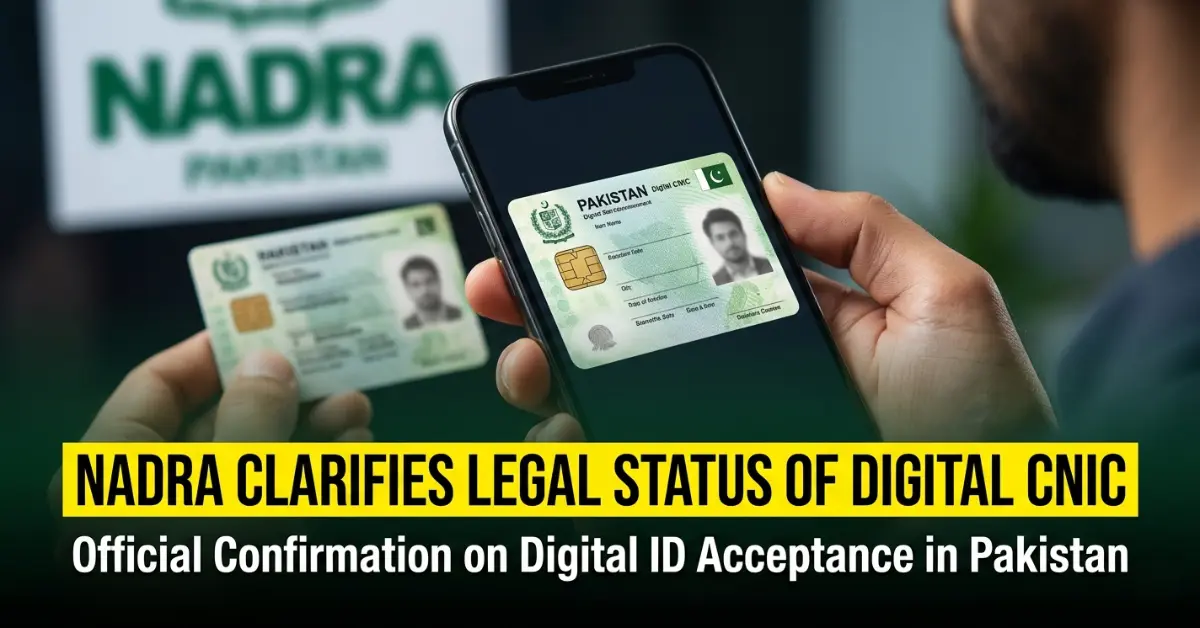
In a landmark clarification issued on March 13, 2026, the National Database and Registration Authority (NADRA) sent a clear and unambiguous message to government departments, financial institutions, telecom operators, and private service providers across Pakistan: refusing to accept NADRA Clarifies Legal Status of Digital CNIC or dematerialized identity credential is a violation of the law. The statement, which carries the full weight of Pakistan’s national identity regulatory framework, marks a decisive step in the country’s transition from a paper-based identity ecosystem to a fully digital one.
Despite NADRA having introduced its official digital identity platform — PakID — and having granted digital credentials full legal recognition under the NADRA Digital Identity Regulations 2025, many offices and service providers continued to insist on physical CNICs or photocopies. That practice, NADRA has now officially declared, is “inconsistent with the applicable legal framework.”
| “NADRA clarifies that insisting on a physical CNIC or its photocopy and refusing to accept the DigitalID or dematerialized CNIC or NICOP or POC available through NADRA’s official digital identity platform PakID is inconsistent with the applicable legal framework.” — NADRA Official Statement, March 13, 2026 |
Background: Pakistan’s Long Road to Digital Identity
NADRA was established under the NADRA Ordinance 2000, initially charged with maintaining a national citizen database and issuing physical identity credentials. Over the past two-and-a-half decades, NADRA has evolved from a registry body into one of the world’s most sophisticated national identity authorities, managing biometric data for over 130 million adult Pakistanis.
The 2026 iPhone 18 Pro Max is rumored to introduce a more immersive display experience by integrating under-display Face ID technology, which could finally shrink or replace the Dynamic Island with a more compact punch-hole layout.
The push towards digital identity credentials accelerated sharply in 2024 and 2025, culminating in the launch of NADRA’s Silver Jubilee milestone — Pakistan’s first-ever dematerialized identity card. President Asif Ali Zardari lauded the initiative, underscoring the authority’s role in reinforcing the social contract between the state and its people while transforming public service delivery. The dematerialized CNIC, accessible through the PakID platform, was introduced as a direct equivalent to the physical card — not a supplement to it.
To anchor this shift in law, NADRA formulated the Digital Identity Regulations 2025 under its foundational Ordinance. These regulations establish a comprehensive framework for the issuance, acceptance, and governance of digital identity credentials in Pakistan — and it is these regulations that now form the backbone of NADRA’s March 2026 clarification.
The Legal Architecture: What Regulations 9 and 10 Say
The two most consequential provisions in the NADRA Digital Identity Regulations 2025 are Regulation 9 and Regulation 10. Their language is precise and leaves no room for institutional ambiguity.
Regulation 9 — Legal Recognition of Digital Identity Credentials — provides that any digital identity credential issued or authorized by NADRA carries the same legal status, validity, and evidentiary value as the equivalent physical identity document. This means a Digital CNIC displayed through the PakID app on a citizen’s smartphone is, in the eyes of the law, as valid as the laminated card in their wallet.
Apple is expected to follow its traditional fall release cycle for the iPhone 18 series. Based on historical patterns and current supply chain insights for 2026, the iPhone 18 Pro Max is anticipated to be announced in early September 2026, with pre-orders likely starting a few days later and official store availability following in late September.
Regulation 10 — Acceptance of Digital Identity Credentials — goes further, placing a positive duty on institutions. It mandates that any public authority, regulated entity, or organization that requires proof of identity must accept digital identity credentials issued or authorized by NADRA as valid proof. This is not a discretionary provision — it is a mandatory compliance obligation.
| Regulation 9 grants digital CNIC credentials the same legal status, validity, and evidentiary value as a physical CNIC. Regulation 10 requires all public authorities, regulated entities, and organizations to accept them without exception. |
Together, these two regulations constitute a comprehensive legislative mandate. Government ministries, provincial departments, federal regulatory bodies, commercial banks, microfinance institutions, telecom operators, educational institutions, and private sector organizations are all within scope. Non-compliance is not merely an administrative inconvenience — it is a breach of the regulatory framework.
NADRA spokesperson Shahbaz Ali confirmed in statements to national media that institutions demanding physical documents or photocopies in place of digital credentials are acting contrary to existing legal and regulatory frameworks. He urged all departments and service providers to issue appropriate internal instructions to their field offices to ensure full compliance.
PakID: The Platform Behind the Policy
The practical vehicle through which citizens access their Digital CNIC is the PakID platform — NADRA’s official digital identity service, available as a mobile application on both Google Play and Apple’s App Store. PakID is designed as a secure, government-issued digital vault that stores verifiable credentials including the dematerialized CNIC, NICOP (National Identity Card for Overseas Pakistanis), and POC (Pakistan Origin Card).
The registration process for PakID is built on multi-layered security. Citizens must create an account using their CNIC number, a valid email address, and a registered mobile number. Upon registration, the platform cross-verifies the applicant’s photograph and fingerprints against NADRA’s national biometric database. Identity is further confirmed through one-time passwords (OTPs) sent to both the registered phone number and email address — ensuring that a Digital ID cannot be fraudulently obtained or impersonated.
Once registered, users receive their digital identity in the form of verifiable credentials stored in the PakID Vault — a secure digital repository within the app. The PakID Vault can also store academic degrees, professional licenses, and other official certificates that can be shared digitally with service providers. Critically, each document in the vault carries a unique QR code that enables both online and offline verification, making it operational even in low-connectivity areas.
| The PakID platform allows citizens to store, manage, and share their digital CNIC and other identity credentials securely. Each credential comes with a unique QR code enabling instant verification — online or offline. |
The platform also incorporates a consent management framework, giving citizens explicit control over who can access their identity data, for what purpose, and for how long. This aligns with global privacy standards and Pakistan’s emerging data protection legislation. The system complies with internationally recognized security frameworks including ISO/IEC 27001 (information security management), ISO/IEC 24760 (identity management), and authentication protocols OAuth 2.0 and OpenID Connect (OIDC) for secure Single Sign-On (SSO) across government and private sector services.
Adoption in Numbers: A Growing Digital Constituency
The scale of PakID adoption provides important context for NADRA’s clarification. According to official NADRA data, more than 500,000 citizens used the PakID mobile application during October and November 2025 alone to obtain various identity documents. The breakdown illustrates the breadth of use:
- Over 270,000 citizens used the app to apply for or manage their Computerised National Identity Cards (CNICs)
- More than 83,000 citizens submitted B-Form applications for child registration via the mobile platform
- Over 70,000 individuals obtained Family Registration Certificates (FRCs)
- More than 49,000 applied for National Identity Cards for Overseas Pakistanis (NICOPs)
These figures represent only a two-month snapshot. Earlier in 2025, NADRA spokesperson Syed Shabbahat Ali disclosed that the PAK-ID app had received over 1.2 million online applications within just three months of expanded rollout — a figure that underscores the velocity of digital adoption among Pakistani citizens. Despite this strong citizen uptake, institutional resistance has persisted, creating the friction that prompted NADRA’s formal March 2026 intervention.
Technical Upgrades: The 2026 CNIC Overhaul
NADRA’s digital identity push in 2026 is not limited to the PakID platform. Earlier this year, the Federal Government formally notified sweeping amendments to the National Identity Card Rules, 2002 and the Pakistan Origin Card Rules, 2002. These amendments, issued through S.R.O. 330(I)/2026 and S.R.O. 331(I)/2026 under Section 44 of the NADRA Ordinance 2000, were published in the Gazette of Pakistan on February 24, 2026.
The reforms represent the most significant technical overhaul of Pakistan’s identity card system in years. Among the landmark changes:
- QR Code as Legal Security Feature: The Quick Response (QR) code has been formally recognized in statute as a legally defined security and verification feature. Under the revised rules, QR codes are defined as secure, machine-readable, two-dimensional barcodes capable of storing encoded identity data for instant verification.
- Iris Scanning and Facial Recognition: NADRA has officially added iris scanning and facial recognition to the legal verification framework, recognizing multi-modal biometrics as legally valid authentication methods.
- Facial Recognition Certificate: For citizens whose fingerprints have faded — particularly the elderly — NADRA has introduced a Facial Recognition Certificate at a nominal fee of Rs. 20, valid for seven days, enabling biometric authentication at banks and telecom outlets.
- Digital Kill-Switch: If a card is lost or suspended, NADRA can trigger an immediate digital kill-switch that disables all linked verification services — preventing fraudulent use for SIM activation or banking transactions.
- Lifetime Validity for Senior Citizens: Citizens aged 60 and above now receive lifetime-valid Smart ID cards by default, with a simplified renewal process requiring only an affidavit and two witnesses.
- Uniform Card Standard: The dual structure of chip-based and non-chip CNICs is being phased out in favor of a uniform QR-enabled card, streamlining identity authentication across sectors.
These amendments authorize the use of a QR code or any other technological feature in place of the traditional microchip system, giving NADRA flexibility to adopt future verification technologies without requiring fresh legislative amendments each time.
Expanding Access: CNICs Without Birth Certificates
NADRA’s digital transformation efforts run in parallel with an equally significant push toward greater documentation inclusivity. In February 2026, NADRA announced a time-bound facilitation scheme allowing first-time applicants to obtain CNICs without a local government-issued computerised birth certificate — a facility valid until December 31, 2026.
The rationale behind this scheme is grounded in data. A ten-year analysis of national registration data, conducted in coordination with the Pakistan Bureau of Statistics, the Election Commission of Pakistan, the National Commission on the Status of Women, and other stakeholders for NADRA’s Annual Report 2025, revealed that 98.3% of Pakistan’s adult population is now registered in the national identity system. The remaining 1.7% — millions of citizens — remain undocumented, with the gap disproportionately affecting women and residents of districts with weak civil registration infrastructure.
| 98.3% of Pakistan’s adult population holds a CNIC. The remaining 1.7% are disproportionately women and residents of districts with weak civil registration. NADRA’s 2026 facilitation scheme specifically targets this excluded population. |
The scheme was approved under Section 5(1)(b) and Section 20 of the NADRA Ordinance 2000, read with Rule 8 of the NADRA NIC Rules 2002, which permit alternative verification mechanisms in specified categories. For married women aged 18 and above, applicants must provide a Nikah Nama, valid CNICs of either parent and husband, and biometric verification of one parent and the husband. For unmarried women, the husband-related condition does not apply but parental CNICs and biometric verification remain mandatory. For male applicants above 24, at least one parent and one sibling must hold valid CNICs, with parental biometric verification required.
Importantly, non-smart CNICs applied for under the normal category through this scheme will be issued without any fee. NADRA has cautioned, however, that once parentage, date of birth, and place of birth are entered into the national identity system under this scheme, they become permanent and non-changeable — underscoring the gravity of accuracy in the initial application.
Data Protection: A Central Rationale
One of the most compelling arguments NADRA has made for universal acceptance of the Digital CNIC is the data protection dimension. The widespread practice of collecting and storing physical CNIC photocopies has created a vast and largely ungoverned reservoir of citizens’ personal biometric data — names, photographs, national identity numbers, addresses, and family information — scattered across banks, telecom shops, hotels, real estate offices, and hundreds of other institutions.
This data is frequently misused. Identity theft, unauthorized SIM registrations, fraudulent financial transactions, and other forms of impersonation-based crime have proliferated in environments where physical CNIC copies can be obtained, reproduced, and distributed without the knowledge or consent of the cardholder. The shift to digital verification directly addresses this vulnerability.
When a citizen presents their Digital CNIC through PakID, the verification is transactional and consent-based. The institution receives only the identity confirmation it needs, not a permanent copy of the citizen’s credentials. The PakID platform’s consent management architecture ensures that the citizen retains control over their data — deciding who sees it, for what purpose, and for how long. This is a fundamentally different — and substantially safer — model than photocopying.
NADRA has explicitly highlighted this dimension in its March 2026 clarification, noting that digital identity credentials reduce the need for photocopies of CNICs, strengthen the protection of citizens’ personal data, and minimize the risk of misuse of identity information. Accepting digital credentials is thus not merely a technological upgrade — it is a data rights imperative.
Compliance Obligations and Citizen Recourse
NADRA’s statement directs all government departments, public authorities, financial institutions, telecom operators, and other service providers to ensure compliance and to issue appropriate instructions to their field offices. The institutions explicitly named in NADRA’s advisory cover the near-entirety of Pakistan’s formal service sector:
- All federal and provincial government departments
- Public authorities and statutory bodies
- Commercial banks, Islamic banks, microfinance institutions, and development finance institutions
- Telecom operators and franchise service centers
- Educational institutions and examination bodies
- Private sector organizations and regulated entities
For citizens who encounter refusal despite NADRA’s clarification, the authority has provided a clear path of recourse. Citizens facing non-acceptance of their Digital CNIC may file formal complaints with NADRA through its official complaint management system. NADRA has committed to taking appropriate action in accordance with the law against institutions and individuals found to be in breach of Regulation 10.
How to Get Your Digital CNIC: A Step-by-Step Guide
For citizens who have not yet registered for the Digital CNIC through PakID, the process is straightforward and can be completed entirely from a smartphone. Here is a summary of the steps:
- Step 1: Download the PakID mobile app from Google Play Store or the Apple App Store.
- Step 2: Create an account using your CNIC number, a valid email address, and your registered mobile number.
- Step 3: Verify your identity biometrically — the app will match your photo and fingerprints against NADRA’s national database.
- Step 4: Confirm your registration via OTP codes sent to your mobile number and email.
- Step 5: Select the Digital Card option within the app and scan the QR code printed on the back of your physical CNIC.
- Step 6: Navigate to your PakID Inbox and download your Digital Card, which is now legally valid for all identity verification purposes.
Citizens must be at least 18 years old to register. A SIM registered on their CNIC and biometric verification capability (fingerprint or facial recognition) are prerequisites. The Digital ID works across e-government portals, educational institutions, financial services, and health platforms — and functions even offline, with QR-based verification available without an active internet connection.
The Broader Significance: Pakistan in the Global Digital Identity Landscape
Pakistan’s 2026 digital identity framework places it alongside a growing number of nations that have enacted legislation giving digital credentials parity with physical documents. Countries including Estonia, India, the United Arab Emirates, and Singapore have implemented comparable frameworks — but Pakistan’s scale presents both a unique challenge and a unique opportunity. With over 130 million registered adult citizens, a successful transition to digital identity verification would represent one of the largest such shifts in the world.
The implications extend well beyond administrative convenience. A functioning digital identity infrastructure is foundational to financial inclusion, enabling unbanked citizens to access digital financial services without physical documentation. It underpins e-government service delivery, reduces corruption opportunities embedded in paper-based processes, and enables Pakistan’s growing digital economy to verify customer identities securely and efficiently.
The QR-enabled CNIC’s integration with the National Data Exchange Layer — Pakistan’s interoperability platform for government data systems — is particularly significant. It means that identity verification can be seamlessly connected to other public data systems, enabling faster service delivery, reduced duplication, and better-targeted government programs. The BISP Ehsaas social protection program, for instance, already relies heavily on CNIC-based verification for beneficiary identification — a system that digital credentials will further strengthen.
Conclusion: A Non-Negotiable Transition
NADRA’s clarification of March 13, 2026 is not a suggestion. It is a formal statement of existing law — a reminder to institutions that have been slow to adapt that the legal framework has already moved ahead of their practices. The NADRA Digital Identity Regulations 2025, grounded in the NADRA Ordinance 2000, give digital credentials identical legal force to physical ones. Refusing them is not caution or due diligence — it is non-compliance.
For Pakistan’s 130 million registered adult citizens, the Digital CNIC is a powerful tool: secure, convenient, portable, and legally equivalent to the physical card they have carried for years. The PakID platform’s 500,000-plus users in just two months of late 2025 testify to the demand for this transition. The regulatory infrastructure is in place. The legal mandate is clear. What remains is institutional compliance — and NADRA has served notice that it will be enforced.
As Pakistan presses ahead with its broader Digital Pakistan vision, the Digital CNIC stands as one of the most concrete and consequential expressions of that ambition — a proof point that governance, technology, and citizen rights can advance together.