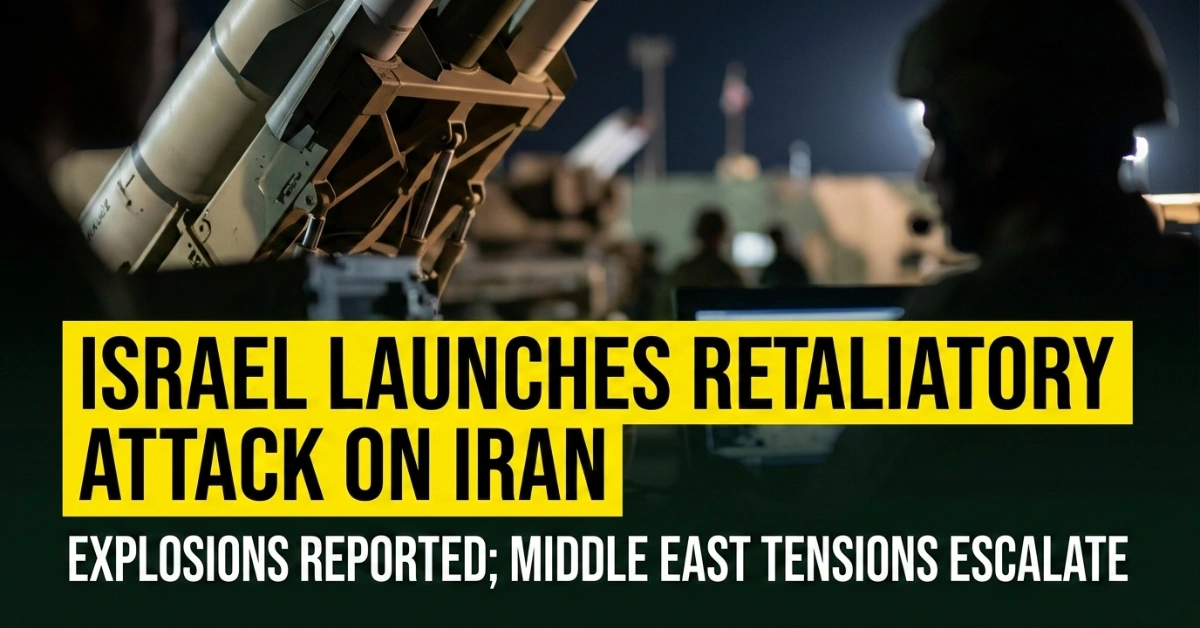
United States President Donald Trump says the US has begun “major combat operations” in Iran after Israel also said it had Israel Says It Has Launched Attack on Iran against the country. Iran’s Revolutionary Guards says it has launched first large-scale wave of retaliatory missile and drone strikes towards Israel.
This is not a political statement or threat. This is an active, ongoing military conflict unfolding in real time on Saturday, February 28, 2026. Looking for an affordable ride? Check out the Top 10 Cars in Pakistan Under 10 Lakhs 2026 for the best fuel-efficient and budget-friendly options available today.
Pakistan is not directly involved, but the consequences are already cascading across your nation. Let’s break down what’s actually happening, why it matters, and what comes next.
What Is Happening Right Now?
The Dual Attack: “Operation Epic Fury” and “Lion’s Roar”
The U.S. military appeared to have dubbed the military strikes on Iran “Operation Epic Fury,” according to a post on X from the Defense Department. Israeli Prime Minister Benjamin Netanyahu referred to his country’s operation — which was launched in conjunction with the U.S. strikes — “The Roar of the Lion.”
These are not casual nicknames. They signal intent: comprehensive, overwhelming, coordinated military action against Iran’s regime and military infrastructure.
The Scale of the Attack
The military action in Iran could last for several days, two U.S. officials told NBC News, as President Donald Trump vowed to eliminate any nuclear threat. The strikes are described as significant and are not small strikes, according to two U.S. officials. Iranian state media has reported explosions in central Tehran, and news agency video showed plumes of smoke over the capital.
This is crucial language. “Not small strikes” means:
- Multiple targets across multiple Iranian cities
- Sustained operations lasting days, not hours
- Coordination of aircraft carriers, aircraft, cruise missiles, and naval vessels
- Preparation that has taken months
Geographic Scope
According to the Fars news agency, explosions have been heard in Isfahan, Qom, Karaj, and Kermanshah. Explosions can also be heard in the Iranian city of Tabriz in the northwest. According to Iran state media, the port city of Bushehr has been attacked. It is unclear whether the Bushehr nuclear power plant was damaged.
These cities span across Iran—from north to south, east to west. This is not a targeted raid on military bases near the border. This is comprehensive strikes on Iran’s economic, military, and nuclear infrastructure.
Save on your next ride! Check the Top 10 Cars Under 10 Lakhs 2026 and find the best fuel-efficient deals in Pakistan.
Trump’s Announcement: The Official Declaration
President Donald Trump announced “major combat operations” against Iran on Saturday, with strikes in the joint U.S.-Israel Says It Has Launched Attack on Iran targeting military and government sites, officials said. Trump said: “Our objective is to defend the American people by eliminating imminent threats from the Iranian regime, a vicious group of very hard, terrible people.”
More significantly, Trump urged Iranians to take over the government once the military campaign comes to an end. “The hour for your freedom is at hand,” Trump said, addressing Iranians in a video posted on Truth Social. “When we’re finished, take over your government. It will be yours to take. This will be probably your only chance for generations.”
This language suggests the attack isn’t just about degrading military capability—it’s about regime change.
Iran’s Response: Retaliation Has Begun
The Islamic Revolutionary Guard Corps issued a statement via Iranian state broadcaster IRIB saying an attack on Israel had begun. “In response to the aggression of the hostile and criminal enemy against the Islamic Republic of Iran, the first wave of widespread missile and drone attacks by the Islamic Republic of Iran against the occupied territories has begun,” the IRGC said.
More alarming: A second volley of missiles was launched at Israel by Iran, the Israeli military said. The Israel Defense Forces said on social media that “an additional barrage of missiles was launched toward Israel.”
This is not a one-time retaliation. Iran has launched multiple waves. This is sustained escalation.
Why This Moment Matters: How It Leads to Today
The January Protests and Crackdown
Beginning in December 2025, nationwide anti-regime protests erupted in Iran, triggered by economic crisis, the collapse of the rial, and rising prices. The protests, which included calls for regime change, became the largest in scale since the 1979 revolution, spreading to over 100 cities across the country. The Iranian regime responded with violent repression, including massacres of protesters, with the deadliest incidents occurring between 8 and 10 January 2026. During a news briefing on 27 Februrary 2026, US President Donald Trump stated that the Islamic Republic “killed at least, it looks like, 32,000 protesters.”
Trump used the regime’s brutal crackdown as moral justification for military intervention.
Trump’s Threats and Military Buildup
President Trump’s threats to Iran early this year were focused on the regime’s brutal quashing of massive street protests in January. But on Jan. 28, Mr. Trump threatened Iran in a Truth Social post with an attack “far worse” than the strikes he ordered against the country’s nuclear sites in June if it didn’t agree to a deal to curb its nuclear program.
Trump said: “A massive Armada is heading to Iran,” he said in his Jan. 28 post. “It is moving quickly, with great power, enthusiasm, and purpose. … Hopefully Iran will quickly ‘Come to the Table’ and negotiate a fair and equitable deal — NO NUCLEAR WEAPONS — one that is good for all parties.”
Failed Negotiations
Negotiators from the two sides held indirect talks in Oman in early February, followed by two rounds of negotiations in Switzerland later in the month. Iranian officials described the talks in generally positive terms, and Mr. Trump has said that Iran wants a deal. Omani Foreign Minister Badr Albusaidi, who has helped mediate the talks, told CBS News after the third round of negotiations that a deal was “within our reach” and they just “need a little bit more time.” But Mr. Trump told reporters shortly after the third round that he was “not happy” with the pace of progress, saying Iran was “not willing to give us what we have to have.”
Trump wanted “no enrichment.” Iran refused. Negotiations collapsed. War followed.
Why This Is Critical for Pakistan: Your Direct Stakes
Pakistan shares a 905-kilometer border with Iran through Balochistan. What happens in Tehran directly affects Islamabad, Karachi, and every Pakistani citizen.
Pakistan’s Official Response
Pakistan Peoples Party Chairman Bilawal Bhutto Zardari has condemned Israel’s attack on Iran. Bilawal termed Israeli aggression against Iran alarming for peace in the region. “To cover up its atrocities in Gaza, Israel carried out a cowardly attack on Iran. The United Nations and the Organisation of Islamic Cooperation should take all possible measures to stop Israeli aggression against Iran.” “The international community should take notice of Israel’s open violation of Iran’s sovereignty and territorial integrity,” he said.
Even stronger condemnation: Chief of the Jamaat-e-Islami, Hafiz Naeemur Rehman, said that the joint US and Israeli attack on Iran is open terrorism. “The entire region is being pushed into war. Once again, the United States used negotiations as a deception.” “Donald Trump’s ‘Board of Peace’ is in fact a ‘Board of War’,” he said.
Practically: Pakistani airlines have been ordered not to use Iranian airspace.
The Economic Impact: Oil and Inflation
Iran is a major oil producer. Conflict disruption means global oil prices likely spike 20-40% from current levels. Pakistan, importing 90% of oil, faces severe fuel price increases within days.
Current fuel prices will rise. Food inflation will follow. The rupee will weaken. Pakistan’s foreign exchange reserves will drain faster.
The Border Security Risk
A destabilized Iran creates a security vacuum in Balochistan. Militant groups—Baloch separatists, ISIS-K affiliates, cross-border terrorists—gain space to operate. Pakistan’s Balochistan region, already struggling with insurgency, faces heightened threats.
The Sectarian Dynamics
Pakistan hosts one of the world’s largest Shia communities outside Iran. If Iran’s government collapses or is destabilized, Pakistan’s Shia population—estimated at 15-20% of the population—may face political pressure, mobilization by clergy, or sectarian backlash.
The Current Situation on the Ground: What’s Happening Right Now
Internet Blackout in Iran
The internet appeared to have been shut down in Iran on Saturday amid U.S. and Israeli strikes, the NetBlocks organization said.
This is critical for understanding: Information coming out of Iran is limited. We don’t have complete casualty figures, damage assessments, or confirmation of all targets hit.
Israeli State of Emergency
A 48-hour state of emergency has been declared nationwide. Air raid sirens sounded across Israel at approximately 8:15 a.m. local time, warning civilians to prepare to enter bomb shelters. Israel has closed its airspace to all passenger flights, and civil defense protocols have been activated.
This shows the severity: Israel expects significant Iranian retaliation.
Regional Infrastructure Shutting Down
Air Arabia has cancelled flights to Iran, Iraq, and other parts of the region scheduled for February 28 due to evolving security concerns and airspace closures. Several flydubai flights were disrupted on February 28 following the temporary closure of multiple airspaces in the region.
The entire region’s civilian infrastructure is shutting down.
US Military Evacuations in the Region
The US Embassy in Abu Dhabi and the US Consulate in Dubai have issued a shelter-in-place alert for all staff amid heightened security concerns on 28 February 2026, urging all Americans in the UAE to take cover until further notice.
American personnel in the Gulf are sheltering in place. This indicates serious concern about escalation.
The Immediate Risks and Uncertainties
Risk #1: Further Escalation
The operation was planned to last “several days” but with “even more if needed.” If Iran inflicts significant casualties on US or Israeli forces, the campaign will expand dramatically.
Risk #2: Regional Involvement
There are reports of multiple explosions in Bahrain, Abu Dhabi and Qatar, all of which have US bases. Bahrain’s interior ministry urged citizens to move to the nearest safe location immediately.
Missiles from Iran reaching US bases in the Gulf means the conflict is spreading.
Risk #3: Oil Supply Disruption
Iran, a founding member of OPEC, is a major oil producer and sits at the heart of the strategically vital Strait of Hormuz, through which about 20% of the world’s oil passes. Sustained conflict disrupts global oil supplies, spiking prices worldwide.
Risk #4: Regime Collapse
Iranian sources reported that Supreme Leader Ali Khamenei was moved to a secure location during these events. According to Reuters, Ayatollah Khamenei is safe and has been relocated to a protected compound.
If Iran’s government collapses, the regional chaos would be unprecedented.