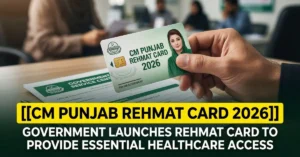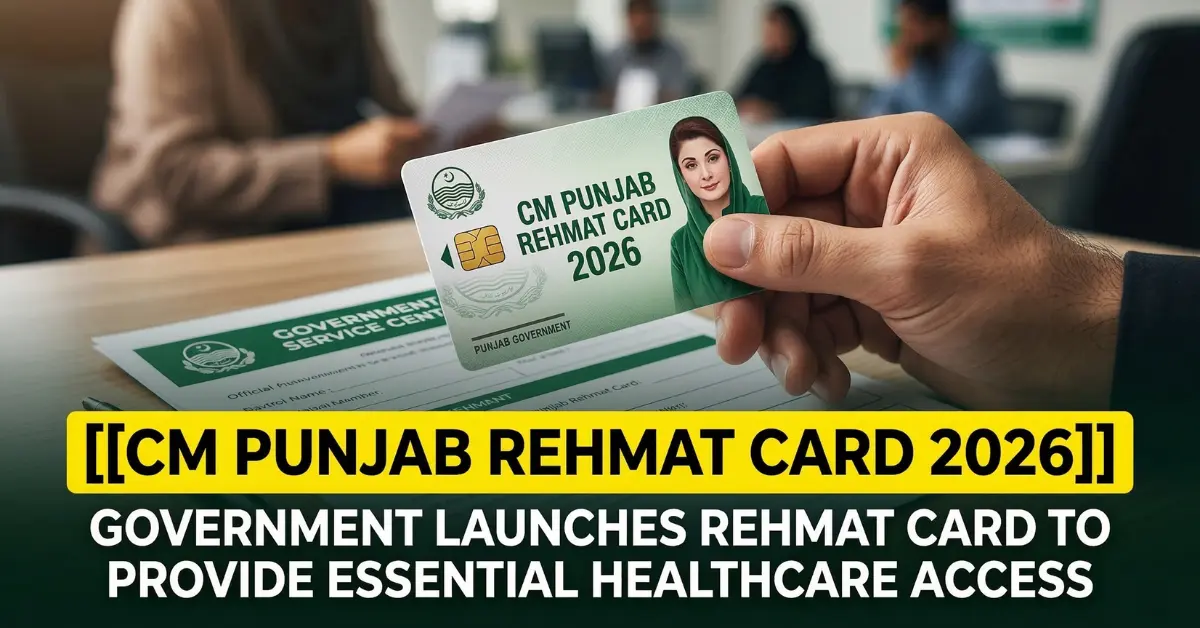
Chief Minister Maryam Nawaz has approved Pakistan’s boldest provincial welfare initiative for widows and orphans — a fully digital, biometrically verified financial empowerment programme backed by NADRA, NSER, and the Zakat & Ushr Department.
By Staff Reporter | Lahore / Islamabad, March 2026
LAHORE — When a family loses its primary breadwinner, the consequences are immediate and unforgiving. School fees go unpaid. Medical appointments get missed. Meals are skipped. For Punjab’s estimated millions of widows and orphaned children living below the poverty line, these are not statistics — they are daily realities. Addressing this painful social reality head-on, Punjab Chief Minister Maryam Nawaz Sharif officially approved the CM Punjab Rehmat Card 2026 in a high-level welfare meeting chaired at the Chief Minister’s Secretariat on March 5, 2026. The programme, whose name literally translates to ‘Card of Mercy,’ promises to be the province’s most ambitious direct cash transfer initiative targeted specifically at families who have lost their primary earning member.
Top 10 Cars in Pakistan Under 10 Lakhs (2026 Edition)
Under the scheme, eligible widows will receive Rs. 100,000 as a lump-sum financial grant, while each orphaned child will receive Rs. 25,000 to support educational and household expenses. In the first phase alone, over 50,000 households across Punjab are expected to benefit — with a separate target of reaching 100,000 Yateem (orphaned) children across the province. Registration is expected to begin after Eid-ul-Fitr 2026, with distribution commencing immediately thereafter through a secure digital card system. The programme is fully funded by the Punjab provincial government and is designed to ensure that not a single rupee is lost to intermediaries, agents, or administrative inefficiency.
“It is the responsibility of the government to assist the underprivileged and ensure they receive necessary financial support. No widow should feel helpless, no orphan should feel abandoned.” — CM Maryam Nawaz Sharif, March 5, 2026
NADRA Digital ID Legal Status in Pakistan 2026
CM Punjab Rehmat Card 2026 — Key Facts
Before diving into the full details, here is a consolidated factsheet of everything that has been officially confirmed about the CM Punjab Rehmat Card 2026 as of mid-March 2026:
| Program Name | CM Punjab Rehmat Card 2026 |
| Approved by | Chief Minister Maryam Nawaz Sharif |
| Approval Date | March 5, 2026 |
| Financial Aid — Widows | Rs. 100,000 (lump-sum capital grant) |
| Financial Aid — Orphans | Rs. 25,000 per child (educational grant) |
| Phase 1 Target Families | 50,000 households across Punjab |
| Orphan Children Target | 100,000 Yateem children (announced) |
| Distribution Start | After Eid-ul-Fitr 2026 |
| Verification Systems | NADRA + NSER + Zakat & Ushr database |
| Dedicated Helpline | 1000 (Punjab Social Welfare) |
| Monthly Cash Support | Up to Rs. 10,000/month (on Rehmat Card) |
| Healthcare Benefit | Free treatment at THQ/DHQ hospitals |
| Application Cost | 100% Free — no agent fees required |
Why Punjab Needs the Rehmat Card
Pakistan’s welfare crisis — and Punjab’s share of it — is well-documented by international authorities. A landmark World Bank assessment released in September 2025, titled Reclaiming Momentum Towards Prosperity: Pakistan’s Poverty, Equity and Resilience Assessment, laid bare the scale of the challenge. After steady poverty reduction from 64.3 percent in 2001-02 down to 21.9 percent in 2018-19, Pakistan’s national poverty rate has been climbing again since 2020, driven by compounding shocks: the COVID-19 pandemic, devastating monsoon floods, chronic inflation, and macroeconomic instability. As of the latest available projections, nearly 40 percent of Pakistan’s population is either living in poverty or at acute risk of falling into it.
AI Employment Impact: Predictions for 2026–2030
Pakistan spends only approximately one percent of its GDP on social protection — far below the expenditure levels of peer economies and international welfare standards. The Benazir Income Support Programme (BISP), the country’s largest federal safety net, currently covers around nine million deserving women with quarterly payments of Rs. 9,000 to Rs. 13,500. While vital, BISP’s reach remains insufficient for the full scale of need, and widows and orphans — among the most economically vulnerable demographics in any society — frequently fall through its targeting gaps.
Punjab, as Pakistan’s most populous province with over 130 million residents, carries the largest share of this welfare burden. Widows with dependent children face a dual vulnerability: they have lost their source of income at the same time they are most responsible for the upbringing and education of children. Orphaned children, particularly those who have lost fathers, face a statistically high risk of dropping out of school and entering the informal labour force — a cycle that entrenches intergenerational poverty. It is precisely this intersection of loss, vulnerability, and systemic gap that the Rehmat Card is designed to address.
Financial Benefits: What Beneficiaries Will Receive
For Widows — Rs. 100,000 Capital Grant
The Rehmat Card’s flagship benefit for widows is a Rs. 100,000 lump-sum payment — a deliberately substantial amount that reflects a conscious departure from the small monthly stipend model that has characterised most Pakistani welfare programmes. Chief Minister Maryam Nawaz has been explicit about the reasoning: small monthly transfers do not break the cycle of poverty. They sustain subsistence, but they do not create opportunity.
A Rs. 100,000 capital injection, by contrast, is meaningful startup capital. It is enough to establish a small home-based business — a tailoring operation, a poultry farm, a food stall, or a small retail outlet. It can clear outstanding debts that have been accumulating since the death of a husband. It can fund medical procedures that have been deferred due to cost.
Gold Price in Pakistan Today (2026): Daily Rates & Trends
Beyond the initial grant, enrolled widows will also receive up to Rs. 10,000 per month loaded directly onto their Rehmat Card — providing ongoing, reliable income to cover recurring household expenses. Rehmat Card holders are additionally entitled to free medical treatment at designated government hospitals and Basic Health Units across Punjab, covering consultations, medicines, and basic procedures. This healthcare integration is achieved through linkage with the Sehat Sahulat Programme, Punjab’s universal health coverage initiative, giving Rehmat Card beneficiaries automatic priority access.
For Orphaned Children — Rs. 25,000 Educational Grant
Each orphaned child registered under the scheme will receive Rs. 25,000 specifically designated for educational expenses. This is not a general cash transfer — it is designed to ensure that orphaned children remain in school rather than entering the workforce prematurely. The Rs. 25,000 per child can cover school fees for multiple terms, the cost of uniforms and textbooks, and transportation expenses for children in rural areas. For a widow with three orphaned children, the combined benefit package reaches Rs. 175,000 — a transformative financial injection for a household otherwise surviving on informal charity or family support.
The Punjab government has officially targeted 100,000 Yateem (orphaned) children for inclusion in the Rehmat Card programme’s orphan support component. This target, announced through official government communications and verified in NADRA’s registration framework, reflects the scale of the orphan crisis in the province. Children who have lost both parents — as opposed to those who have lost only their father — will be given additional priority in the allocation of educational support resources.
Eligibility Criteria: Who Qualifies?
The Punjab government has established strict, multi-layered eligibility criteria to ensure that the Rehmat Card’s benefits reach only the most deserving families. Verification is conducted automatically through the integration of three authoritative databases: NADRA’s national citizen registry, the National Socio-Economic Registry (NSER), and the Punjab Zakat and Ushr Department’s beneficiary database. This triple-verification approach is designed to eliminate fraud, prevent duplication with other programmes, and ensure that aid reaches families with genuine need.
Widow Status (NADRA-Verified): The applicant must be registered as a widow in NADRA’s national database. A verified husband’s death certificate — issued by NADRA or the relevant Union Council — is mandatory. Widows whose marital status has not yet been updated in NADRA’s records should do so before the registration portal opens.
Punjab Residency: Applicants must be permanent residents of Punjab and hold a valid Punjab-issued CNIC. Temporary residents or those domiciled in other provinces are not eligible.
Orphaned Children: Children under 18 years of age who have lost one or both parents qualify for the orphan support component. NADRA B-Form registration is mandatory for child beneficiaries.
Low Income Threshold: The household’s monthly income must fall below the poverty line as defined by the Punjab Social Protection Authority. Families receiving full-time government salaries are excluded.
PMT Poverty Score: Applicants are evaluated through the National Socio-Economic Registry’s Proxy Means Test (PMT) — a scoring system that assesses household poverty based on assets, income sources, housing conditions, and educational levels. Only households with low PMT scores will be approved.
Asset Verification: Applicants must not own luxury vehicles or significant agricultural land. Asset declarations are cross-verified against revenue and registration records.
Widowed mothers with dependent children will be given top priority within the eligible pool. The government has made clear that this programme is not for families with moderate incomes or existing government support — it is for households living at or below the margin of subsistence.
How to Apply: Registration Methods
The Punjab government has designed the Rehmat Card registration system to be maximally accessible — recognising that many of the programme’s intended beneficiaries are elderly, semi-literate, or living in rural areas without consistent internet access. Four official registration channels have been established, and all of them are completely free of charge. Citizens are strongly warned against paying any agent, representative, or facilitator claiming to offer faster processing — such individuals are operating fraudulently.
1. Official Web Portal
The primary digital channel for registration is the Punjab Government’s official welfare portal. Applicants visit the portal, enter their 13-digit CNIC number, fill out the registration form with household details, and upload scanned copies of required documents. The portal guides users through each step and issues a tracking number upon successful submission.
2. Mobile Application
A dedicated Rehmat Card mobile application is available for download from Google Play and the Apple App Store. The app allows applicants to register using their CNIC, submit documentation via smartphone camera, and track application status in real time. Push notifications are sent at each stage of the verification process, keeping applicants informed without requiring repeat visits.
3. Zakat & Ushr Department Offices
For citizens without internet access or those who prefer in-person assistance, every district and tehsil-level office of the Punjab Zakat and Ushr Department will serve as a physical registration point. Staff at these offices will guide applicants through the form-filling process, accept physical document submissions, and initiate biometric verification using on-site equipment. This channel is particularly important for rural applicants, elderly widows, and those unfamiliar with digital platforms.
4. Helpline — 1000
A dedicated helpline, 1000, has been established by Punjab Social Welfare for citizens who require guidance through the registration process. Call center agents are trained to assist with eligibility queries, document requirements, application status updates, and complaint resolution. The helpline is available during official working hours and provides support in Urdu and local languages.
Once an application is submitted through any of these channels, the verification process — conducted through NADRA, NSER, and Zakat records — takes approximately 15 to 30 working days. Successful applicants receive an SMS notification on their registered mobile number, followed by card issuance either by home delivery or collection from the nearest designated distribution centre.
Required Documents: What to Prepare
Applicants should gather the following documents before the registration portal opens to ensure a smooth and fast-tracked application:
For Widows: Valid CNIC with Punjab address; husband’s verified death certificate issued by NADRA or Union Council; proof of residency; and a current mobile phone number registered in the applicant’s name.
For Orphaned Children: NADRA B-Form; parent’s death certificate(s); guardian’s CNIC; school enrolment record (if applicable); and a recent photograph.
Income Proof: Any documents confirming household income level, such as a labour department certificate, property tax records (to confirm absence of significant assets), or an affidavit of poverty verified by the Union Council.
NADRA has confirmed that death certificates can be obtained or updated digitally through the Pak ID mobile application. Applicants who have not yet updated their husband’s death status in NADRA’s database are advised to do so immediately, as this step is a prerequisite for widow eligibility verification.
Transparency and Anti-Fraud Architecture
One of the Rehmat Card’s defining design features is its commitment to eliminating the intermediaries and unofficial agents that have historically siphoned welfare funds in Pakistan. The programme uses biometric digital verification — thumbprint authentication at the point of payment — to ensure that funds are disbursed only to the verified, registered beneficiary. No middleman can intercept, divert, or duplicate payments.
The triple-database verification model — NADRA for identity, NSER for poverty scoring, and Zakat records for cross-referencing existing beneficiaries — ensures that applicants cannot simultaneously receive duplicate benefits from multiple programmes without disclosure. The system is integrated with BISP and other provincial welfare schemes to prevent overlap, ensuring that limited resources are targeted at households not already covered by federal safety nets.
The Punjab government has issued explicit public warnings against fraudulent websites, unofficial WhatsApp groups, and agents offering paid registration services. All legitimate registration through official channels is entirely free. The official helpline, 1000, and the official web portal are the only authorised points of contact for the Rehmat Card programme. Citizens are advised to verify any communication claiming to be from the Rehmat Card office by calling the helpline directly before taking any action or sharing personal information.
The Rehmat Card in Punjab’s Broader Welfare Architecture
The Rehmat Card does not exist in isolation. It is one pillar of a rapidly expanding welfare architecture that Chief Minister Maryam Nawaz has been constructing since taking office. Companion programmes include the CM Punjab Bewa Sahara Card — which provides monthly stipends to widows who do not qualify for the larger capital grant — and the CM Punjab Yateem Card, a sub-component of the Rehmat Card specifically focused on orphan children. Together, these schemes form what the Punjab government describes as a Sarkari Kafalat (State Patronage) system: a formal acknowledgement that the state bears responsibility for citizens who have no family breadwinner to rely upon.
Additional concurrent welfare programmes under Maryam Nawaz’s administration include the Maryam Nawaz Rashan Card Scheme, which provides food support to low-income households struggling with rising inflation — with more than 200,000 families already receiving assistance as of early 2026 — and the CM Punjab E-Taxi Scheme and 100,000 Electric Bike Distribution Programme, which target income generation for youth. The Roshan Mustaqbil Card focuses specifically on educational costs for fatherless children, complementing the Rehmat Card’s orphan support component.
This multi-programme approach reflects an understanding that poverty is multidimensional. Cash transfers address immediate financial deprivation; food support addresses nutrition insecurity; educational stipends address the human capital deficit; healthcare linkage addresses medical vulnerability. The Rehmat Card’s integration with the Sehat Sahulat Programme exemplifies this cross-programme design: a widow receiving her Rs. 100,000 grant is simultaneously enrolled in Punjab’s health coverage scheme, ensuring that a medical emergency does not immediately erode the capital she has received.
Checking Your Application Status
Once registered, applicants can monitor the progress of their Rehmat Card application through three channels. The official web portal allows applicants to log in using their CNIC and assigned tracking number to view real-time processing status. SMS notifications are automatically sent to the registered mobile number at each stage of the verification process — from initial acknowledgement, through NADRA and NSER verification, to final approval and card issuance. Applicants who prefer in-person updates can visit their nearest district Social Welfare Office for manual status confirmation.
Monthly payments begin automatically from the calendar month following card activation. Beneficiaries are advised to keep their CNIC and registered mobile number current and updated at all times. Any interruption in mobile service or a change of number that is not reported to the Zakat & Ushr Department may cause a delay in monthly payment loading. Card replacement in case of loss or damage can be processed through the nearest Zakat office or via the official helpline.
Conclusion: A Step Toward a Welfare-Driven Punjab
The CM Punjab Rehmat Card 2026 represents the most financially substantial and technologically sophisticated welfare initiative ever launched by the Punjab government specifically for widows and orphaned children. With Rs. 100,000 for eligible widows — enough to start a small business, clear debts, or fund years of household expenses — and Rs. 25,000 per orphaned child for education, the programme moves deliberately beyond subsistence transfers toward genuine economic empowerment.
The architecture matters as much as the money. By routing verification through NADRA’s biometric database, the NSER poverty registry, and Zakat records, the Punjab government has built a system that is theoretically difficult to game and genuinely targeted at those who need it most. The elimination of agents and the insistence on direct digital disbursement address the corruption risks that have undermined welfare programmes in Pakistan for decades.
In the context of Pakistan’s widening poverty crisis — with nearly 40 percent of the population at or near the poverty line according to the World Bank’s September 2025 assessment — provincial initiatives like the Rehmat Card are not supplementary gestures. They are essential frontline responses. For a widow in rural Punjab who lost her husband last year and has been surviving on informal charity since, Rs. 100,000 arriving in a biometrically verified digital account — with no agent to appease, no middleman to pay — is not merely financial relief. It is, as the card’s name suggests, a mercy.
Registration opens after Eid-ul-Fitr 2026. Eligible families are urged to prepare their documents now, verify their NADRA records, and apply through official channels — the web portal, the mobile app, the helpline at 1000, or the nearest Zakat & Ushr Department office. The programme is free, the process is digital, and the support is real.
Frequently Asked Questions (FAQs)
Q: What is the CM Punjab Rehmat Card 2026? A: It is a Punjab government welfare initiative approved by CM Maryam Nawaz Sharif providing Rs. 100,000 to eligible widows and Rs. 25,000 per orphaned child across Punjab.
Q: When does registration begin? A: Registration is officially set to open after Eid-ul-Fitr 2026. Distribution is expected to commence shortly thereafter.
Q: How much total can a widow with children receive? A: A widow with three orphaned children can receive Rs. 100,000 (widow grant) + Rs. 75,000 (3 x Rs. 25,000 orphan grants) = Rs. 175,000 total, plus ongoing monthly support of up to Rs. 10,000.
Q: Is the application free? A: Yes. The registration process is 100% free. Anyone demanding payment for registration is operating fraudulently.
Q: How do I check my eligibility? A: Send your 13-digit CNIC to 8171 or 8070, or visit pser.punjab.gov.pk. You can also call the dedicated helpline at 1000.
Q: What if my husband’s death is not yet updated in NADRA? A: Update the death certificate through NADRA’s Pak ID app or the nearest NADRA office before applying. This is a mandatory prerequisite.