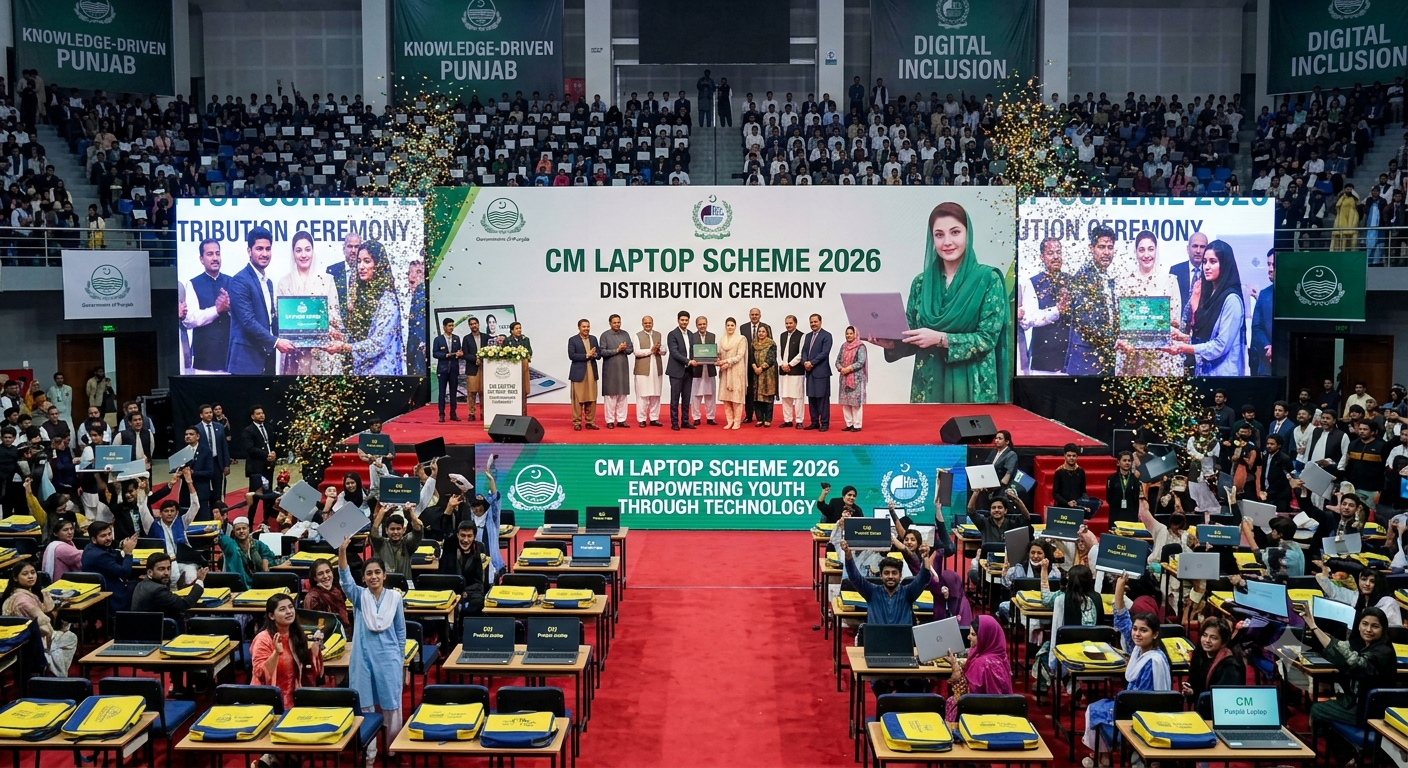
the Punjab Government has relaunched the CM Punjab Laptop Scheme (Chief Minister Laptop Program), with an expanded phase actively running in 2026.
This scheme is a flagship digital-education initiative under the government of Chief Minister Maryam Nawaz Sharif, aimed at providing talented and deserving students with free, high-performance laptops — so they don’t fall behind in online learning, research, and digital skill-building. In this article, we’ll walk you through every detail of the scheme — eligibility, documents, the application process, deadlines, helpline numbers, and real user experiences — so you don’t miss a single important step.
If you or someone you know is a student enrolled in a public sector college or university in Punjab, this guide is for you.
“To stay up to date with the latest allocation news, merit lists, and step-by-step application updates, make sure to follow the CM Laptop Scheme Updates archive.”
Background & Official Announcement
The CM Laptop Scheme 2026 isn’t a new concept in Punjab. It traces back to Shahbaz Sharif’s tenure (2011–2018), when the “Chief Minister’s Laptop Scheme” first benefited millions of students. After Maryam Nawaz Sharif became Chief Minister, the scheme was relaunched with upgraded specifications and a more transparent process.
The 2026 Phase 2 Launch: The Punjab Government announced Phase 2 of the CM Laptop Scheme in January 2026, starting from Gujranwala Division, where the first distribution ceremony was held at the University of Gujrat. The rollout was then extended to South Punjab. At an event held in Dera Ghazi Khan division, according to a Punjab government-affiliated social media post, <cite index=”12-1″>a total of 1,645 laptops were distributed among students of Dera Ghazi Khan Division, including 586 laptops for public university students in the region.</cite>
This shows the scheme is progressing in a division-wise phased rollout — starting with Gujranwala, then DG Khan, with other divisions expected to follow. This suggests the government’s focus is on ensuring equal access across all of Punjab, particularly in regions that were previously underserved.
What’s new in 2026? Compared to earlier phases (2018 and 2025), a few notable changes stand out:
- Division-wise phased rollout — instead of a single province-wide distribution, ceremonies are now organized division by division, which is expected to improve verification and reduce the chances of fraud.
- Increased South Punjab quota — multiple official and institutional updates indicate a significant share of laptops is reserved for South Punjab students, aimed at reducing regional economic disparity.
- Multiple deadline extensions — the 2026 application deadline has been extended several times (from February into March), suggesting the government is trying to include as many eligible students as possible.
Important: Since deadlines and specific figures change over time, we strongly recommend checking the official portal cmlaptophed.punjab.gov.pk before applying, to get the most current and accurate information.
“If you are having trouble accessing the official portal or tracking your application ID, you can follow this step-by-step CM Punjab Laptop Scheme 2026 Login Guide to sign in and check your verification status safely.”
Eligibility Criteria — Who Can Apply?
Eligibility criteria vary slightly depending on the phase and the student’s program (BS, Medical, DVM, Nursing, etc.). The table below gives you a general overview — always confirm the exact, final criteria on the official portal.
| Category | Eligibility Requirement |
|---|---|
| Domicile | Must hold a valid Punjab domicile — from any district |
| Institution Type | Regular enrollment in a public sector university, college, or HEC-recognized degree-awarding institute |
| BS Programs | Generally 1st or 2nd semester students with at least 65% marks in Intermediate |
| Medical & Dental (MBBS/BDS) | 1st professional year students with 80% marks in Intermediate |
| DVM Students | Minimum 75% marks in Intermediate |
| Nursing Students | Public sector nursing college students with at least 65% marks |
| Academic Session | Priority typically given to newly enrolled 2024-onwards sessions |
| Age/Regular Status | Only regular students are eligible — private candidates are excluded |
| Previous Beneficiary | Students who already received a laptop under any previous government scheme are not eligible again |
Who Cannot Apply (Ineligible Categories)
- Private candidates or students not regularly enrolled in an HEC-recognized institute
- Non-Punjab domicile holders (unless specifically notified as an exception)
- Students who have already received a laptop under any previous federal or provincial laptop scheme
- Students who don’t meet the required minimum marks/CGPA threshold
- Institutes that are not listed on the official portal (some private institutes are included, but only if officially notified)
Practical Tip: If you’re from South Punjab (Multan, Bahawalpur, DG Khan divisions), make sure your domicile certificate is accurate and up to date to benefit from the reserved quota — it can genuinely make a difference in selection.
“Before you begin filling out the application form, make sure you meet the criteria and follow the CM Punjab Laptop Scheme 2026 Online Registration checklist to keep your documents scanned and ready.”
Required Documents — Complete List
Before starting your application, have clear scanned copies of the following documents ready:
- CNIC / B-Form — of the applicant, or the guardian’s CNIC if the applicant is a minor
- Domicile Certificate — from any district of Punjab; this determines your division-wise eligibility and quota
- Latest Result Card / Marksheet — from Intermediate or your previous degree, used to verify your marks
- Proof of Current Enrollment — university/college fee challan, student ID card, or enrollment certificate
- Recent Passport-Size Photograph — in digital format, per the portal’s specifications
- Signed Affidavit — required in many cases, confirming you haven’t previously benefited from a government laptop scheme
- Bank Account Details (if applicable — requested in some phases for verification purposes)
Warning: Blurry or incomplete documents are the most common reason for application rejection. Make sure all text is clearly legible when scanning.
Step-by-Step Application Process
Here’s the complete process, step by step, as if you were sitting at the portal yourself.
Step 1: Visit the Official Portal
Type cmlaptophed.punjab.gov.pk into your browser. (Screenshot description: The homepage shows the Punjab Government logo, a CM Laptop Program banner, and a prominent “Apply Now” button.)
Step 2: Create a New Account (Sign Up)
Click “Sign Up” or “Register.” Enter your CNIC number, mobile number, and email address. (Screenshot description: A simple form with fields for CNIC, Name, Mobile, Email, and Password.)
Step 3: OTP Verification
You’ll receive an OTP (One Time Password) on your mobile number. Enter it to verify your account.
Step 4: Complete Your Profile
After logging in, enter your personal and academic details — domicile district, current institute name, program (BS/MBBS/DVM/Nursing), semester, and Intermediate marks.
Step 5: Upload Documents
Scan all the required documents listed above and upload them in the portal’s specified file size and format (usually PDF or JPG). (Screenshot description: A separate upload box for each document, with a green checkmark appearing once each upload is complete.)
Step 6: Review Your Form
Before submitting, double-check all your entries — especially spelling and marks, as these get cross-checked during verification.
Step 7: Final Submission
Click “Submit.” You’ll receive an Application Tracking ID — save this carefully, as you’ll need it for future correspondence and status checks.
Step 8: Track Your Status
Log back into the portal to check your dashboard for updates — “Under Review,” “Shortlisted,” or “Rejected” statuses will appear here.
Pro Tip: Take a screenshot of your tracking number right after submission, and don’t delete your confirmation SMS/email.
Benefits & Subsidy Details
This scheme is completely free — no fees or charges are collected from applicants at any stage. Here are the exact benefits:
- Laptop Specifications: Generally, 13th Generation Intel Core i7 processor laptops are being distributed, suitable for modern software, research tools, and coding/design applications.
- Zero Cost to Student: From registration to laptop collection, the entire process is completely free.
- South Punjab Quota: According to multiple reports, a significant share (up to 32% in previous phases) of laptops is reserved for South Punjab students.
- Gender Inclusion: A special quota is also reserved for female students to reduce the gender gap in education.
- Distribution Ceremonies: Laptops are distributed at official division-wise ceremonies, often attended by the Chief Minister or her representatives — helping ensure transparency.
- Timeline: From application to distribution, the process generally takes 2-3 months, though verification and merit list preparation can extend this timeline.
Real Impact: The benefit of such scholarship and laptop schemes goes beyond just a device. As in Ayesha’s case, a laptop gives students the opportunity to work on freelancing platforms (Fiverr, Upwork), write research papers, and learn digital skills — a long-term investment in their careers.
Common Mistakes, Myths & FAQs
Myth 1: “This scheme is only for university students”
Reality: Eligibility criteria vary by phase — in some phases, top position holders from Intermediate/Matric are also eligible. Check the portal for your specific category.
Myth 2: “Paying an agent guarantees you a laptop”
Reality: This is a complete scam. No official channel asks for money. Use only the official portal.
FAQs
Deadlines, Helpline & Official Sources
- Official Portal: cmlaptophed.punjab.gov.pk
- Note on Deadlines: The Phase 2 (2026) deadline has been extended multiple times between February and March — so we can’t guarantee a specific date here. Always check the current deadline on the official portal before applying.
- Query/Complaint Channel: Contact the Higher Education Department Punjab’s official social media pages, or your university’s Focal Person.
- Address (HED Punjab): Opposite Lahore Museum, Shahrah-e-Quaid-e-Azam, Lahore
- Related Official Resource: Punjab Higher Education Department — hed.punjab.gov.pk
Caution: Because different websites report conflicting deadlines and figures for this scheme, Daily Agahi advises readers to rely only on the official government portal or their university’s HEC focal person for final confirmation.
Pros, Cons & Real User Impact — A Balanced View
Pros
- Completely free, high-spec laptops that meet modern academic and freelancing needs
- Dedicated quota for South Punjab and underserved areas, helping reduce regional inequality
- Online, transparent application process that reduces scope for bribery and political influence
- Special quota for female students, promoting gender-inclusive education
Cons
- Frequent deadline changes cause confusion among students
- Limited institutional coverage — restricted to public sector or officially listed institutes
- Verification and distribution can sometimes stretch out over several months
- Some students report that merit list transparency could be improved
Real User Impact
Students who attended the ceremonies in Gujranwala and DG Khan division reported that receiving a laptop made attending online classes, submitting assignments, and accessing research materials significantly easier. This small assistance can make a real difference in the academic journey of children from families who couldn’t otherwise afford a new laptop.
Conclusion: Secure Your Future Today
The CM Punjab Laptop Scheme 2026 isn’t just about handing out a gadget — it’s an effort to bring Punjab’s youth up to par in the digital world. If you or someone you know is eligible, don’t delay: get your required documents ready, visit the official portal cmlaptophed.punjab.gov.pk, and submit your application as soon as possible to avoid last-minute technical issues from heavy portal traffic.
What to do now:
- Scan and prepare your domicile and academic documents
- Create an account on the official portal
- Confirm the latest deadline with your university’s Focal Person
- Submit your application and save your tracking ID
Every student has a stake in Punjab’s digital progress — and this scheme is one way to make that possible.