March 17–18, 2026 | Special Report
The Night That Changed Iran’s War Leadership Forever
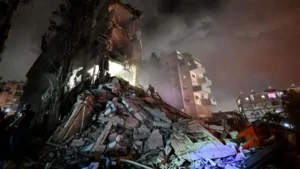
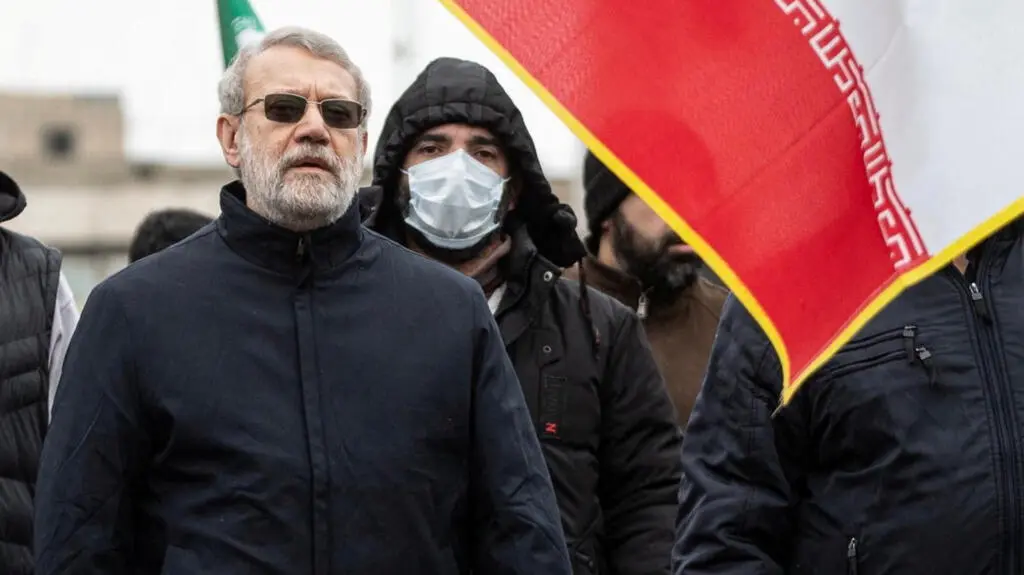
In the early hours of March 17, 2026, Israeli warplanes and drones carried out a sweeping wave of targeted strikes deep inside Tehran. When the dust settled, two of the Islamic Republic’s most consequential surviving figures were dead. Top Iranian security official Ali Larijani and the commander of Iran’s internal Basij militia, Gholamreza Soleimani, have been killed, Iran’s state media confirmed hours after Israel claimed to have killed the two.
- “With tensions rising across the Middle East, you can follow the Iran war latest news today for minute-by-minute updates on the military situation.”
The twin assassinations, confirmed by both Israeli and Iranian authorities in the hours that followed, represent the single most devastating blow to Iran’s wartime leadership since the conflict began on February 28, 2026. Larijani is the highest-ranking Iranian official killed in US-Israeli attacks on Iran since former Iranian Supreme Leader Ayatollah Ali Khamenei was assassinated on the first day of the war. With these two men now gone, the Islamic Republic finds itself fighting one of the most ferocious foreign wars in its history — while simultaneously scrambling to replace an entire generation of its top commanders.
Israel Claims Responsibility: “The Leaders of the Regime Are Being Killed”
Israel wasted no time in announcing the strikes. Israeli Defense Minister Israel Katz said Tuesday that Iran’s security chief, Ali Larijani, had been killed in airstrikes overnight. Katz said in a statement that he had been informed by the military that Larijani and the commander of Iran’s Basij forces, Gholamreza Soleimani, had both been killed.
The IDF referred to Larijani as “the de facto leader of the Iranian terror regime.” The IDF also confirmed it had assassinated Gholamreza Soleimani, head of the Islamic Revolutionary Guard Corps Basij paramilitary militia, and his deputy, Seyyed Karishi. The two were killed in a makeshift tent area, which had been set up to make it harder to follow them than if they had been based in their headquarters.
The operational significance of that detail — the tent camp — reveals a cat-and-mouse dynamic that has defined this war. According to the IDF, the Basij had set up the camp after the military struck many of the headquarters of the paramilitary force. In other words, Soleimani had gone to considerable lengths to evade Israeli intelligence — and still did not survive.
An Israeli official also confirmed to The Jerusalem Post that the majority of the Basij leadership was eliminated overnight in the Israeli airstrike. Additionally, the IDF announced it killed the IRGC’s Aerospace Force chief.
“Make sure to check the latest updates on the NADRA Digital ID legal status in Pakistan 2026 before applying for your virtual identity.”
Prime Minister Benjamin Netanyahu appeared on television following confirmation of the deaths. “This morning we eliminated Ali Larijani, the boss of the Revolutionary Guards, which is the gang of gangsters that actually runs Iran,” Netanyahu said, noting that overthrowing clerical authorities “will not happen all at once.” “But if we persist in this — we will give them a chance to take their fate into their own hands,” the Israeli prime minister said.
The Prime Minister’s Office released an image showing the moment in which Prime Minister Benjamin Netanyahu issued the order for the targeted assassinations, alongside incoming Mossad chief Roman Gofman. After Larijani’s death was confirmed, the Mossad’s Farsi account posted on X, saying: “In the end, people without mercy will die.”
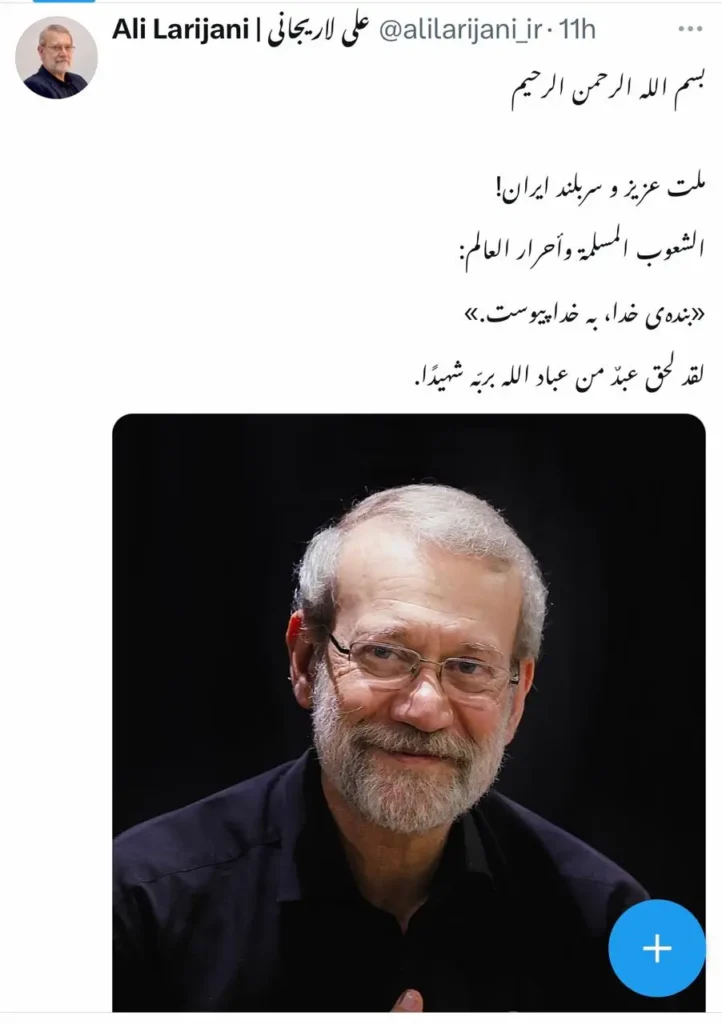
Iran Confirms: “The Sweet Grace of Martyrdom”
For several hours after Israel’s announcement, Tehran maintained its characteristic silence. Then, late Tuesday night, the confirmations came in rapid succession. In a statement carried by Iran’s semi-official Mehr news, the country’s Supreme National Security Council confirmed the assassination of its secretary, Larijani, saying: “After a lifetime of striving for the elevation of Iran and the Islamic Revolution, he finally reached his long-cherished wish, answered the call of truth, and proudly attained the blessed rank of martyrdom in the service front.”
The council said the pure souls of the martyrs embraced Larijani’s purified soul, and confirmed that his son and his bodyguards had died with him.
“With rising inflation, finding a reliable vehicle is tough, but you can still find great value in our list of the top 10 cars in Pakistan under 10 lakhs for 2026.”
Separately, in a statement shared by Iran’s semi-official Tasnim news agency, the IRGC said the 62-year-old Soleimani was killed in an “attack by the American-Zionist enemy.”
Who Was Ali Larijani? The “Kennedy” of Iranian Politics
To understand the magnitude of Larijani’s death, one must appreciate the extraordinary breadth of his life and career. Born on June 3, 1958, in Najaf, Iraq, to a wealthy family from the Iranian city of Amol, Larijani belonged to a dynasty so influential that in 2009, Time magazine described them as the “Kennedys of Iran.” His father, Mirza Hashem Amoli, was a prominent religious scholar. His brothers have held some of the most powerful positions in Iran, including in the judiciary and the Assembly of Experts.
Unlike many of his peers who came solely from religious seminaries, Larijani also had a secular academic background. In 1979, he earned a bachelor’s degree in Mathematics and Computer Science from the Sharif University of Technology. He later completed master’s and doctorate degrees in Western philosophy from the University of Tehran, writing his thesis on Immanuel Kant.
The image of an IRGC officer and wartime security chief who wrote philosophical texts about Kantian metaphysics captures the layered, contradictory nature of the man.
A veteran of the Islamic Revolutionary Guard Corps during the Iran-Iraq War, Larijani later headed state broadcaster IRIB for a decade from 1994, before serving as parliamentary speaker from 2008 to 2020. In 1996, he was appointed as Khamenei’s representative to the Supreme National Security Council. He later became secretary of the SNSC and chief nuclear negotiator, leading talks with Britain, France, Germany, and Russia between 2005 and 2007.
His appointment as Secretary of the Supreme National Security Council in 2005 placed him at the center of one of the most consequential diplomatic crises of the early twenty-first century: the Iranian nuclear standoff with the United States and its European allies. He famously derided a subsequent nuclear agreement as “trading pearls for bonbons,” signaling his belief that Tehran had conceded too much for too little.
He ran in the 2005 presidential elections, losing to populist candidate Mahmoud Ahmadinejad, with whom he later had disagreements over nuclear diplomacy. Larijani was then disqualified from running for president in both 2021 and 2024.
His most consequential chapter began just months before his death. In 2025, following Israel’s 12-day war with Iran, President Masoud Pezeshkian appointed Larijani secretary of the SNSC. In that role, Larijani played a key part in the brutal suppression of the Iranian protests in January 2026. As the United States used the protests to ramp up pressure on Iran, Larijani became the central figure in Iranian foreign policy, as both head of security and a veteran of nuclear negotiations.
According to The New York Times, Larijani has effectively been running Iran since January 2026 and was in “charge of crushing, with lethal force, the recent protests demanding the end of Islamic rule.”
When Khamenei was killed on February 28, the scale of Larijani’s responsibilities expanded overnight. He played an important role alongside the three-man transitional council running Iran after Khamenei’s killing. He warned the US that it was delusional to think killing leaders would destabilise Iran.
Just weeks before the current escalation, Larijani was reportedly engaged in indirect negotiations with the US. In February, during talks mediated by Oman, he said that Tehran had not received a specific proposal from Washington, and accused Israel of trying to sabotage the diplomatic track to “ignite a war.” In an interview with Al Jazeera before the US and Israel’s attacks on Iran, Larijani described his country’s position on the talks as “positive”, noting that the US had realised that the military option was not viable.
“Larijani has been the central player in maintaining the continuity of the Iranian government for several months, and in particular since June 2025,” said David Khalfa, co-director of the Middle East Observatory at the Jean Jaures Foundation think tank. “He has effectively been the figure in charge of the regime’s survival, its regional policy and its defence strategy.”
Defiant until the very end, Larijani warned only a week before his death, in a message aimed at President Trump, that the Iranian people “do not fear your empty threats; even those greater than you have failed to erase them… so beware lest you be the ones who disappear.”
Who Was Gholamreza Soleimani? Iran’s Iron Fist at Home
If Larijani was Iran’s diplomat-soldier, Gholamreza Soleimani was its enforcer. Soleimani was the commander of the country’s most powerful internal security forces for the past six years and a veteran of the Iran-Iraq War, having fought on the front lines. Al Jazeera
In the spring of 1981, Gholamreza Soleimani deployed to the Shush front lines at the Iraq border as a teenage volunteer. Over the gruelling eight-year conflict, he participated in several major offensives, including Operations Tariq al-Qods, Fath ol-Mobin, and Beit ol-Moqaddas, serving as both a fighter and a battalion commander. He joined the IRGC in 1982.
On July 2, 2019, Khamenei appointed Soleimani as head of the Basij, a volunteer paramilitary force under the IRGC, tasked with enforcing internal security through local branches across the country. The official decree tasked Soleimani with “elevating the Basij and the culture of resistance” while expanding armed groups and deepening revolutionary values among Iranian youth.
The Basij under Soleimani’s command was not merely a military organization. It was the Islamic Republic’s primary tool for silencing its own people. As the commander of the Basij, Soleimani was frequently deployed to quell domestic unrest. In November 2019, months after he took command, the Basij was heavily involved in violently suppressing nationwide antigovernment protests. The paramilitary force, with an estimated 450,000 personnel, has often been deployed to clamp down on protests against the government and has played a major role in suppressing uprisings, including the 2009 Green Revolution and the 2022–2023 protests.
For these actions, Soleimani paid an international price. He has been sanctioned by the US, the European Union, and other countries for his alleged role in suppressing dissent through the Basij.
In regard to the 2023 Hamas-Israel war, in November 2024 Soleimani claimed that Israel was facing economic collapse due to its ongoing conflict with Hamas in Gaza. He stated that Iran-backed militias, including Hezbollah in Lebanon, continued to engage in near-daily cross-border clashes with Israeli forces.
As the war with the US and Israel intensified in 2026, Soleimani’s Basij became more central than ever — both in suppressing a restive civilian population at home and in mobilizing its vast paramilitary network. His death, alongside much of the Basij’s top leadership, delivers a potentially crippling blow to Iran’s internal security infrastructure.
The Diplomatic Casualty: A Negotiator Silenced by a Bomb
One of the most profound and unreported dimensions of Larijani’s killing is what it means for any potential off-ramp to this war. Iranian American political analyst Trita Parsi said Larijani could have played a role in future ceasefire negotiations, noting the Israelis recognized him as a negotiator behind the scenes, whether with Russia or the United States. “The Israelis have fought so hard to get the United States to go into a full-scale war with Iran for more than 20 years. It is in their interest to prolong this war as long as they can, and kill off any potential off-ramps that Trump may be looking for.”
President Donald Trump said yesterday that he didn’t know who to negotiate with in Iran, yet at the same time the US and Israel keep assassinating senior leaders inside the Islamic Republic. A top, inner circle figure, Larijani was respected as someone close to the center of power in the country, with good ties to the Islamic Revolutionary Guard Corps, the clerics, and the civilian government. Some had touted him as a future leader.
He led the Iranian team in the recent nuclear negotiations. So while the US is saying it doesn’t know who was in charge, it appears that one of the people who it certainly did know and who was in a position of considerable authority has just been taken out.
Iran Vows: “Decisive and Regrettable” Revenge
Tehran’s response was swift and unambiguous. Iran vowed a “decisive” retaliation for the death of its security chief Ali Larijani, firing off a wave of missiles at Israel. A barrage of Iranian missiles killed two people near Israel’s commercial hub Tel Aviv, while Gulf nations intercepted rockets and drones headed for targets including US bases in the region.
Iran held funerals on Wednesday for Larijani and Gholamreza Soleimani, according to the Fars and Tasnim news agencies.
Iran’s military commanders issued some of their starkest warnings of the conflict. The Iranian army chief declared that the response would be decisive and regrettable, and that the blood of the martyrs would be avenged. The IRGC, for its part, announced that its strikes had targeted more than 100 military and security targets in Israel as initial revenge for the killings.
What Comes Next: A Regime Under Decapitation Strategy
The killing of Larijani and Soleimani fits squarely into a deliberate Israeli strategy of what analysts call “leadership decapitation” — systematically eliminating not just military commanders but the political and institutional figures who hold the Islamic Republic together.
Besides Khamenei’s son Mojtaba and Larijani, another figure who could be running much of the regime behind the scenes is Ahmad Vahidi, the IRGC deputy chief on the eve of the war. On March 1, the IRGC announced Vahidi as its new leader. This would be ironic because Vahidi was unknown and not even among the IRGC’s top 10 until December, when he became its deputy chief. Most of Iran’s top leadership was killed in June 2025, and the majority of its current top leaders are relatively new to their posts. NBC News
Yet the strategy is not without its critics. Mohamad Elmasry, professor at the Doha Institute for Graduate Studies, said the US and Israel were playing a “game of Whac-A-Mole” as they target Iranian leaders. “There’s always another leader… so I don’t think this is going to suggest any kind of collapse of the Iranian regime. Having said that, this is very significant symbolically and psychologically.”
What is certain is that Iran on March 18, 2026, is a fundamentally different country than it was 18 days ago when this war began. It has lost its supreme leader, its security chief, its Basij commander, its IRGC Aerospace Force chief, and the majority of its top military leadership. It is fighting a war on multiple fronts, with its oil revenues choked by the closure of the Strait of Hormuz and its population enduring relentless bombardment. And yet it continues to fight — firing missiles at Tel Aviv, targeting US bases across the Gulf, launching drones into Kuwait and Saudi Arabia, and holding state funerals that double as rallies of defiance.
Ali Larijani — philosopher, nuclear negotiator, parliamentarian, wartime leader, and, in his final weeks, the de facto ruler of the Islamic Republic — is dead at 67. Gholamreza Soleimani — the teenage volunteer who fought on the Iraq front and rose to become the iron hand of Iran’s internal security — is dead at 62. The war they gave their lives defending continues.