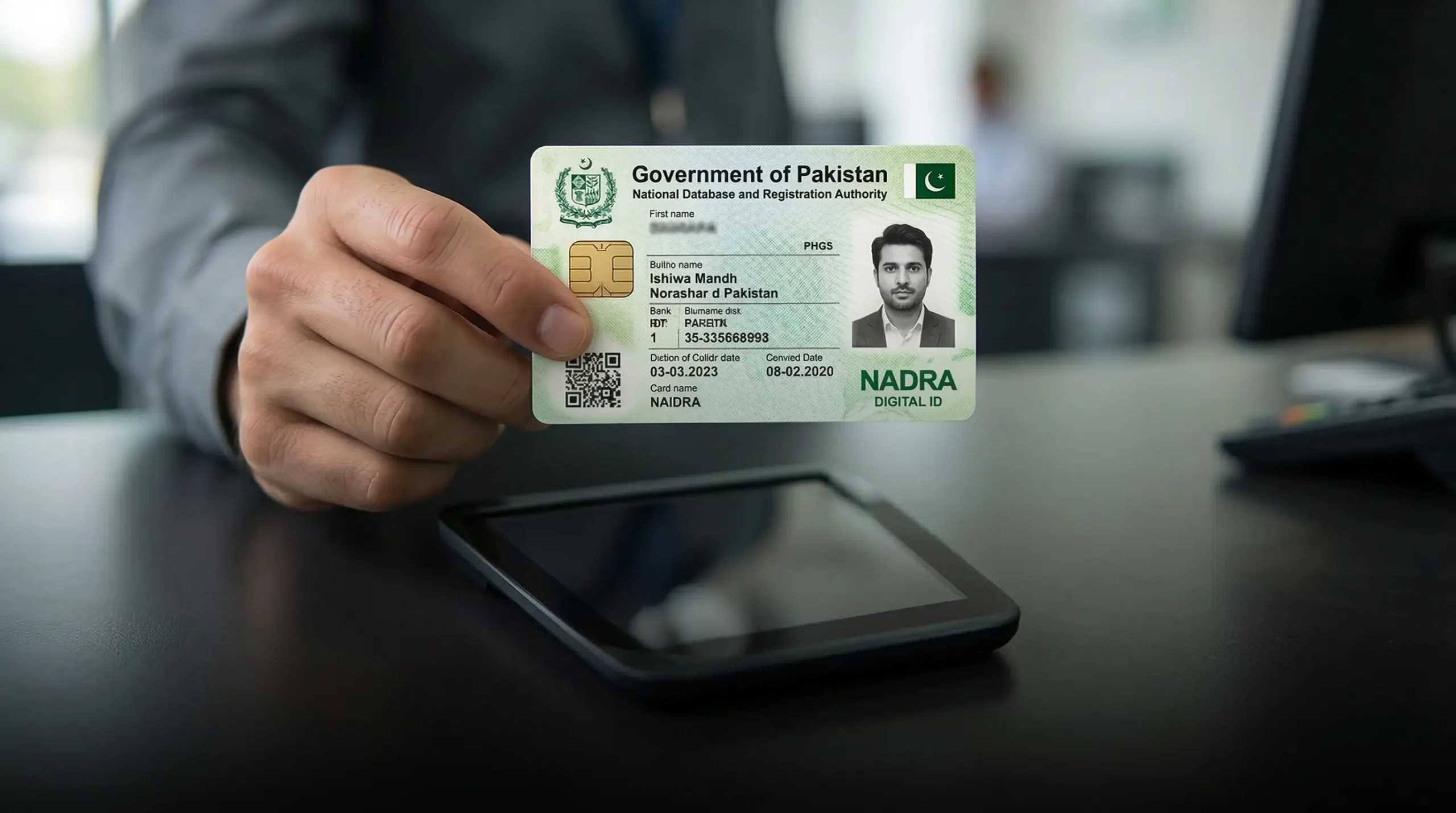
In a sweeping NADRA digital ID legal status Pakistan 2026 regulatory clarification issued on Friday, Pakistan’s National Database and Registration Authority formally declared that digital identity credentials issued through its PakID platform are legally identical to physical CNICs — and has warned all institutions that continued demands for photocopies are unlawful.
By Staff Reporter | Islamabad, March 13, 2026 | Updated 12:30 PM PKT
ISLAMABAD — Pakistan’s National Database and Registration Authority (NADRA) issued a definitive legal clarification on Friday, March 13, 2026, declaring that digital identity cards made available through its official PakID platform carry precisely the same legal status, evidentiary weight, and institutional standing as physical Computerised National Identity Cards (CNICs). The pronouncement arrived as a formal warning directed at government offices, financial institutions, and telecom operators that have continued demanding physical cards or photocopies — a practice NADRA described as not only unnecessary but directly contrary to Pakistan’s established regulatory framework.
For more information on the upcoming Apple flagship, you can check out the latest updates on the iPhone 18 Pro Max release date.
NADRA spokesperson Shahbaz Ali, speaking on behalf of the authority, confirmed that some offices and service providers have been insisting on the production of a physical CNIC or its photocopy, and are refusing to accept the digital ID or dematerialised CNIC, NICOP, or POC available through the PakID platform. He stressed that this practice is inconsistent with the applicable legal framework.
“The DigitalID or dematerialized CNIC, NICOP or POC is legally equivalent to the physical CNIC and must be accepted wherever proof of identity is required.” — NADRA Official Statement, March 13, 2026
The statement marks a decisive shift from guidance to enforcement. With the legal instruments now fully in place and publicly cited, NADRA is no longer treating non-compliance as a cultural lag to be accommodated — it is treating it as a regulatory violation to be reported and remedied.
The Legal Architecture: Regulations 9 and 10
NADRA’s clarification draws its authority from two interlocking legal instruments: the NADRA Ordinance 2000 and the Digital Identity Regulations 2025. Together, these statutes provide a comprehensive framework that treats physical and digital identity credentials as fully interchangeable in all institutional and legal contexts.
“Learn more about AI and the job market.”
The NADRA Ordinance 2000 mandates that the Authority maintain the national citizen database and issue identity credentials. Pursuant to this mandate, the NADRA Authority Board — following approval from the Ministry of Law and Justice — formally issued the Digital Identity Regulations 2025. These regulations were developed under the government’s Digital Economy Enhancement Project (DEEP), a major digital transformation programme supported by the World Bank.
Regulation 9 — Legal Recognition of Digital Identity Credentials: A digital identity credential issued or authorised by NADRA shall have the same legal status, validity, and evidentiary value as a physical identity credential. This regulation explicitly extends full legal recognition to the DigitalID, the dematerialised CNIC, the NICOP, and the Pakistan Origin Card (POC).
Regulation 10 — Acceptance of Digital Identity Credentials: Any public authority, regulated entity, or organisation requiring proof of identity must accept digital identity credentials issued or authorised by NADRA as valid proof of identity. This provision binds all government departments, financial institutions, telecom operators, and other regulated service providers without exception.
Legal consultant Mohsin Saleem Ullah, who helped author the regulations under the World Bank-funded DEEP project, has described Pakistan’s Digital ID Regulations 2025 and the accompanying National Data Exchange Layer (NDEL) Regulations 2025 as among the world’s first comprehensive legal regimes governing both a national digital identity system and the data-sharing infrastructure that underpins it. Islamabad Schools Eid Holidays 2026 He argues that Pakistan now possesses a secure, interoperable, and citizen-centred digital ID framework designed to achieve financial inclusion, efficient public services, and data-driven governance.
A Regulatory Warning with Real Teeth
NADRA directed all government departments, public and financial institutions, and telecom operators to ensure full compliance with the digital identity regulations and to issue appropriate instructions to their field offices. The authority simultaneously pointed citizens toward its official complaint management system as the recourse mechanism for any institution that refuses to honour a valid digital ID.
This creates an enforceable accountability loop. Citizens who encounter non-compliance — whether at a government counter, a bank branch, or a telecom outlet — can file a formal complaint with NADRA, triggering a regulatory process against the offending institution. The authority has been explicit: refusal to accept a digital ID is not a matter of institutional preference or risk-aversion; it is a violation of binding law.
The clarification also addresses a data security concern that has long been raised by civil society groups. When institutions demand photocopies of physical CNICs, those copies enter circulation in ways that are difficult to track or control. They can be reproduced without authorisation, retained beyond their intended purpose, or misused to perpetrate identity fraud. NADRA’s statement specifically highlighted that digital identity documents help prevent the misuse of identification data and strengthen the protection of citizens’ personal information — a point that has direct relevance for Pakistan’s ongoing legislative work on data protection.
NADRA by the Numbers: The Scale of the System
To appreciate what it means to have a legally recognised digital identity in Pakistan, it is necessary to understand the infrastructure behind it. NADRA’s 2025 annual performance report reveals a system of extraordinary reach and depth:
| Citizens in NADRA database | 227 million (98.3% of adult population) |
| Fingerprint records | 1.64 billion across enrolled citizens |
| Facial biometric records | 170 million citizens |
| Iris scan records | 7 million citizens |
| Biometric verifications in 2025 | 445 million processed |
| Pak ID app downloads | 12 million+ (as of early 2026) |
| Daily cases via Pak ID | 10,000+ (15% of NADRA workload) |
| Quarterly digital applications | 1.2 million (Q4 2025, +45% surge) |
| NADRA registration centres | 938 centres + 231 mobile vans |
| Users via Pak ID in 2025 | More than 6 million citizens |
These figures place Pakistan’s national identity system among the largest biometric databases in the world. The scale of the infrastructure directly underpins the legal standing of digital credentials: a digitally verified identity is authenticated against 1.64 billion fingerprint records, 170 million facial biometric profiles, and seven million iris scans in real time — a level of verification that no physical document can match.
NADRA has also expanded its physical and digital reach to ensure that no citizen is left outside the system. The authority now operates 938 registration centres supplemented by 231 mobile vans — including 33 satellite-equipped units for remote and underserved areas — and six overseas counters to serve Pakistanis abroad.
The Pak ID Platform: Infrastructure of a Digital Nation
At the operational heart of Pakistan’s digital identity ecosystem is the Pak ID mobile application, available on both Google Play and the Apple App Store. With more than 12 million downloads as of early 2026, Pak ID is one of Pakistan’s most widely adopted public-service platforms, handling over 10,000 identity cases daily and accounting for 15 percent of NADRA’s total workload. In the final quarter of 2025 alone, more than 1.2 million applications were processed through the app — a 45 percent surge compared to the previous period. Over the course of 2025, more than six million citizens accessed identity services through the platform.
The application supports a comprehensive and expanding suite of services. Citizens can apply for new CNICs or NICOPs, renew existing documents, submit biometric data, upload supporting documents, book appointments at registration centres, track application status, and make fee payments — all without visiting a physical office. A dedicated PakID Vault securely stores verified identity documents including the digital CNIC, academic degrees, licences, and certificates, making them accessible for instant sharing with authorised institutions.
The app’s technical architecture is designed to meet international standards for digital identity. NADRA’s PakID platform complies with NIST 800-63 digital identity guidelines, OAuth 2.0 delegated access protocols, OpenID Connect (OIDC) for secure Single Sign-On, TLS 1.2/1.3 encryption for data transmission, and both ISO/IEC 27001 (information security management) and ISO/IEC 24760 (identity management framework). Biometric capabilities include ICAO-compliant photograph capture, fingerprint acquisition via mobile camera, facial recognition login, and digital signature capture.
“Pak ID is not just a facility — it is the foundation of Pakistan’s digital future.” — NADRA, via official social media
Looking ahead, NADRA has announced plans to introduce home-based biometric verification for elderly or infirm users, an AI-powered guidance system, and a full digital identity wallet. A ‘Proof of Life’ service is also in development to assist pensioners who face biometric verification challenges due to age or health conditions.
The Nishan Pakistan portal — a secure digital verification platform launched as part of the DEEP project — enables banks, telecom operators, and financial institutions to authenticate citizen identities online, directly from NADRA’s database, without requiring the citizen to present any physical document. This back-end infrastructure is what makes the legal equivalence of digital IDs practically operational: institutions no longer need physical documents to verify identity, because they can query the authoritative source directly.
Milestones on the Road: From Silver Jubilee to Digital Law
Pakistan’s first fully dematerialised national identity card was launched during NADRA’s Silver Jubilee celebrations in March 2025 — a milestone that President Asif Ali Zardari described as a major step in providing legal and unique identity to citizens and reinforcing the social contract between the state and its people. Federal Minister for Interior and Narcotics Control Mohsin Raza Naqvi called the launch a major advancement in the nation’s digital identity initiative and confirmed that the feature would be integrated directly into the Pak ID mobile app, allowing citizens to securely store their identity cards on their smartphones.
Full implementation of the digital identity system was anchored to Pakistan’s Independence Day, August 14, 2025, when the framework — including new smart non-chip national ID cards with QR code verification alongside the dematerialised digital card — was formally rolled out.
That rollout was preceded by significant regulatory modernisation. In February 2026, the Government of Pakistan notified amendments to the National Identity Card Rules 2002 and the Pakistan Origin Card Rules 2002 through S.R.O. 330(I)/2026 and S.R.O. 331(I)/2026, published in the Gazette of Pakistan. These amendments formally embedded QR code-based verification into the legal identity framework, defining the QR code as a secure, machine-readable, two-dimensional barcode capable of storing encoded identity information. The amendments also introduced iris scan and facial recognition as legally recognised biometric modalities, added a digital kill-switch allowing immediate suspension of lost or compromised cards across all verification channels, and granted lifetime validity to identity cards for citizens aged 60 and above.
Separately, new rules mandated the collection of biometric data from applicants between the ages of 10 and 18, compulsory birth registration of children for the Child Registration Certificate, and a formal legal status for the Family Registration Certificate (FRC) — all aimed at improving the integrity and comprehensiveness of NADRA’s national database.
The Broader Policy Context: Digital Nation Pakistan
NADRA’s March 13 clarification does not exist in a policy vacuum. It is an enforcement action within a much larger and rapidly maturing digital governance architecture. The Digital Nation Pakistan Act 2025 established the Pakistan Digital Authority (PDA) as an autonomous regulatory body under Section 6, charged with operationalising the country’s digital vision. PDA founding chair Dr Sohail Munir has described the authority’s mandate as addressing the fragmented nature of prior digital initiatives and bringing the coherence needed to lead digital transformation at scale.
The PDA is building sector-specific digital public infrastructure sub-stacks covering health IDs, education records, and financial identity — all anchored to the NADRA-issued digital identity as the foundational credential. The Digital ID and the National Data Exchange Layer together form the backbone of Pakistan’s broader Digital Public Infrastructure (DPI), enabling paperless verification across government portals, financial services, educational institutions, and healthcare systems.
The World Bank, which is co-funding these reforms through the DEEP project, has expressed strong optimism about NADRA’s digital transformation trajectory. The bank’s support reflects an international assessment that Pakistan’s digital identity framework — combining near-universal biometric registration, robust mobile infrastructure, and now a comprehensive legal regime — represents a credible model for digital public service delivery in the developing world.
Why the Clarification Was Necessary
If the legal framework has been in place since the promulgation of the Digital Identity Regulations 2025, why was a public clarification necessary in March 2026? The answer lies in the persistent and well-documented gap between the enactment of policy and its adoption in institutional practice.
Institutional inertia is a universal challenge in digital identity transitions. Government offices that have required physical CNICs or their photocopies as part of established workflows for decades do not automatically update their procedures when new regulations are enacted. Front-line staff may be unaware of regulatory changes; risk-averse managers may default to legacy practices to protect themselves from accountability; and systemic inertia in large bureaucracies can mean that even clear legal mandates take years to filter into daily operations.
NADRA’s statement is notable for its precision. Rather than issuing broad guidance encouraging digital adoption, the authority cited specific regulation numbers, named the categories of institutions in violation, and directed citizens to a formal complaint mechanism. This signals a transition from promotion to enforcement — a recognition that legal rights without practical enforceability are of limited value.
There is also a national security dimension. Pakistan’s Prevention of Electronic Crimes Act 2016 already imposes penalties for unauthorised access to or misuse of NADRA’s identity systems. The circulation of physical CNIC photocopies beyond regulated channels creates vulnerabilities that digital verification eliminates. By insisting on digital authentication through NADRA-verified channels, the authority is simultaneously reducing fraud risk, strengthening data protection, and asserting the integrity of the national identity ecosystem.
What This Means for Citizens
For the average Pakistani citizen, the implications of Friday’s clarification are immediate and practical. When opening a bank account, registering a SIM card, applying for a government service, applying to an educational institution, or presenting identification at any regulated entity, a digital ID displayed through the Pak ID mobile application is now unambiguously sufficient. No physical CNIC is required. No photocopy can be lawfully demanded.
Citizens who encounter non-compliance — an institution that refuses to accept their digital ID or insists on a physical card or photocopy — now have a clear legal basis to object and a formal channel to pursue the matter. NADRA’s official complaint management system at complaints.nadra.gov.pk provides citizens with a direct recourse mechanism, and complaints filed there trigger regulatory accountability for the offending institution.
The transition also carries security benefits that accrue directly to citizens. Physical photocopies of CNICs, once handed to an institution, are difficult to track. They can be copied further, retained without authorisation, or misused. Digital verification through PakID’s authenticated channels eliminates this risk: the credential is verified against NADRA’s biometric database in real time, no physical copy changes hands, and the citizen retains full control over who accesses their data through PakID’s consent management system.
For Pakistan’s diaspora community, the clarification reinforces rights that extend internationally. NADRA has launched a digital download system for overseas Pakistani identity cards (NICOPs), and the Pak ID app now allows overseas Pakistanis to apply for or renew their Smart NICOP entirely from their smartphones, including biometric data submission. NADRA has established counters in 22 Pakistani missions abroad to facilitate the overseas community’s access to digital identity services.
Conclusion: Asserting a Right Already Won
Pakistan’s digital identity infrastructure has, in many respects, outpaced its institutional adoption. NADRA has spent twenty-five years building one of the world’s most comprehensive biometric databases: 227 million registered citizens, 1.64 billion fingerprints, 170 million facial records, and a mobile platform handling millions of verifications monthly. The legal framework granting full equivalence to digital IDs has been in force since the Digital Identity Regulations 2025. The Pak ID app has been downloaded more than 12 million times.
What has lagged is the willingness — or awareness — of institutions to honour this framework in daily practice. NADRA’s March 13, 2026 clarification is, at its core, an act of assertion: a reminder that a legal right already exists, that it is enforceable, and that institutions which ignore it do so at regulatory risk.
For Pakistan’s digital governance ambitions — anchored in the Digital Nation Pakistan Act, driven by the World Bank-funded DEEP project, and expressed through the rapidly maturing PakID platform — the enforcement of digital ID equivalence is not merely a bureaucratic update. It is a foundational requirement. A country cannot have a functional digital public infrastructure if the identity credentials at its base are not universally accepted. With Friday’s directive, NADRA has drawn a clear line: the digital future it has built is not optional, and the institutions of the state are now required to inhabit it.