By dailyagahi | April 18, 2026
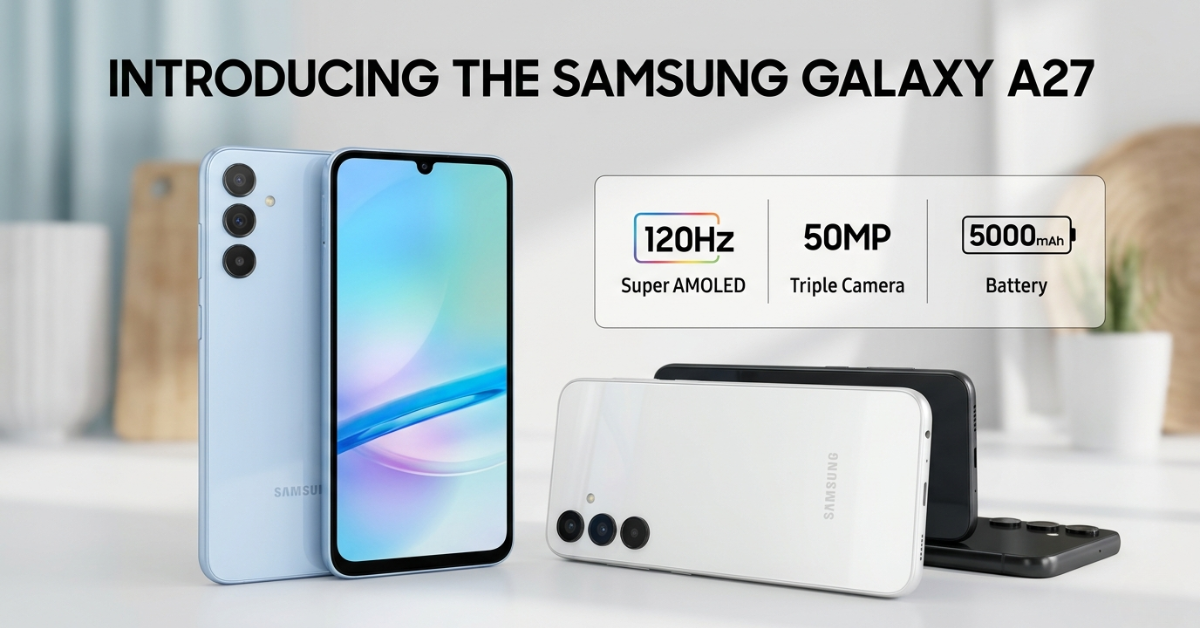
First CAD-based renders reveal Samsung’s Galaxy A27 has ditched the waterdrop notch for a modern punch-hole display, bringing flagship design language to the budget segment. Here’s everything we know — design, specifications, launch timeline, and how it compares to the A26.
samsung galaxy a27 renders A-series has long walked a difficult tightrope: deliver reliable mid-range performance at accessible prices while accepting that design compromises are part of the territory. For years, that compromise was most visible in the A2x lineup — the Galaxy A24, A25, and A26 — where the waterdrop notch, thick bottom bezel, and budget aesthetic lingered stubbornly even as Samsung’s flagship S-series and higher-tier A-series phones moved on to cleaner, more modern designs.
That era appears to be over.
In the past three days, detailed CAD-based renders of the Samsung Galaxy A27 have surfaced through a collaboration between reliable leaker OnLeaks (Steve Hemmerstoffer) and HotEUDeals, giving us the first comprehensive look at Samsung’s next entry-level mid-range smartphone. The renders — published by SamMobile, GSMArena, Android Authority, Notebookcheck, and virtually every major tech publication tracking Samsung leaks — reveal a design transformation that changes the visual positioning of the Galaxy A2x series entirely.
The biggest change? The waterdrop notch is gone. In its place: a centered punch-hole cutout for the selfie camera, bringing the Galaxy A27’s front design in line with Samsung’s Galaxy A37, A57, and even the flagship Galaxy S26 series. Combined with thinner bezels around a flat 6.7-inch display, the A27 finally sheds the “budget” look that has defined its predecessors for years.
For anyone who cares about how a phone looks and feels in hand — and that is a far larger percentage of smartphone buyers than the spec-obsessed corners of the internet like to admit — this is the first time a Galaxy A2x phone will look premium rather than apologetic. And if the leaked specifications hold, it will do so while keeping the price accessible.
This article covers everything currently known about the Samsung Galaxy A27: the design revealed in the leaked renders, the specifications that have surfaced through Geekbench listings and early leaks, how it compares to the Galaxy A26, when it is expected to launch, and what it means for Samsung’s strategy in a brutally competitive mid-range market.
The Design: Finally, a Modern Look
The leaked CAD renders show the Galaxy A27 from multiple angles — front, rear, sides, top, and bottom — giving a clear picture of Samsung’s design direction.
The Front: Punch-Hole Display and Thinner Bezels
The most immediately noticeable change is the shift from the Infinity-U waterdrop notch — a design that last felt modern in approximately 2019 — to a centered punch-hole cutout. This single design decision dramatically elevates the A27’s aesthetic. The display feels more immersive, content looks less interrupted, and the phone stops announcing “I am a budget device” every time you unlock it.
The display itself is expected to be a 6.7-inch Super AMOLED panel — the same size as the Galaxy A26 — with Full HD+ resolution and a 120Hz refresh rate. The bezels around the screen are noticeably thinner than on the A26, particularly the bottom chin, which has been a persistent sore spot in the A2x lineup’s design language for years. The result is a more balanced, symmetrical front face that brings the A27 visually closer to the Galaxy A37 and A57, both of which launched globally last month.
Peak brightness is expected to remain at around 1,000 nits, which is perfectly adequate for mid-range use in most lighting conditions but well below the 1,500+ nit peaks that flagship panels now routinely achieve. That said, the A26’s display was already quite good for its price tier, and there is no reason to expect the A27 to regress.
The Frame: Key Island and Side-Mounted Fingerprint
The renders confirm Samsung’s Key Island button layout, which combines the power button and volume rocker into a slightly raised section on the right edge of the phone. The power button is recessed and doubles as a capacitive fingerprint scanner — a reliable, fast biometric solution that many users prefer to optical in-display scanners, which can be slower and less accurate in bright sunlight or with wet fingers.
The frame itself appears to be plastic — Samsung has historically used polycarbonate frames on the A2x series to manage costs, and nothing in the leaks suggests a shift to aluminum for the A27. That said, the renders show a cleaner, more refined frame design with slightly bumped sections around the physical buttons, giving the phone a more premium tactile feel even if the material choice remains budget-oriented.
According to the leaked CAD data, the Galaxy A27 measures approximately 162.3 x 78.6 x 7.9 mm. For context, the Galaxy A26 measured 164.0 x 77.5 x 7.7 mm. This means the A27 is slightly shorter (1.7 mm), slightly wider (1.1 mm), and marginally thicker (0.2 mm). These are minor adjustments, likely reflecting internal component shifts — possibly a larger battery or slightly different board layout — but not a fundamental size change.
The Rear: Triple Camera and Refined Rings
The back of the Galaxy A27 retains a vertical triple-camera arrangement with an LED flash, a layout that has become Samsung’s signature design language across nearly its entire lineup. The camera island housing looks nearly identical to the Galaxy A26, but there is one subtle refinement: the camera rings no longer feature the concentric circles that appeared on the A26. Instead, the lenses sit in clean, simple rings, giving the rear a more sophisticated, less busy appearance.
The leaked renders show the A27 in black and lavender color options, though Samsung typically offers additional colors for different markets. The rear panel is expected to use Corning Gorilla Glass Victus+, the same protective glass featured on the A26, providing scratch resistance and a premium feel compared to plastic backs.
The Bottom: USB-C, Speaker, SIM Tray
The bottom edge houses a USB Type-C port, a single downward-firing speaker, and a physical SIM card tray. There is no 3.5mm headphone jack — Samsung removed this from the A-series years ago, following the broader industry trend. Wireless audio is the expected path forward.
The CAD renders do not show a second speaker grille at the top, which suggests the A27 will continue using a hybrid mono/stereo setup where the earpiece doubles as a second speaker for stereo sound. This is the standard configuration for mid-range Samsung phones and works adequately for media consumption, though it does not match the loudness or separation of true dual-speaker flagships.
The Specifications: What We Know So Far
While the CAD renders give us the design story, a Geekbench listing spotted by tipster Abhishek Yadav reveals the core hardware.
Chipset: Snapdragon 6 Gen 3
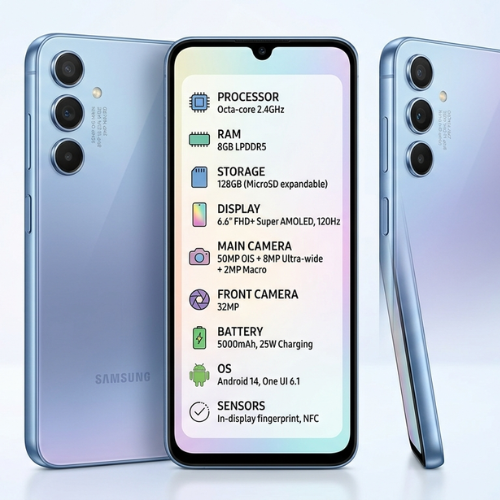
The Galaxy A27 is shown running on Qualcomm’s Snapdragon 6 Gen 3 chipset, built on a 4nm process. This is a significant shift from the Galaxy A26, which used Samsung’s in-house Exynos 1380 on a 5nm node.
The Snapdragon 6 Gen 3 features an octa-core CPU configuration: four Cortex-A78 performance cores clocked at 2.4 GHz and four Cortex-A55 efficiency cores at 1.8 GHz. Graphics are handled by the Adreno 710 GPU. On Geekbench, the A27 posted scores of 777 in single-core and 1,802 in multi-core tests — solidly mid-range numbers that place it in the same performance bracket as devices like the Realme 12 Pro and Motorola Edge 50 Fusion.
The move from Exynos to Snapdragon is notable for several reasons. First, Qualcomm silicon tends to offer better thermal management and power efficiency in sustained workloads, which translates into less throttling during long gaming sessions or extended video recording. Second, Snapdragon chips enjoy broader software optimization across the Android ecosystem — third-party apps and games are often tuned more thoroughly for Qualcomm hardware than for region-specific Exynos variants. Third, the switch addresses a longstanding complaint among Samsung buyers: Exynos chips in mid-range phones have historically been perceived as less reliable and more prone to heating issues than their Snapdragon equivalents.
However, the Snapdragon 6 Gen 3 is not a new chipset — it launched in 2023 and has been used in numerous mid-range devices since then. By 2026 standards, it is a safe, proven choice rather than a cutting-edge performer. It will handle everyday tasks — social media, streaming, messaging, light photography — without issue, but users expecting flagship-tier gaming performance or heavy multitasking will find it lacking.
RAM and Storage
The Geekbench listing shows the A27 with 6 GB of RAM, which is curiously lower than the 8 GB offered on the base model of the Galaxy A26 at launch. This has raised eyebrows among tech observers, particularly given that RAM prices have stabilized in 2026 and most competitors in this segment now offer 8 GB as standard.
There are two possible explanations. First, Samsung may be offering multiple configurations — 6 GB as the absolute base model with an 8 GB option available at a higher price tier. Second, Samsung may be aggressively managing costs to keep the A27’s starting price competitive with the A26’s launch price of approximately Rs 24,999 in India or €300 in Europe. Given that memory and storage prices spiked significantly in late 2025 due to AI-driven demand for high-capacity chips, offering a 6 GB base model may be Samsung’s strategy to avoid raising the entry price.
Storage options are expected to mirror the A26: 128 GB and 256 GB configurations, both with microSD card expansion support. Samsung has been consistent in offering expandable storage across its A-series lineup, which remains a competitive advantage over brands like Apple and Google that no longer provide this option.
Operating System: Android 16 with One UI 8.5
The Geekbench listing shows the Galaxy A27 running Android 16, which will launch under Samsung’s One UI 8.5 skin. This is Samsung’s latest software version, rolling out to flagship and mid-range devices in mid-2026.
More importantly, Samsung is expected to continue its industry-leading software support policy for the A27: six years of Android OS updates and security patches. This means the A27 will receive updates through 2032 — longer than many flagship phones from competing brands. For users who keep devices for three to five years, this is one of the most compelling reasons to choose a Samsung mid-ranger over alternatives from Realme, Poco, or Motorola, which typically offer only two to three years of support.
One UI 8.5 brings Samsung’s Awesome Intelligence suite — a collection of AI-powered features including real-time translation, object eraser in photos, voice-to-text transcription, and smart battery management — to the mid-range tier. These features, previously reserved for flagship devices, are now trickling down to more affordable phones, making the value proposition of the A-series stronger than ever.
Camera: 50MP Main, Upgraded 12MP Selfie
Leaked specifications suggest the Galaxy A27 will feature a triple rear camera setup: a 50MP main sensor, an 8MP ultra-wide lens, and a 2MP macro camera. This configuration is identical to the Galaxy A26 and has become the standard formula for Samsung’s mid-range lineup.
The 50MP main sensor will use pixel binning — combining four pixels into one to produce brighter, clearer 12.5MP images in most shooting scenarios. Samsung’s mid-range cameras have historically been reliable in good lighting but struggle in low-light conditions, where the smaller sensor size and narrower aperture become limiting factors. Computational photography improvements in One UI 8.5 may help bridge some of that gap, but users should not expect flagship-tier night photography.
The 8MP ultra-wide lens provides a wider field of view for landscape shots and group photos, but image quality typically drops noticeably compared to the main sensor. The 2MP macro camera is, by most accounts, a token inclusion — its image quality is low, and most users will never use it. It exists primarily so Samsung can advertise a “triple camera system,” which has marketing appeal even if the third lens contributes little practical value.
The more interesting camera upgrade is on the front. The Galaxy A27 is rumored to feature a 12MP selfie camera — down from the 13MP sensor on the A26 — but with a larger physical sensor and 4K video recording capability. A larger sensor means better light capture, which translates into improved low-light selfies and more accurate skin tones. The addition of 4K front video recording is a tangible upgrade for content creators, vloggers, and users who rely heavily on video calls, as it provides significantly better image quality than the 1080p standard still common in this segment.
Battery and Charging
The Galaxy A27 is expected to feature a 5,000 mAh battery — the same capacity as the Galaxy A26 and now the standard across Samsung’s mid-range and flagship lineup. Battery life on the A26 was adequate but not exceptional in real-world testing, typically lasting a full day of moderate use but requiring nightly charging for heavy users.
The A27’s battery performance will depend heavily on the power efficiency of the Snapdragon 6 Gen 3 chipset and software optimizations in One UI 8.5. Given the 4nm process node and Qualcomm’s generally strong efficiency track record, the A27 may deliver marginally better screen-on time than the A26, but expectations should be tempered — this is not a multi-day battery phone.
Charging speeds are where the leaks diverge. Some sources suggest the A27 will retain 25W wired fast charging, matching the A26. Other rumors point to an upgrade to 45W fast charging, which would bring the A27 in line with the Galaxy A37 and A57. If the 45W charging rumor proves accurate, it would be a meaningful quality-of-life improvement — cutting charging time from empty to full from roughly 90 minutes (at 25W) to approximately 60 minutes (at 45W).
Wireless charging remains absent. This is expected for a budget-tier device, as wireless charging coils and the associated circuitry add cost that Samsung has historically reserved for mid-tier and flagship models.
How Does It Compare to the Galaxy A26?
The Galaxy A27 is not a revolutionary leap over the A26 — it is an iterative refinement. Here are the key differences:
Design: The A27 replaces the waterdrop notch with a punch-hole cutout and features thinner bezels, making it look significantly more modern and premium.
Chipset: The A27 uses the Snapdragon 6 Gen 3 (4nm), replacing the Exynos 1380 (5nm) found in the A26. This should deliver better thermal management and broader app optimization, though raw performance will be similar.
RAM: The leaked listing shows 6 GB of RAM on the A27 versus 8 GB on the base A26 — a potential downgrade unless Samsung offers higher configurations at launch.
Selfie Camera: The A27 upgrades to a 12MP front camera with a larger sensor and 4K video recording, compared to the 13MP sensor with 1080p video on the A26.
Charging: Potentially upgraded to 45W fast charging (unconfirmed), up from 25W on the A26.
Software: Both will run One UI 8.5 based on Android 16, but the A27 ships with it out of the box while the A26 receives it via update.
Price: Expected to maintain the A26’s starting price of approximately Rs 24,999 in India and €300 in Europe, though inflation and component costs may push it slightly higher.
In practical terms, existing Galaxy A26 owners have little reason to upgrade — the changes are incremental rather than transformative. But for users coming from older devices or considering a new mid-range purchase, the A27’s design improvements and Snapdragon chipset make it the more attractive option.
When Will It Launch?
Samsung launched the Galaxy A26 in March 2025. Following the company’s yearly update cycle, the Galaxy A27 is expected to launch in March 2026 — which is next month.
Some leaks suggest the device may arrive slightly later, in the summer or early fall of 2026, but the weight of evidence points to a Q1 or early Q2 launch. Samsung typically announces its Galaxy A-series devices in waves: the flagship A5x and A7x models launch first, followed by the more affordable A3x and A2x models.
With the Galaxy A37 and A57 already official — they launched globally in March 2026 — the Galaxy A27 is the missing piece of the mid-range puzzle.
What It Means for Samsung’s Mid-Range Strategy
The Galaxy A27 reflects Samsung’s evolving approach to the mid-range market: deliver flagship aesthetics at budget prices, prioritize long-term software support, and rely on brand trust rather than spec-sheet wars to differentiate from Chinese competitors.
Brands like Realme, Poco, and Nothing are aggressively pushing high-refresh-rate screens, fast charging (often 67W or 80W), and higher RAM configurations into the $300-$400 price bracket. On paper, these devices often look more compelling than Samsung’s offerings. But Samsung is betting that consumers care about more than raw specifications: they value reliable software updates, brand credibility, service network availability, and resale value — all areas where Samsung has historically outperformed its rivals.
The design upgrade on the A27 is Samsung’s acknowledgment that appearance matters. For years, budget Samsung phones looked… budget. The A27 changes that narrative. It brings the visual language of the Galaxy S26 flagship to a phone that costs a fifth of the price. For many buyers — particularly first-time smartphone users, parents buying devices for their children, or users upgrading from much older phones — that premium look is worth more than an extra 2 GB of RAM or 20W of charging speed.
The Verdict: Worth the Wait?
The Samsung Galaxy A27 is shaping up to be the phone the Galaxy A2x lineup should have been years ago: modern, clean, and visually indistinguishable from devices costing three times as much.
If the leaked specifications hold and Samsung maintains the A26’s starting price — approximately Rs 25,000 to Rs 30,000 in India or €300 in Europe — the A27 will be a strong contender in the crowded mid-range segment. The Snapdragon chipset, upgraded selfie camera, and six years of software support give it tangible advantages over many competitors. The design transformation gives it emotional appeal.
But it is not without compromises. The rumored 6 GB base RAM configuration is underwhelming in 2026. The lack of wireless charging, while expected, is still a limitation. And while the Snapdragon 6 Gen 3 is competent, it is not exciting — users seeking gaming performance or heavy multitasking power will need to look at higher-tier options.
For existing Galaxy A26 owners, there is no compelling reason to upgrade. But for anyone else in the market for a reliable, long-lasting, good-looking mid-range Android phone with strong software support, the Galaxy A27 — when it officially launches — deserves serious consideration.