By News Desk | April 15, 2026
Urban areas face up to 8 hours of daily blackouts; rural Pakistan endures up to 16 hours as Middle East tensions cut off LNG supplies and circular debt climbs back toward Rs 1.9 trillion
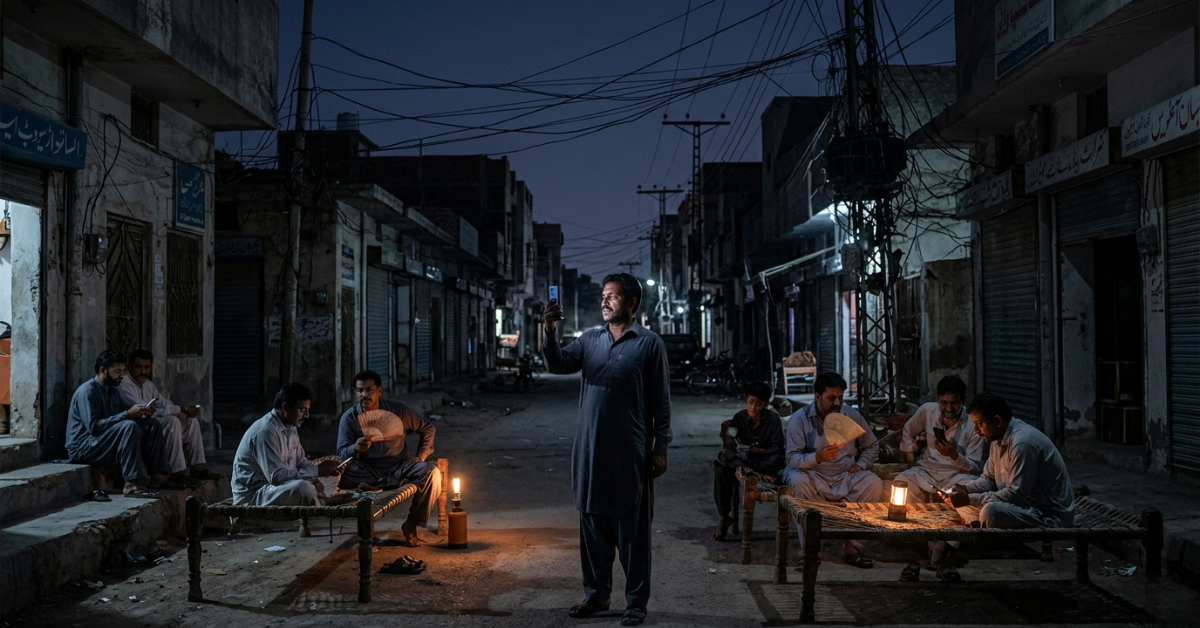
Pakistan’s electricity crisis has taken a sharp turn for the worse this week. As of April 14, 2026, nearly 4,000 megawatts of power generation has been knocked offline due to an acute gas shortage, pushing load shedding hours to levels not seen in recent months. Urban consumers across the country are enduring up to 8 hours of daily outages, rural residents are losing power for 10 to 12 hours, and communities with high electricity theft are sitting in the dark for as long as 14 to 16 hours per day.
The immediate trigger is a geopolitical one. Qatar — Pakistan’s principal supplier of liquefied natural gas (LNG) under two long-term contracts covering up to 1,000 million cubic feet per day — has declared force majeure following damage to its facilities amid escalating regional tensions involving Iran and Israel. Power plants that run on imported gas have gone offline, and furnace-oil-based generation has also been curtailed due to prohibitively high operational costs. Distribution companies, according to Power Division sources, are currently receiving barely half of their allocated electricity supply.

The Islamabad Electric Supply Company (IESCO) has formally announced load management measures in response, and officials in Punjab are bracing for a protracted shortfall as residents in districts served by the Multan Electric Power Company (MEPCO) report outages stretching from a few hours to a full 16 hours in some rural areas.
The Gas Crisis Behind the Blackouts
Pakistan’s power sector is “grappling with a severe gas shortage,” with RLNG supply having dropped sharply to around 80 million cubic feet per day (MMCFD) against a system demand of nearly 350 MMCFD. That yawning gap — less than a quarter of demand being met — has crippled some of the country’s most significant thermal plants. The Bhikki Power Plant, Haveli Bahadur Shah Power Plant, and Balloki Power Plant, all major RLNG-based installations in Punjab, have been hit hard.
Sui Northern Gas Pipelines Limited (SNGPL) has responded by cutting household gas supply to just six hours per day in two narrow windows aligned with breakfast and dinner. In Karachi, the situation is just as grim: the Sui Southern Gas Company (SSGC) is imposing a 13-hour daily suspension on gas across the city, leaving kitchens cold from North Nazimabad to Malir and triggering long queues at roadside eateries and LPG stations.
The Power Division spokesperson acknowledged the crisis while attempting to frame the government’s response in a positive light, noting that electricity consumers received Rs 46 billion in relief between July and February and that base electricity prices were reduced by 71 paisas per unit despite rising fuel costs — “an unexpected relief,” in the official characterisation, achieved through reforms, improved merit order enforcement, and better utilisation of cheaper generation sources.
A Crisis Decades in the Making
To understand why electricity load shedding in pakistan, remains so vulnerable to a single supply shock, one must trace the chronic structural failures that have made this the country’s most persistent national emergency.
Unannounced blackouts lasting 8 to 16 hours a day have been a feature of Pakistani life for years. In some localities, especially during peak summer heat or winter cold, power can be out for 20 hours or more per day — effectively cutting entire communities off the grid. Even Islamabad and other major cities have historically faced hours-long daily load shedding, while rural and remote regions suffer even longer outages.
In early January 2025, a nerve-shredding power outage in northern Pakistan sparked a week-long protest that shut down the Karakoram Highway — the critical link between Pakistan and China. In Gilgit-Baltistan, over 80,000 residents endured winter nights with barely 30 to 60 minutes of electricity in 24 hours as temperatures plunged to -15°C. Protesters blockaded the highway for days. That this happened in a region hosting the China-Pakistan Economic Corridor (CPEC) trade route, into which billions of Chinese investment have flowed, exposed the bitter paradox of Pakistan’s energy story: enormous investment, yet entire communities left in darkness.
The Circular Debt Time Bomb
At the financial heart of Pakistan’s electricity crisis lies what economists have termed a “leaking bucket” — the power sector’s circular debt. This is the cascading chain of defaults in which distribution companies (DISCOs), unable to recover the full cost of electricity they distribute due to theft, technical losses, and non-payment, cannot pay independent power producers (IPPs), who in turn cannot pay fuel suppliers, who then reduce supply, which reduces generation, which causes outages.
The numbers are staggering. Circular debt in Pakistan’s power sector peaked at approximately Rs 2.4 trillion earlier in 2025 before a landmark restructuring effort — described by the Pakistan Banks Association as “the largest banking transaction in Pakistan’s history,” involving Rs 683 billion in debt restructuring and Rs 612 billion in fresh syndicated financing — brought it down to Rs 1.614 trillion by the end of FY 2025. It was, by any measure, a historic achievement.
But the relief was short-lived. By February 28, 2026, the circular debt stock had already climbed back to Rs 1.889 trillion — a surge of nearly Rs 200 billion in just two months. Within that total, liabilities linked to CPEC power projects alone hit a record Rs 543 billion, underscoring the growing burden of capacity payments owed to Chinese-backed independent power producers. The IMF has flagged the issue as “a serious risk to Pakistan’s economic stability,” and it is expected to be a central point of discussion during senior Pakistani officials’ upcoming visit to Beijing.
Paying for Power That Doesn’t Come
Perhaps the most infuriating dimension of the crisis for ordinary Pakistanis is that they are paying more — far more — for electricity they often do not receive. Distribution companies reported losses exceeding 20% of total supplied power in 2025, against an international benchmark of 5 to 8%. A significant share of the consumer tariff goes to “capacity charges” — payments made to IPPs simply to keep plants available, whether or not they generate a single unit of electricity. With Pakistan’s total installed capacity standing at 46,605 MW as of March 2025 but average utilisation at just 34%, and even peak utilisation at a mere 56%, consumers are effectively paying for thousands of megawatts of idle generation infrastructure.
The government raised electricity prices by 26% in FY 2023–24, followed by an additional 20% hike in July 2024. By 2025, electricity prices had more than doubled from their 2021 levels. For FY 2025–26, NEPRA approved a base tariff of Rs 34 per unit — a nominal reduction of Rs 1.50 per unit from the previous year’s Rs 35.50 — but this came after consumers had already been burdened with Rs 2.9 trillion transferred to their bills via circular debt surcharges and petroleum levies over preceding years. Nationwide protests erupted against the earlier increases, with thousands staging sit-ins and refusing to pay bills.
The government has attempted structural corrections. The circular debt was reduced in FY 2025 by Rs 780 billion, achieved through a combination of improved DISCO recovery performance (the recovery rate rose from 92.4% to 96.6%), successful renegotiations with IPPs to waive late payment interest (LPI), and the landmark bank restructuring deal. Transmission and distribution losses decreased marginally from 18.3% to 17.6% in a single year — a positive signal, even if far short of what is needed.
How Load Shedding Is Classified
Pakistan’s power distribution companies currently classify areas into three broad tiers based on payment recovery rates and transmission losses. High-recovery areas, where bill payment records are strong and technical losses minimal, experience minimal to no scheduled load shedding. Medium-recovery zones face 2 to 6 hours of daily outages. Low-recovery areas — where poor payment records and high technical losses prevail — endure 8 to 12 hours of daily power cuts.
The system, while logical in theory, has been widely criticised for punishing communities that already suffer from economic disadvantage and then expecting them to pay bills on time despite unreliable supply. Electricity theft through illegal “kunda” connections compounds the problem: it causes massive line losses, artificially inflates costs, and results in paying consumers being penalised with more outages for the unpaid consumption of their neighbours.
Economic Devastation: Factories, Jobs, and Investment
The macroeconomic toll of Pakistan’s electricity crisis is no longer a matter of projection — it is recorded fact. In fiscal year 2025, Pakistan’s GDP grew at a meagre 2.7%, while the large-scale manufacturing sector contracted by 1.5%. Energy disruptions were a significant contributor.
Major industrial centres, particularly Faisalabad, have seen hundreds of factories shut down over recent years, primarily because of electricity shortages. Small businesses and shops lacking costly generator backup are forced to close early or absorb losses from spoiled perishable goods. The Karachi Chamber of Commerce has repeatedly cited load shedding as a key reason for declining investment — no investor, domestic or foreign, wishes to commit capital to operations where the lights cannot be guaranteed to stay on.
The All Pakistan Textile Mills Association, representing the country’s single largest export sector, has repeatedly warned that energy unreliability is eroding competitiveness. High electricity costs, soaring fuel prices, and rationed supply have made Pakistani exports less attractive in global markets where competitors operate with stable, affordable power.
For households, the human cost is equally severe. Frequent power cuts mean nights without fans or air conditioning in a country where summer temperatures routinely exceed 45°C. Refrigerators fail, food spoils, and families — particularly in poorer districts — resort to candles, wood fires, and kerosene lamps, with attendant health and safety risks. Water supply systems go offline during blackouts, causing tap water shortages in major cities including Karachi, Lahore, and Hyderabad. Hospitals scramble to keep life-saving equipment running on generators that are themselves expensive and unreliable. Students cannot study after dark, missing academic deadlines and contributing to the long-term erosion of human capital.
Pakistan’s Unlikely Solar Revolution
Against this backdrop of systemic failure, one of the most remarkable clean energy transformations anywhere in the world has unfolded — not driven by government planning, but by sheer consumer necessity.
Faced with soaring grid tariffs and unreliable supply, Pakistani households, businesses, and farmers have adopted rooftop solar at a pace that has shocked global analysts. Net-metered solar capacity grew from under 1 GW in 2023 to approximately 5.3 GW by April 2025. Pakistan’s total cumulative solar panel imports by mid-2025 had reached approximately 50 GW — nearly equivalent to the entire installed generation capacity of the national grid.
In 2024 alone, Pakistan imported 17 GW of solar panels, more than any other country in the world, spending approximately $1.4 billion on imports from China in the first half of the year. By 2025, solar had become the largest single electricity source in Pakistan, accounting for more than 25% of total production.
The mathematics were irresistible. Global solar panel prices fell by nearly 50% due to Chinese manufacturing overcapacity, while Pakistan’s grid tariffs more than doubled between 2021 and 2024. The payback period for a rooftop installation dropped to 2 to 4 years. Net metering — introduced under a 2015 NEPRA framework — allowed consumers to sell surplus power back to the grid at favourable rates, offsetting bills further. The result was a consumer-led revolution that has now fundamentally altered Pakistan’s daytime electricity demand profile.
By early 2026, Pakistan’s Ministry of Energy reported approximately 6 GW of net-metered solar capacity in operation, with off-grid installations pushing the true figure considerably higher. Over 283,000 consumers are now registered as net-metering users. Analysts at Renewables First project that on-grid rooftop solar could reach 6 GW by 2026, with off-grid growth significantly exceeding even that pace.
However, the solar boom has created new complications. As wealthier consumers — the biggest bill payers — offset their grid consumption, DISCOs collect less revenue while still bearing the full burden of fixed infrastructure costs. This cost is then shifted onto remaining grid consumers, including poorer households who cannot afford solar, creating a regressive spiral. In February 2026, NEPRA issued new Prosumer Regulations 2026 that effectively ended the old unit-for-unit net metering model for new users, replacing it with a net billing framework that significantly reduced the value of exported power.
After public outcry, the government confirmed that the new rules would apply primarily to new installations, with existing users grandfathered under the original terms. A 10% General Sales Tax on imported solar panels was also imposed in mid-2025, raising concerns that the policy could price out lower- and middle-income households who most need relief from grid costs.
What the Government Is Doing
The government of Prime Minister Shehbaz Sharif has pursued several significant reforms in the power sector, with mixed results.
The historic Rs 1.225 trillion circular debt restructuring deal, executed in late 2025 in collaboration with the Pakistan Banks Association, provided the most substantial single reduction in circular debt in the country’s history. The Finance Ministry’s decision to ring-fence the Rs 3.23 per kWh Debt Service Surcharge (DSS) exclusively for debt reduction was recognised by analysts as a step toward fiscal discipline.
In early 2026, the government officially launched the privatisation process for five major distribution companies, aimed at reducing political interference, improving recovery rates, and attracting private capital for grid modernisation. Aggressive crackdowns on “kunda” illegal connections have been pursued, and the government has renegotiated contracts with multiple IPPs to shift from “take-or-pay” to “take-and-pay” models — a change that, if fully implemented, could substantially reduce the capacity charge burden on consumers.
The Power Division spokesperson, in a statement issued April 14, 2026, insisted that distribution companies had been instructed to share feeder-wise load shedding schedules publicly and that “no unscheduled outages will be allowed.” In case of local faults, consumers are to be informed accordingly.
The Road Ahead
Pakistan faces a structural dilemma that no single intervention can resolve. The country has 46,605 MW of installed generation capacity — a 64% increase since 2013 — yet it cannot reliably deliver power to its population because of distribution failures, governance collapse, and a financial death spiral built on theft, under-recovery, and political price suppression.
NEPRA has warned that average utilisation of installed capacity remains just 34%, and peak utilisation is only 56%. Without modernising the distribution grid, improving governance of DISCOs, and achieving sustainable tariff structures that do not require consumers to subsidise systematic inefficiency, the circular debt — currently consuming approximately 2% of Pakistan’s GDP annually — will continue to grow.
The external shock from the Middle East — disrupting LNG supplies from Qatar and threatening fuel supply chains — has laid bare the country’s dangerous dependence on imported fossil fuels for thermal generation. Analysts warn that Pakistan’s energy security demands urgent diversification toward domestic hydropower, expanded renewables, and grid modernisation that treats distributed solar as a strategic asset rather than a regulatory inconvenience.
For now, as temperatures climb toward summer peaks and examinations begin for millions of students, Pakistan’s citizens are once again navigating a daily life defined by darkness — paying more than ever for electricity that, on far too many nights, simply does not arrive.